Lee vs. History: How Accurate Is the Lee Miller Biopic?
Lee Miller biopic accuracy check: Kate Winslet's 2024 portrait gets Dachau and the Hitler bathtub right - and doesn't soften what it cost her afterward.
Read Wikipedia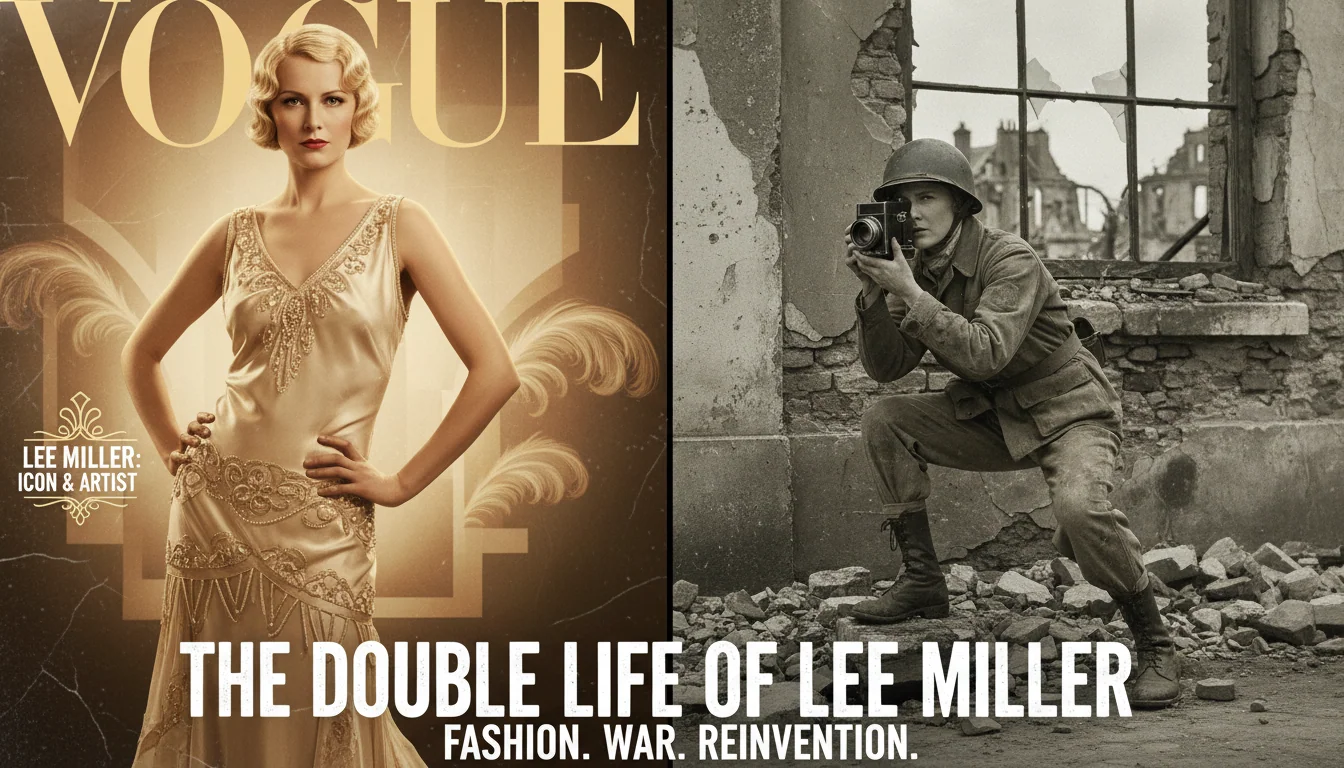
Kate Winslet spent years trying to get this film made. The subject warranted the patience. Lee Miller, born Elizabeth Miller in 1907 in Poughkeepsie, New York, is one of the more extraordinary careers in the history of photography: a woman who was a famous Vogue cover model in the late 1920s, then a collaborator and partner of Man Ray in Paris, then the photojournalist who walked into Dachau three days after liberation with a camera and filed the pictures on deadline for British Vogue, then a woman who never meaningfully spoke about any of it for the rest of her life.
The film, directed by Ellen Kuras and released in 2024, stars Winslet as Miller. It covers roughly the period from the late 1930s through the early 1970s, drawing on the archive that Miller's son Antony Penrose discovered after her death - thousands of photographs, letters, and records of a wartime career she had never once mentioned to him.
So how much of what "Lee" puts on screen actually happened?
Historical accuracy: 7/10
What Hollywood got RIGHT
The war correspondence career
The film's central premise - that a woman best known as a fashion mannequin and a Surrealist's muse became one of the most important visual witnesses to the end of World War II - is documented history, not dramatic invention. Miller used her existing relationship with Conde Nast and Vogue to obtain accreditation as a US Army war correspondent. She was not a correspondent who filed from hotel lounges.
She photographed the siege and liberation of Saint-Malo in Brittany in the summer of 1944, working under combat conditions close enough to the fighting to produce images of genuine documentary force. She was in Paris for its liberation. She photographed field hospitals, the wreckage of battle in the Colmar Pocket, and the final campaign across western Germany in the spring of 1945. Her travel companion and photographic collaborator for much of this period was David E. Scherman, a Life photographer, played by Andy Samberg in the film.
The film presents this correctly. Miller did not have special access or protection. She was doing what accredited correspondents did and she was, by any measure, a serious practitioner who produced work of lasting historical value.
The Dachau photographs and the bathtub
On April 29, 1945, the day after American forces liberated Dachau, Lee Miller and David Scherman entered the camp. What she photographed there - the dead still in the railroad cars, the survivors, the physical evidence of what the camp had been - was among the most directly documented accounts of the Nazi system published in the Western press in the immediate postwar weeks. British Vogue ran the photographs in its June 1945 issue. Miller's own caption instructed readers simply: "BELIEVE IT."
The following day, April 30, she and Scherman drove to Munich and entered Hitler's apartment at Prinzregentenplatz. Miller filled the bathtub and bathed, still carrying the dirt of Dachau on her skin. Scherman photographed her in the tub, with a framed portrait photograph of Hitler visible on a shelf in the background and Hitler's bathmat under her feet and the edge of the tub. She wore her combat boots on the bathmat's rim. Hitler died in his bunker in Berlin the same afternoon.
The film recreates this sequence and gets the most important facts right: the location, the date, the pairing with Scherman, and the image's meaning as both a declaration and a deliberate act of defilement. The juxtaposition - Dachau one day, Hitler's bathtub the next - was not accidental. Miller knew exactly what she was doing.
Roland Penrose and the marriage
Miller met the British Surrealist artist Roland Penrose in the late 1930s. He was a close friend of Pablo Picasso, a painter, writer, and eventually one of the founders of the Institute of Contemporary Arts in London. He was devoted to Miller in a way that outlasted most of her capacity for reciprocation. They married in 1947 and had one son, Antony, born the same year. The film's portrait of Penrose as loving, patient, and eventually bewildered by the woman who came back from the war is consistent with what Antony Penrose has written and said publicly about his father.
The silence and the PTSD
After the war, Lee Miller did not return to serious photographic work. She retreated to Farley Farm, the Sussex property where she and Penrose lived, and into cooking - she was a genuinely accomplished cook who contributed recipes and food writing in later years. She also retreated into alcohol. She refused to discuss her wartime photographs with anyone, including her son. Antony grew up knowing almost nothing about his mother's career until he found the archive in the attic after her death in 1977.
The film does not resolve this with a third-act recovery. Miller does not heal in time for the credits. The film ends with her still carrying what she saw. This is historically accurate and is one of the production's genuine achievements.
What Hollywood got WRONG or dramatized
The interview framing device
Much of the film's later section is structured around a dramatized confrontation between Miller and her son, in which she is pressed to account for her wartime experience and her decades of silence. This interview is not documented in the form shown. Antony Penrose, who cooperated with the production and whose relationship with the project was publicly positive, has described the framing as a dramatization of what might have been said - an imagined accounting for a silence that was, in reality, far more complete and far less confrontable.
The substitution makes dramatic sense. But it converts Miller's genuine and total silence into an articulate if reluctant explanation. The real situation was quieter and more opaque: a woman who said nothing, and a son who learned the truth from boxes in an attic. That story is harder to film.
The Man Ray years are compressed
Miller's time in Paris from around 1929 onward - as Man Ray's partner, muse, model, and photographic collaborator - is handled briefly. The creative relationship between them was substantive on both sides. The printing technique known as solarization, which became closely associated with Man Ray's work, was, by most detailed accounts, discovered accidentally by Miller during a darkroom session when an unplanned light exposure produced an unexpected tonal reversal. She ran to Man Ray, they observed the result together, and the technique entered their shared vocabulary. Man Ray later claimed it largely for himself. The film touches this history without dwelling on what the attribution dispute reveals about both of them.
The editorial friction is heightened
The film depicts conflict between Miller and Vogue editorial figures over the decision to publish wartime and concentration camp imagery. In reality, Miller's editor at British Vogue, Audrey Withers, was one of her most consistent allies. Withers pushed to run the Dachau photographs over internal resistance and succeeded. The film compresses various pressures and resistances into confrontations that are more dramatic than the documented record fully supports.
Why the subject is worth the film
Lee Miller was more complicated than most biopics dare to present their subjects. She was a childhood trauma survivor, a famous face, a Surrealist, a skilled photographer, a combat correspondent who stood in a concentration camp within 24 hours of its liberation and filed the pictures in time to matter, an accomplished cook, and a mother who could not speak to her child about the most significant work of her life.
"Lee" does not capture all of this. The framing device is an invention and her pre-war years are underexplored. But the film takes seriously the question that most biographical treatments of wartime figures avoid: what does it cost, after the fact, to have been present for what you were present for? On that question, Winslet's performance and the film's refusal of easy resolution are both honest and deserved.
For other biographical films checked against the historical record, see A Complete Unknown vs. History and The Aviator vs. History.
Quick Answers
Common questions about this topic
Is the film Lee based on a true story?
Yes. Lee is based on the life of Elizabeth 'Lee' Miller (1907-1977), an American model who became a WWII photojournalist for British Vogue. The film draws on her documented wartime career, her relationship with British Surrealist Roland Penrose, and the archive discovered by her son Antony after her death.
Did Lee Miller really photograph in Hitler's bathtub?
Yes. On April 30, 1945 - the day Hitler died in Berlin - Lee Miller and colleague David E. Scherman entered Hitler's Munich apartment. Miller bathed in Hitler's tub, still dirty from Dachau, while Scherman photographed her. The image was published in Vogue.
Was Lee Miller actually at Dachau?
Yes. Miller and Scherman entered Dachau on April 29, 1945, the day after its liberation by the American 7th Army. Her photographs were published in British Vogue in June 1945, accompanied by her own caption: 'BELIEVE IT.' She was one of the first journalists to document the camp photographically.
Did Lee Miller suffer from PTSD after the war?
Yes, though it went undiagnosed during her lifetime. After the war Miller retreated from photography, struggled with alcoholism, and refused to speak about her wartime work - even to her son Antony, who discovered her entire photographic archive in the attic after her death in 1977.

Debate the Accuracy with the Real Figures
Ask the real people what Hollywood got wrong about their lives.
Create your free account →No card required. Talk to anyone in history with 8 free credits a day. Some features require a paid plan.
Join the HistorIQly Club
Get smarter about the past.
Weekly stories, deep dives, and exclusive content straight to your inbox.