Origins: Who Invented the Calendar - The Long War Between Humans, the Sun, and the Moon
Who invented the calendar? The sun and moon refuse to agree, and five thousand years of astronomers, priests, and politicians tried to force the issue.
Read Wikipedia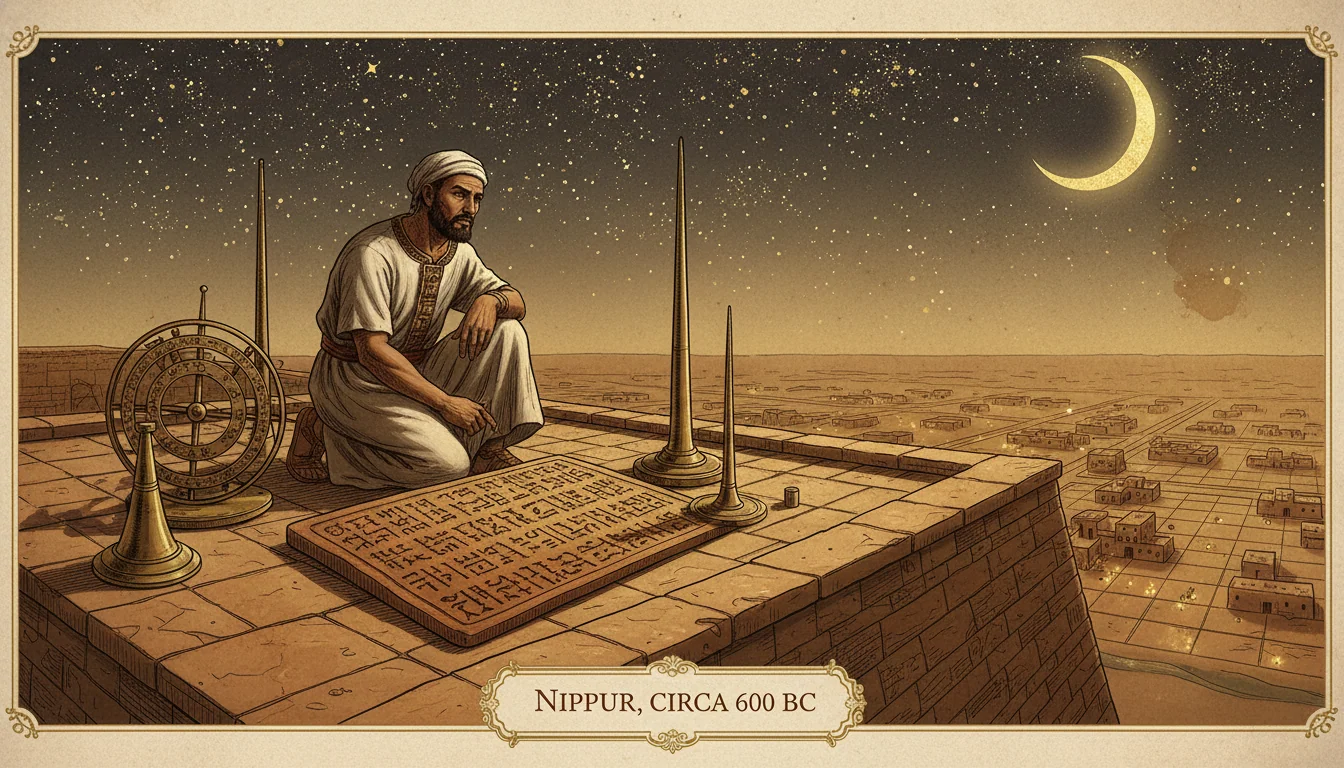
The problem with inventing the calendar is that the universe did not design the solar year and the lunar month with a common divisor in mind. The solar year - the time it takes Earth to complete one orbit around the sun - is approximately 365 days and 5 hours and 49 minutes: just over 365.24 days. The lunar month - one complete cycle of the moon's phases - is approximately 29.53 days. Neither is a whole number. Neither divides cleanly into the other. Twelve lunar months give you about 354 days, leaving you nearly 11 days short of a solar year, a gap that compounds into seasonal confusion within a few years.
Every civilization that built a calendar was fighting this arithmetic problem. Most of the history that followed is a record of different strategies for losing more slowly.
The first problem: why calendars existed at all
Before the solution, the need. Agricultural societies required predictable tracking of seasons. Planting, flooding, migration, and harvest all depended on knowing where you were in the annual cycle. The night sky was the most reliable clock available: the rising and setting of specific stars marked agricultural benchmarks that were stable across generations. Sirius rising before dawn in Egypt marked the coming Nile flood. The Pleiades' position marked planting season across cultures from Greece to Mesoamerica.
But watching the sky and having a calendar are different things. A calendar is a fixed administrative system, a way of labeling days so that the same date means the same season year after year, so that taxes can be collected, festivals scheduled, and contracts enforced without consulting a priest about where Sirius was this morning. The calendar is an administrative invention as much as an astronomical one.
Egypt: the earliest solar calendar
The Egyptian civil calendar, dating to roughly 3000 BCE or possibly earlier, is among the oldest documented solar calendars. It ran on 12 months of exactly 30 days each, plus 5 additional days at the end of the year called the epagomenal days, which mythology assigned to the birthdays of Osiris, Horus, Set, Isis, and Nephthys. Total: 365 days.
This was strikingly sophisticated by ancient standards: a fixed-length year, no lunar month, no intercalation headache. The problem was the fraction. The actual solar year is about 365.24 days, not a whole 365. Without a leap year, the Egyptian calendar drifted one day every four years relative to the actual solar cycle. Over a long enough span, the months lost their seasonal anchor entirely. Egyptian astronomers were aware of this. The Sothic cycle - the period of 1,461 Egyptian years after which the rising of Sirius would coincide with New Year's Day again - was tracked as a long-period correction. But the civil calendar itself was never formally reformed by the pharaonic state. It kept drifting until the Roman period.
Mesopotamia: the lunisolar solution
The Babylonian calendar, which shaped the Hebrew, early Persian, and Greek calendars, took the opposite approach: it started with the lunar month rather than the solar year. Each month began with the first visible crescent moon. Twelve lunar months gave a year of about 354 days.
The Babylonians solved the shortfall problem through intercalation: periodically inserting an extra month, called Second Adar or Second Ululu depending on the position, to keep the calendar roughly aligned with the seasons. Early intercalation was decided by royal or priestly authority year by year. By around the 6th century BCE, Babylonian astronomers had worked out a systematic 19-year cycle - now called the Metonic cycle, after the Greek astronomer Meton who independently discovered it around 432 BCE - in which 7 extra months are inserted over 19 years, keeping the lunar calendar very closely synchronized with the solar year.
This was elegant mathematics. The 19-year cycle with 7 intercalations keeps the calendar to within about 2 hours of the solar year over the full cycle. The Hebrew calendar still runs on this system.
The Roman disaster
The Roman Republican calendar is a study in what happens when a technically serviceable system is handed to politicians.
Roman tradition attributed the original calendar to Romulus, the city's legendary founder: 10 months, 304 days, beginning in March. This calendar had no winter months because Roman farmers did not farm in winter and therefore did not need to count it. Numa Pompilius, the second king, reportedly added January and February, bringing the year to 355 days.
The Republican calendar managed the drift between its 355-day year and the solar year by intercalating a 27-day month called Mercedonius in alternate years, though the actual practice was irregular. The pontiffs - the priestly college responsible for the calendar - had authority to add or omit the intercalary month, and they exercised this authority with a flexibility that sometimes correlated suspiciously with the terms of public officials, financial contracts, or the needs of political allies. By Julius Caesar's return from his Egyptian campaigns, the calendar was roughly 80 days out of alignment with the solar year. January was falling in autumn.
Caesar and Sosigenes
Julius Caesar encountered the Egyptian civil calendar during his time in Alexandria. Its fixed 365-day structure, even with its drift problem, was cleaner than the Roman mess. He also had access to the Alexandrian astronomer Sosigenes, who proposed a solution: a 365-day year with a 366-day leap year every four years, for an average year of 365.25 days. This was close enough to the true value to matter.
Caesar promulgated the Julian calendar in 46 BCE. To bring the Roman calendar back into alignment with the actual solar year, 46 BCE was given 445 days, including two extra intercalary months alongside the regular Mercedonius. Roman writers called it the ultimus annus confusionis, the last year of confusion.
The Julian calendar was a genuine achievement. It ran with only minor administrative corrections for over 1,500 years across the Roman world and its successor states, and it remained in use in England until 1752 and in Russia until 1918. Its flaw - that 365.25 is about 11 minutes longer than the actual tropical year - was real but slow-acting, accumulating approximately one day of drift per 128 years.
The Gregorian reform of 1582
By the 16th century, the Julian calendar was 10 days behind the actual solar year. This mattered most to the Catholic Church because Easter, the central celebration of the Christian liturgical year, was calculated relative to the spring equinox. The Council of Nicaea in 325 CE had fixed the equinox for calculation purposes on March 21. By 1582, the actual astronomical equinox was falling around March 11. Easter was drifting away from spring.
Pope Gregory XIII convened a reform commission. The mathematician and Jesuit astronomer Christopher Clavius did the technical work. The Gregorian calendar made two changes. First, it dropped 10 days immediately: in October 1582, the day after October 4 became October 15. Second, it adjusted the leap year rule: century years (1700, 1800, 1900) would not be leap years unless also divisible by 400. This removes 3 leap years per 400-year cycle, giving an average Gregorian year of just over 365.24 days - off from the true value by about 26 seconds per year, which accumulates to a full day's drift only after roughly 3,300 years.
Catholic countries - Spain, Portugal, France, Italy, and the Catholic German states - adopted immediately. Protestant and Orthodox countries resisted, some viewing the reform as a papist imposition. Britain and its American colonies adopted in 1752. Russia adopted after the 1917 revolution. Greece waited until 1923. The date discrepancy between Julian and Gregorian calendars created genuine administrative chaos across Europe for centuries, particularly in diplomatic correspondence, legal contracts, and the dating of historical events.
The calendars that did not conform
Not every tradition adopted the solar model. The Islamic calendar remains purely lunar: 12 months, 354 or 355 days per year, no intercalation. Ramadan travels through all seasons over a 33-year cycle, completing a full circuit roughly three times per century. This is not a flaw from the Islamic perspective - it is the intended design, reflecting the primacy of the lunar cycle as a divine ordering of time.
The Hebrew calendar is lunisolar, following the Babylonian Metonic cycle with 7 intercalary months per 19-year cycle. Its months track the moon; its years stay anchored to the seasons.
The French Revolutionary government introduced a decimal calendar in 1793: 12 months of 30 days each, named after seasons and agricultural phenomena, with 5 or 6 additional days at year's end. Weeks were abolished and replaced with 10-day decades. The system was rational, systematic, and widely despised. It was abolished in 1806.
What was agreed upon and what remains disputed
The Gregorian calendar is the international standard for commerce, diplomacy, and most civil administration. It is not universal in religious or cultural life. The gap between the Julian and Gregorian calendars now stands at 13 days (it was 10 in 1582, growing as century years passed), which is why the Russian Orthodox Church celebrates Christmas on January 7 by the civil calendar and why historical dates before 1582 require careful notation of which calendar system they use.
The actual solar year continues to be just over 365.24 days, stubbornly refusing to round. The Gregorian reform has delayed the next drift problem by millennia. When it eventually becomes significant again, the civilization dealing with it will have resources the Babylonian astronomers who first mapped the Metonic cycle could not have imagined - which is perhaps less reassuring than it sounds, given what the Romans did with their calendar when they had the chance.
The year in use today is Julius Caesar's concept, corrected by Pope Gregory's commission, adopted over several centuries of political resistance, and still about 26 seconds wrong per year. For other long histories of accidental invention, the origins of bread traces a 14,400-year journey from hunter-gatherer campfire to industrial bakery, and the origins of glass follows another discovery from Bronze Age Egypt to the present. The sun and moon remain unimpressed.
Quick Answers
Common questions about this topic
Who invented the calendar?
No single civilization invented the calendar. The earliest documented solar calendar was Egyptian, roughly 3000 BCE, with 12 months of 30 days plus 5 extra days at the end of the year. The Babylonians developed a sophisticated lunisolar calendar that influenced nearly every calendar in the ancient Near East. Julius Caesar, advised by the Alexandrian astronomer Sosigenes, introduced the 365.25-day Julian calendar in 46 BCE. The modern Gregorian calendar was adopted in 1582.
Why did Julius Caesar reform the Roman calendar?
The Roman Republican calendar had drifted roughly 80 days out of alignment with the actual solar year by 46 BCE, due to decades of mismanagement by the pontiffs who controlled intercalation. Caesar, returning from campaigns in Egypt where he had encountered the Egyptian solar calendar, worked with the Alexandrian astronomer Sosigenes to produce a 365-day calendar with a leap year every four years. The year 46 BCE was given 445 days to bring the calendar back into alignment - Roman writers called it the Year of Confusion.
Why was the Gregorian calendar adopted in 1582?
The Julian calendar's average year of 365.25 days is about 11 minutes longer than the actual solar year. Over 1,300 years, this accumulated to 10 days of drift. By 1582, the spring equinox was falling on March 11 instead of March 21, which mattered deeply to the Catholic Church because Easter's calculation depended on the equinox. Pope Gregory XIII, working with the Jesuit mathematician Christopher Clavius, dropped 10 days from the calendar and adjusted the leap year rule to eliminate most future drift.
When did Britain adopt the Gregorian calendar?
Britain, then operating under the Julian calendar alongside most Protestant countries, adopted the Gregorian calendar in September 1752. To align with the Gregorian standard, 11 days were dropped: September 3, 1752 became September 14, 1752. According to popular legend, this produced riots from people demanding their 11 days back, though historians have found little evidence that serious riots actually occurred - the legend appears to be mostly a later embellishment.

Ask the Inventors Themselves
Chat with the people who were there when familiar things began.
Create your free account →No card required. Some figures and features require a paid plan.
Join the HistorIQly Club
Get smarter about the past.
Weekly stories, deep dives, and exclusive content straight to your inbox.