Origins of Tea: How the World's Favorite Drink Was Discovered
The origins of tea trace back not to a mythical emperor's cup but to Yunnan forests, Tang dynasty monasteries, and two thousand years of accumulated cultural meaning.
Read Wikipedia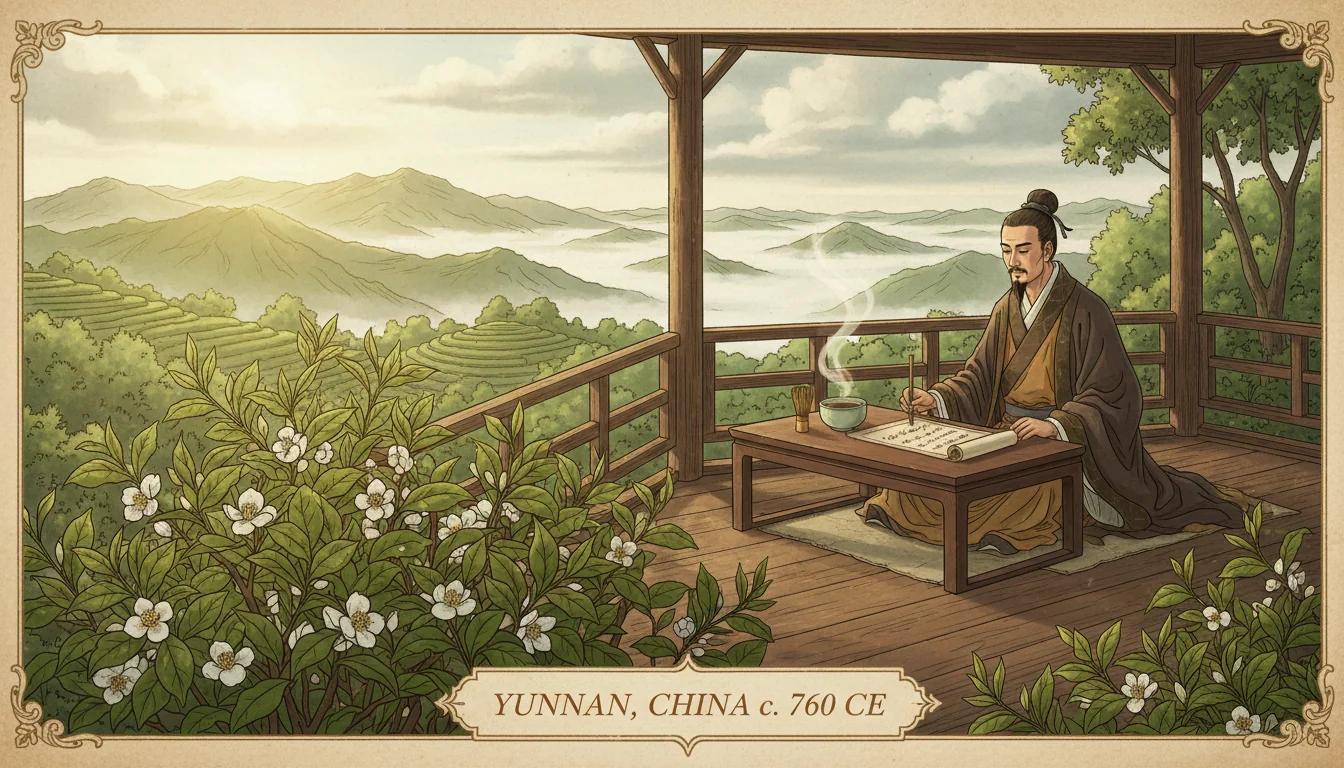
The legend says a Chinese emperor was boiling water beneath a tree in 2737 BCE when leaves from a nearby branch fell into his cup. He tasted the resulting infusion, found it pleasant and medicinal, and tea was born. The emperor's name was Shennong, a mythological culture hero credited with inventing both agriculture and herbal medicine. The story is lovely and entirely without foundation.
The Shennong tea legend appears in writing during the Tang dynasty - which would put the written record roughly 3,400 years after the supposed event. Shennong himself is not a historical figure but a mythological one, a semi-divine ancestor whose portfolio includes most of the things early Chinese civilization needed to explain. Attributing tea to him is the same move as attributing grain to Demeter or fire to Prometheus. It is a civilization's way of saying: this thing matters, so it must have divine origins.
Tea does matter. But its actual origins are stranger, more contingent, and considerably more interesting than a leaf falling into a mythological emperor's cup.
The plant and its homeland
Camellia sinensis, the species that produces all true tea, is native to a belt of highland forest running from northeastern India through Yunnan province in southwestern China and into mainland Southeast Asia. Wild tea trees in Yunnan can reach tens of meters in height and live for centuries - some specimens in remote parts of the province are estimated to be over a thousand years old and are locally venerated.
The plant's homeland in Yunnan sits at altitudes between roughly 1,000 and 2,000 meters, in the same general biogeographic zone where rice, citrus, and a large number of other cultivated species have their wild ancestors. The genetic diversity of tea plants in Yunnan is dramatically higher than anywhere else in the world, which is the botanical fingerprint of a species at or near its center of origin.
This matters for the origin story because it places the plant's homeland in one of the most ecologically diverse regions of China, one that was integrated into the Chinese agricultural and trade network relatively late. The kingdoms and dynasties that shaped early Chinese civilization were centered in the Yellow River basin, far to the north and east. Yunnan was frontier territory for most of the Zhou dynasty and into the Han. Tea probably moved into the mainstream Chinese world from the periphery, not from the center.
The earliest evidence: Han dynasty
The oldest physical evidence of tea consumption in China comes from an unexpected source: the tomb of Liu Qi, Emperor Jingdi of Han, who died around 141 BCE. Excavations at the tomb complex near Xi'an, conducted in the early 2000s and continuing since, recovered compressed lumps of plant material that were initially difficult to identify. Researchers working with the material in the 2010s identified them as tea leaves - apparently placed in the tomb as a luxury offering for the emperor's afterlife.
This pushes confirmed tea use back to the 2nd century BCE, more than two thousand years before the Shennong legend's supposed date. The Han dynasty context also makes cultural sense: it was a period of significant expansion into southwestern China, increased trade with Yunnan and Sichuan, and systematic recording of botanical and medical knowledge. Tea appears in some Han dynasty medical texts as a medicinal substance - bitter, stimulating, useful for digestive complaints.
What the Han dynasty does not show is tea as a daily beverage or a cultural institution. The quantities are small, the references are sporadic, and the preparation methods described are different from later tea culture. Tea in the Han period was probably a medicine and occasional luxury, not a drink.
The Tang dynasty: tea becomes a culture
The transformation of tea from medicinal curiosity to cultural institution happened during the Tang dynasty (618-907 AD), and it is associated with one extraordinary book.
Lu Yu was an orphan raised by a Buddhist abbot who grew up to become the most important figure in tea history. Around 760 AD he completed the Cha Jing, the Classic of Tea - a systematic treatise on every aspect of tea cultivation, preparation, and appreciation. It covered the character of the plant, the quality of water from different sources, the design of tea equipment, the proper technique for boiling and serving, and the aesthetic principles governing a proper tea experience.
Nothing like it had existed before. Tea had been drunk and described; Lu Yu made it into a system. The Cha Jing became immediately influential and was copied widely. It codified a practice that had been developing through the Tang dynasty and gave it intellectual and aesthetic dignity. Tea went from being something people drank to being something people thought about, argued about, and competed at.
The Tang method of tea preparation was different from what most people recognize today. Tea leaves were compressed into cakes, which were then broken apart, roasted, and ground to powder. The powder was then mixed with boiling water and sometimes flavored with salt, ginger, or dried fruit. This sounds strange from the perspective of modern tea, but it is recognizably a predecessor to what the Japanese would develop into the matcha tradition.
Tang dynasty tea culture spread rapidly through the Buddhist monastery network, which provided both practitioners and a distribution system. Monasteries were often located in the highlands where tea grew, and monks were among the most enthusiastic early adopters of Lu Yu's systematic approach.
Song refinement and Japan
The Song dynasty (960-1279) refined Tang tea culture into something even more elaborate. The fashion shifted toward finer powdered tea whisked into a froth in ceramic bowls - a practice that required considerable skill and the right equipment, and that became the subject of competitive tea-tasting events where connoisseurs identified the origins of different teas by taste alone.
Song emperors were passionate about tea. Emperor Huizong, who ruled in the early 12th century before his capture by the Jurchen Jin dynasty, wrote a treatise on tea and collected the finest examples with the same intensity he applied to painting and calligraphy. The imperial tea gardens in Fujian produced teas whose quality would not be surpassed for centuries.
This Song tradition was what Japanese Buddhist monks encountered when they traveled to China to study. The monk Eisai returned from China around 1191 with tea seeds and planted them at temple gardens near Kyoto. His 1211 book Kissa Yojoki - which can be translated as Drink Tea and Prolong Life - promoted tea as simultaneously healthful and spiritually beneficial. The powdered tea-whisking tradition he imported from Song China eventually became the foundation of the Japanese tea ceremony, chanoyu, developed and formalized over the following centuries.
The Japanese transmission preserved and elaborated the Song method even after China itself moved on. When the Ming dynasty overthrew the Mongol Yuan dynasty in the 14th century, Chinese tea fashion shifted from powdered tea to the loose-leaf steeped tea that remains the global standard today. Japan kept the powdered tradition. The result is that modern matcha is a living relic of 12th-century Song Chinese tea culture.
Europe's relationship with a substance it did not understand
Portuguese sailors had contact with Chinese tea during the 16th century, but they did not establish the commodity trade. That distinction belongs to the Dutch East India Company, which began importing tea commercially around 1610. Tea arrived in Europe as a curiosity - expensive, exotic, and surrounded by competing claims about its medical properties.
The Dutch brought tea to England through their trade networks, and it was first sold in London coffeehouses in the 1650s. The drink's popularity among the English upper classes accelerated dramatically after 1662, when Charles II married Catherine of Braganza of Portugal, who arrived in England with tea-drinking as a fixed habit. The queen's tea preference gave the drink aristocratic legitimacy that it retained and amplified.
The East India Company moved decisively into the tea trade in the late 17th century, and by the mid-18th century it was one of the company's most profitable commodities. England's tea consumption grew from a luxury habit to a national institution over roughly a century. The practice of afternoon tea - a light meal in the mid-afternoon - is traditionally attributed to Anna Maria Russell, Duchess of Bedford, who found the gap between lunch and late dinner too long and began requesting tea with small snacks around 1840. Whether she invented it or made it fashionable enough to be documented is the usual origin-story ambiguity.
The imperial disruption: Assam and the modern trade
The British monopoly on the China tea trade was disrupted, deliberately, by the discovery of wild tea plants in the Assam region of northeastern India in the 1820s. The East India Company, keen to break its dependence on China - whose government tightly controlled access and whose prices it could not control - began systematic cultivation of Assam tea in the 1840s. The Assam plant, Camellia sinensis var. assamica, produces a larger leaf with a bolder, more robust flavor profile than the Chinese varieties, and it adapted well to mass plantation cultivation.
The development of Indian and later Ceylonese tea production, combined with improvements in transportation from the mid-19th century onward, democratized tea in Britain. By 1900, it was the drink that factory workers, soldiers, office clerks, and schoolchildren drank multiple times a day.
What the origin story tells us
Tea's journey from wild tree in Yunnan to the most consumed beverage after water took roughly two thousand years and required Buddhist monks, Tang dynasty aesthetic theory, Song dynasty imperial culture, Dutch maritime commerce, and British colonial agriculture. The Shennong legend compresses all of that into a single divine moment.
The real origin is less elegant and more human: a plant with useful properties, discovered and forgotten and rediscovered in the way that most useful things are, slowly accumulating the cultural infrastructure - the vocabulary, the ritual, the social meaning - that eventually makes it indispensable. The origins of tea are less elegant and more human than legend allows. Tea did not begin the moment a leaf fell into water. It began when someone wrote down what the leaf tasted like, and someone else read it, and thought: I want some of that.
For more on how everyday substances acquired their history, see our pieces on the origins of bread and the origins of glass.
Quick Answers
Common questions about this topic
Where was tea originally discovered?
Tea originates in the highland forests of southwestern China, particularly the region of Yunnan, where the tea plant Camellia sinensis grows wild. The earliest physical evidence of brewed tea comes from the Han dynasty - researchers identified compressed tea leaves in the tomb of Emperor Jingdi of Han, who died around 141 BCE. Regular, widespread tea drinking as a cultural practice is documented from the Tang dynasty onward, particularly after the publication of Lu Yu's Cha Jing around 760 AD.
Is the story of Emperor Shennong discovering tea true?
Almost certainly not. The legend of Shennong - a mythical Chinese emperor who supposedly discovered tea in 2737 BCE when a leaf blew into his boiling water - first appears in writing during the Tang dynasty, more than three thousand years after the supposed event. Shennong is a legendary culture hero credited with inventing agriculture and herbal medicine; the tea story is a retrospective attribution that places the discovery at the foundation of civilization. It is not supported by any early archaeological or textual record.
When did tea come to Japan?
Tea came to Japan through Buddhist monks who had studied in Tang dynasty China and returned with tea seeds and the practice of drinking it. The Japanese monk Eisai brought tea seeds from China around 1191 and planted them at Kyoto-area temples. His book Kissa Yojoki (Drink Tea and Prolong Life, 1211) promoted tea as both a health practice and a spiritual discipline. The formal Japanese tea ceremony (chanoyu) developed later, drawing on the powdered matcha tradition of the Song dynasty.
How did tea reach Europe?
Portuguese traders had contact with Chinese tea during the 16th century, but commercial-scale importation to Europe was established by the Dutch East India Company, which began shipping tea from Java and China around 1610. Tea reached England in the 1650s and became fashionable after Charles II married the Portuguese princess Catherine of Braganza in 1662, who brought tea-drinking habits with her. The East India Company subsequently dominated the English tea trade for over a century.

Ask the Inventors Themselves
Chat with the people who were there when familiar things began.
Create your free account →No card required. Some figures and features require a paid plan.
Join the HistorIQly Club
Get smarter about the past.
Weekly stories, deep dives, and exclusive content straight to your inbox.