Origins: Who Invented Toilet Paper
Who invented toilet paper? Not Joseph Gayetty in 1857. The real origins of toilet paper trace to 6th-century China, a thousand years earlier.
Read Wikipedia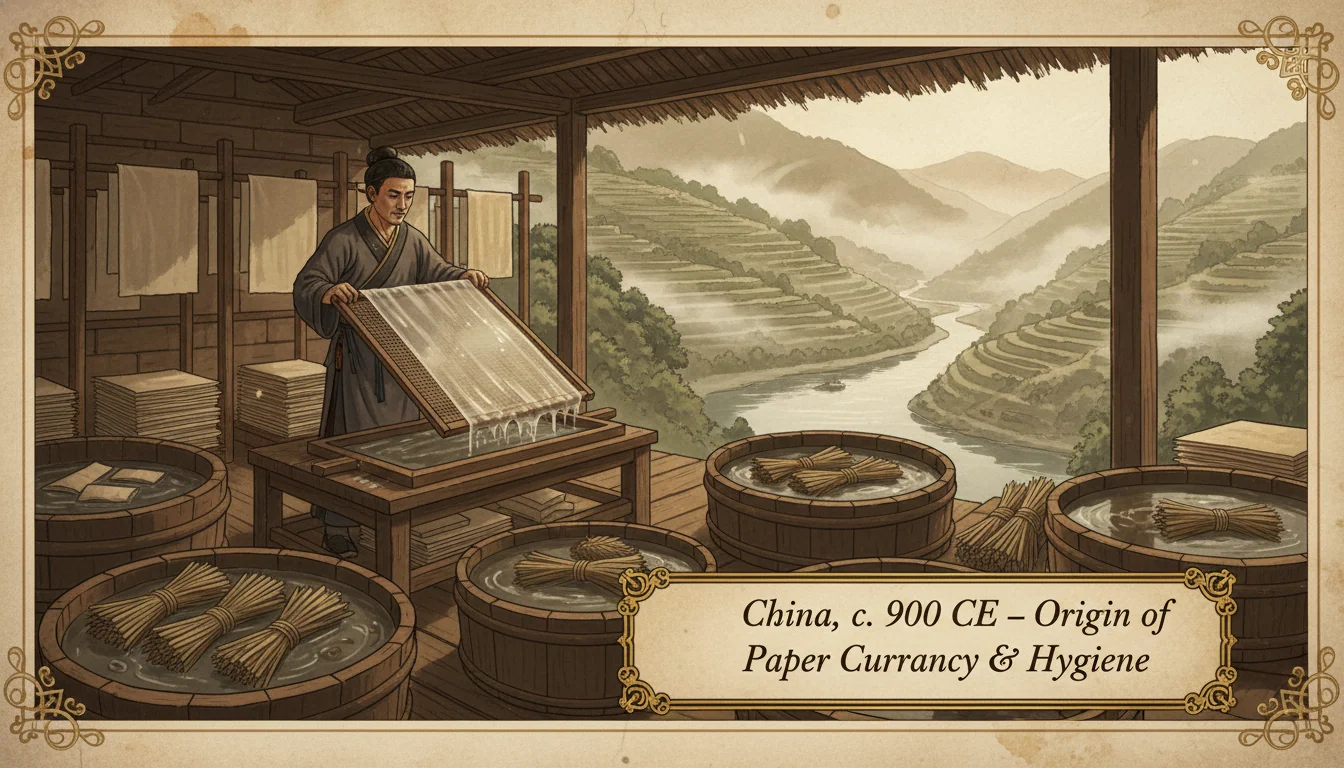
The myth most Americans carry about toilet paper is roughly this: it was invented by a gentleman in New York in 1857, improved with perforations in 1891, and represents a clean break with the unsanitary past. This is the kind of origin story that a commodity industry finds useful and that the historical record does not support.
The accurate version begins in China, where paper had been manufactured since at least the early centuries of the Common Era and where written documentation of paper used for hygiene appears more than a thousand years before Joseph Gayetty printed his name on a medical flat sheet and called it an invention.
What people used before paper
The question of pre-paper hygiene is one of those historical topics that tends to be approached with either extreme delicacy or extreme prurience, and that benefits from neither. The practical answer is that people used whatever their local environment and social position made available, and that the solutions ranged from the clever to the frankly uncomfortable.
In the Roman world, the standard tool in a public latrine was the tersorium or xylospongium: a sea sponge on a wooden or bone stick, kept in a bucket of salt water or diluted vinegar and shared among users. The germ-theory implications of sharing a sponge on a stick are obvious to us; they were invisible to Romans who did not know what a germ was. Wealthy Romans likely had private facilities with superior arrangements. Street-level public latrines, some of which survive in Pompeii and Ostia, show the communal design clearly.
Greeks and Romans also made use of pessoi: smooth flat stones, pottery sherds, or in some instances terracotta pieces purpose-made for the task. Archaeological deposits at Greek sites have yielded examples with recognizable patterns of wear. The Talmud specifies smooth stones as appropriate for the purpose, with the interesting precision that one stone may serve for three uses - reflecting both the value of resources and the limited choices available.
Medieval Europeans in ordinary circumstances used hay, moss, straw, leaves, corn husks, or rags depending on season and location. The wealthy used linen, which was soft, washable, and valuable enough that it was kept and laundered rather than discarded. The French royal court's laundry lists survive in some detail. There was nothing casual about the maintenance of fine linen in a medieval household.
China invents paper and then finds uses for it
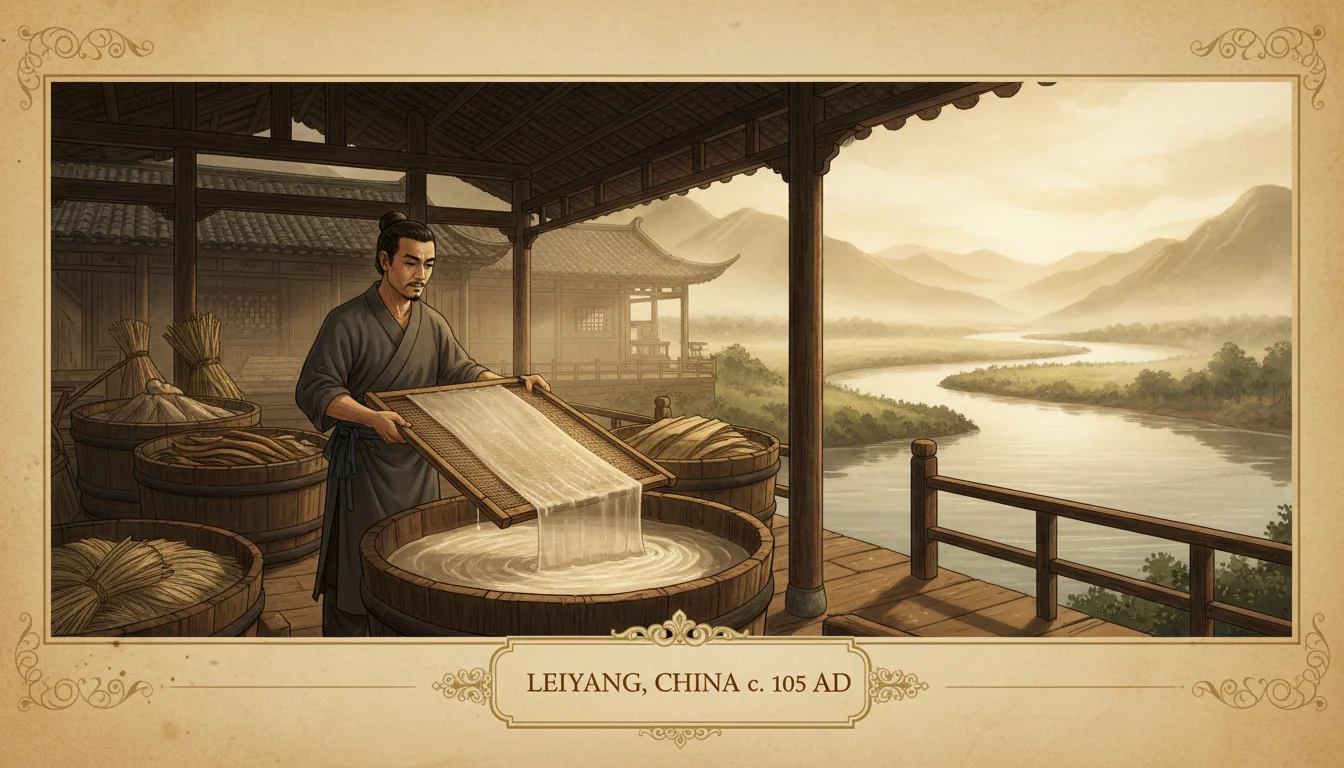
Paper, in the sense of a sheet material made from plant fibers reduced to a pulp and dried on a screen, was already in use in China before Cai Lun, the Han dynasty court official traditionally credited with its formalization around 105 CE, standardized the process. Fragments of paper predating Cai Lun have been found at archaeological sites in Gansu province. What Cai Lun contributed was a reliable, reproducible method using bark, hemp, rags, and fishing nets as raw materials, allowing paper to be manufactured at scale.
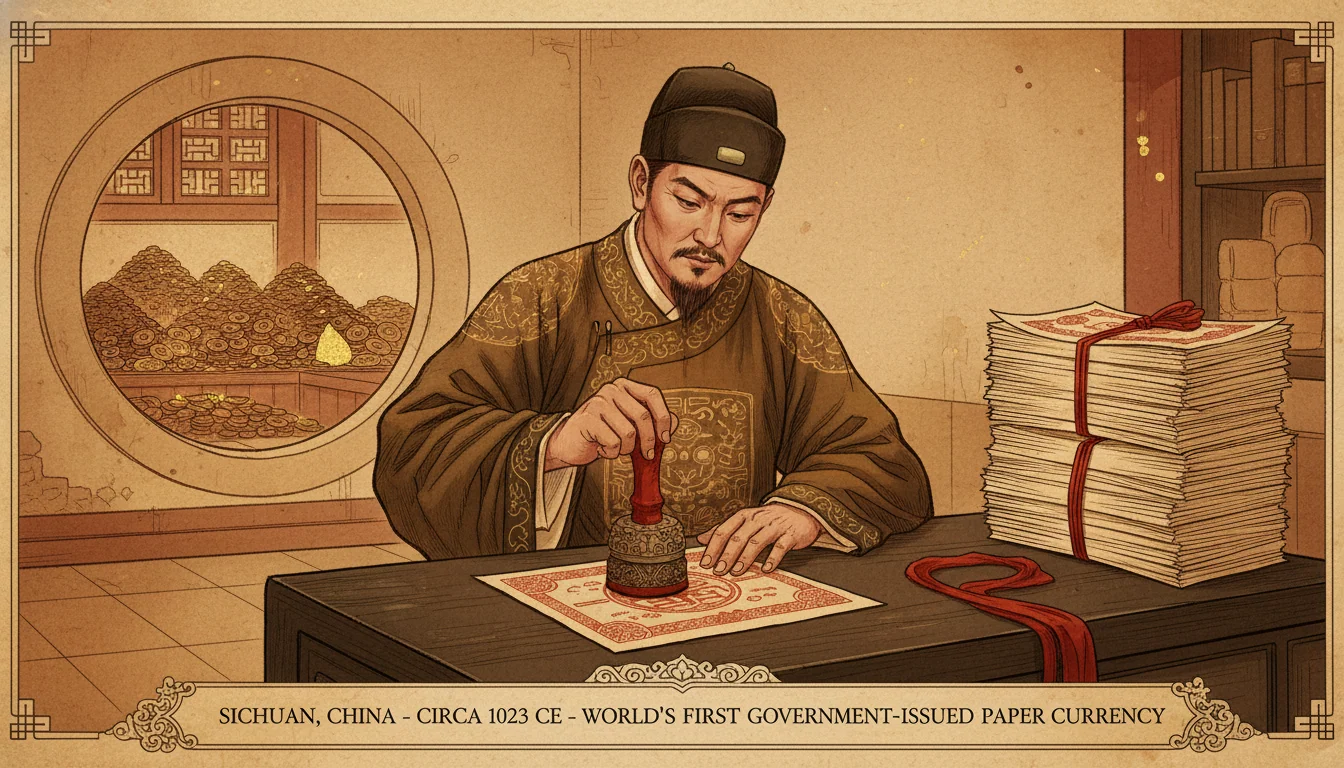
By the 3rd and 4th centuries CE, paper had substantially replaced silk and bamboo strips as the standard writing material in China. By the Tang dynasty (618-907 CE) it was widely available and relatively inexpensive. It was used for writing, wrapping, and money (the Tang introduced the first true paper banknotes), and it was available in sufficient quantity and low enough cost that it could be used for applications beyond the literary.
The first documented hygiene use
The earliest explicit written reference connecting paper to personal hygiene is generally traced to the scholar and official Yan Zhitui, who lived from 531 to approximately 591 CE and wrote a practical guide for family conduct known as the "Yanshi Jiaxun" or "Family Instructions for the Yan Clan." Among its observations on respectful behavior, Yan Zhitui wrote that he dared not use paper bearing quotations from the Five Classics or the names of sages for toilet purposes.
The comment is not about prohibiting paper use in general. It is about which paper is too sacred to use. The clear implication is that using ordinary paper for hygiene was already a normal practice, so normal that it required no explanation but simply a note about the categories that deserved exemption.
This places documented toilet paper use in China no later than the late 6th century - roughly a thousand years before any comparable Western reference.
Arab observers react
As trade between the Arab world and Tang dynasty China intensified, travelers began noting Chinese practices that struck them as alien. An account attributed to an Arab merchant named Sulayman al-Tajir, from around 851 CE and preserved in a text called "Accounts of China and India," includes an observation that the Chinese do not wash themselves after relieving themselves, as was Arab custom, but instead clean themselves with paper. The author finds this unsanitary by the standards of Islamic ablution practice, which requires water.
The observation is notably free of contempt - it reads more as an anthropological note than a complaint - but it confirms that paper hygiene use in China was visible and consistent enough to register as a cultural marker for foreign visitors in the mid-9th century.
Ibn Battuta, the Moroccan traveler whose 14th-century accounts of Asia and Africa remain primary sources for the history of those regions, made a similar note about Chinese practices in his Rihla. By his time the practice had been in place for centuries, and his observation was not new information to anyone familiar with China; it was confirmation of a long-standing cultural difference.
Imperial scale in the Ming dynasty
Chinese documentation of toilet paper use becomes more precise and more quantitative in the later imperial period. A 14th-century account of the paper production organized for the Bureau of Imperial Household records an order of 720,000 sheets of paper specifically for the emperor's use in a single year. A separate order of 15,000 sheets described as thick, soft, and fragrant was specified for the emperor's personal hygiene.
The scale of these orders suggests that by the early Ming dynasty, purpose-made hygiene paper was not a curiosity or a luxury of the very top of the imperial household but a routinely manufactured commodity at significant volume - just one that was stratified by quality, as most commodities in the imperial supply chain were.
The manufacturing infrastructure that could fill a 720,000-sheet annual order for one household was not assembled from scratch. It was built on centuries of paper production at scale.
The West remains uninformed
While China was ordering hundreds of thousands of hygiene sheets a year, medieval and early modern Europe was still using hay, rags, and linen. The paper technology existed in Europe from the 12th century onward, introduced through the Islamic world via Spain and Italy. What did not transfer was the hygiene application - or, more precisely, no one writing texts that survive described making the connection.
This gap is not fully explained. Paper was expensive in early medieval Europe, cheaper by the late medieval and early modern periods. The custom did not develop, or if it developed, it was not recorded in the sources that survive. By the 18th century, books, pamphlets, and newspapers were being used secondarily for the purpose - almanacs in particular were a common secondary-use text in colonial America - but this was improvised rather than manufactured.
Gayetty's medicated sheets
Joseph C. Gayetty of New York introduced "Gayetty's Medicated Paper for the Water-Closet" in 1857 in the United States. It was sold in packages of 500 flat sheets, each sheet watermarked with his name, for 50 cents a package. He marketed it as a medical product, claiming it was infused with aloe vera and would help prevent and treat hemorrhoids.
The medical claims were largely fanciful. The product was real and functional. Gayetty is often called the inventor of toilet paper in American popular history, which is incorrect in the way that calling Columbus the discoverer of America is incorrect: there were people there already, doing the thing, for a very long time.
What Gayetty deserves credit for is introducing the commercial concept to the American market and establishing that a consumer product in this category could be sold as such rather than improvised from whatever paper happened to be available.
Seth Wheeler and the roll
The form of toilet paper most familiar today - paper on a roll with regular perforations for tearing off individual sheets - was patented by Seth Wheeler of the Albany Perforated Wrapping Paper Company in 1891. US Patent 465,588, granted December 22 of that year, shows a perforated roll mounted on a bracket with a clear illustration of the paper feeding over the top of the roll toward the user.
This patent drawing is the primary evidence in what has become an unexpectedly popular online debate about the correct orientation of a toilet paper roll. Wheeler was the inventor of the roll format. His diagram shows "over." The question has been answered since 1891. That it continues to provoke arguments in 2026 may say something about the human appetite for low-stakes domestic controversy, or it may say something about how much of the history described in this article goes unread.
The Chinese officials who processed the emperor's 720,000 sheets annually, and the Sufi scholars who debated the appropriate material for ablution, and the Roman soldiers rinsing the communal sponge, were all managing the same universal human requirement. Wheeler just figured out the most efficient packaging.
For the origins of other everyday inventions, see Origins of Soap and Origins of the Calendar.
Quick Answers
Common questions about this topic
Who invented toilet paper?
Paper for hygiene was first used in China, with the earliest written documentation from around the 6th century CE. The scholar Yan Zhitui, writing around 589 CE, mentioned that paper bearing sacred texts should not be used for toilet purposes - implying the practice was common. Arab travelers noted Chinese toilet paper use by the 9th century. The first commercial toilet paper in the West was sold by Joseph Gayetty in 1857.
When was toilet paper invented?
Paper use for hygiene in China is documented from at least the 6th century CE. By the 14th century, imperial Chinese households were ordering hundreds of thousands of hygiene sheets annually. In the United States, Joseph Gayetty commercialized flat sheets in 1857, and Seth Wheeler patented the perforated roll in 1891.
What did people use before toilet paper?
It varied dramatically by region and era. Romans used a sponge on a stick called a tersorium, shared in public toilets. Greeks and Romans also used smooth pottery sherds called pessoi. Medieval Europeans used hay, moss, leaves, corn husks, rags, and wool. The wealthy used fine linen. Most of the pre-paper world simply used whatever was locally available.
Does the toilet paper patent prove 'over' is correct?
Yes. Seth Wheeler's 1891 US patent for perforated toilet paper on a roll includes a clear drawing showing the paper going over the top of the roll toward the user. Wheeler founded the company that commercialized the roll format, making him the original arbiter of the question.

Ask the Inventors Themselves
Chat with the people who were there when familiar things began.
Create your free account →No card required. Talk to anyone in history with 8 free credits a day. Some features require a paid plan.
Join the HistorIQly Club
Get smarter about the past.
Weekly stories, deep dives, and exclusive content straight to your inbox.