Origins: Where Wine Was First Made
Where was wine invented? Neolithic Georgia, 6000 BCE - not Greece or Rome. This is the story of how grape fermentation became civilization's most persistent ritual drink.
Read Wikipedia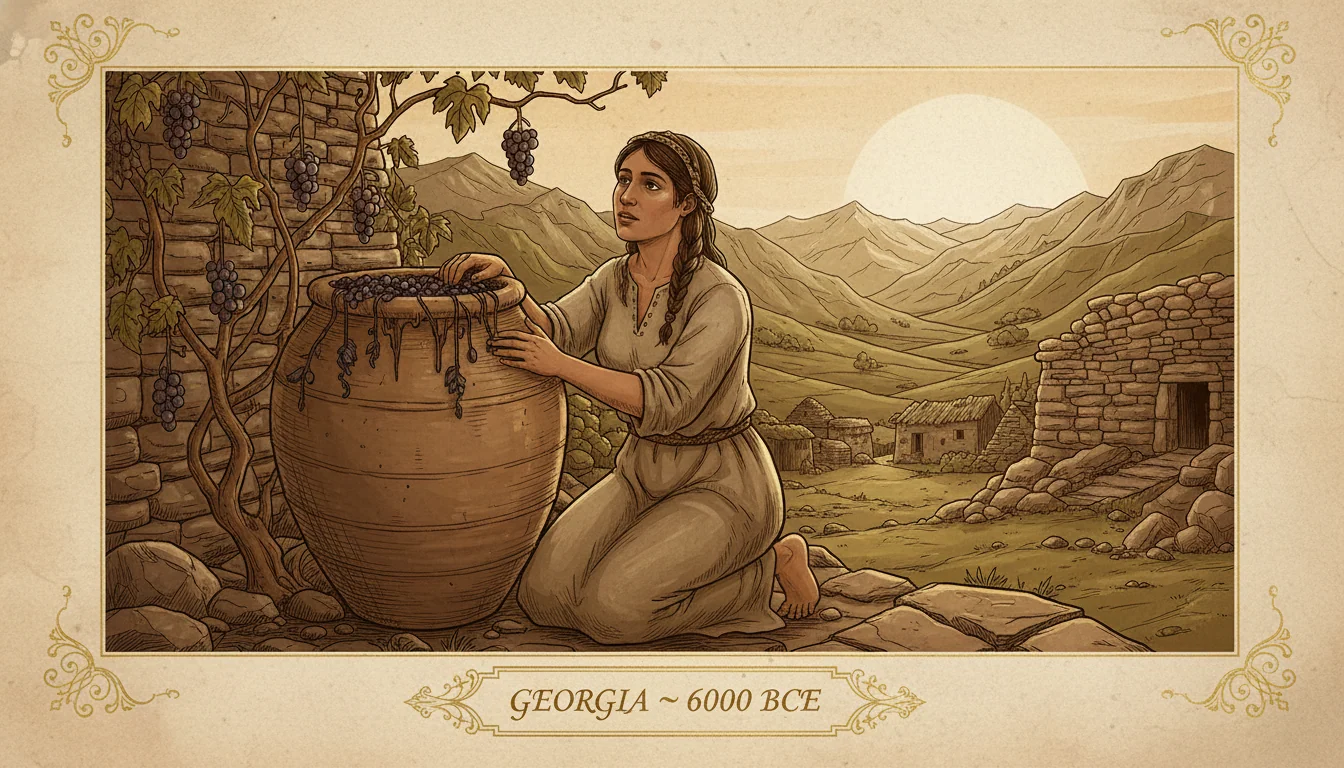
Before the grape there was the accident. Across every culture that eventually developed wine, the founding mythology involves the same essential moment: someone left fruit in a vessel longer than intended, something unexpected happened to the liquid, and whoever tasted the result either attributed it to the gods or decided to do it again. In the Dionysus myth, the god of wine was twice-born - torn apart and reassembled - a metaphor for fermentation that the Greeks would have recognized as exact even if they would have explained it differently.
The question of where wine was invented has a more ancient and surprising answer than any of these myths suggest. The trouble with mythology as history is that it flattens a process that took millennia and attributes a gradual discovery to a single divine moment. Wine did not arrive in a flash. It accumulated: first as wild fermentation that humans noticed and valued, then as deliberate production in simple vessels, then as a managed agricultural system, then as the commodity that ran the ancient Near Eastern economy and eventually much of the ancient world. The actual origins are older than Greece, messier than Genesis, and located not in the Mediterranean basin but in a Neolithic village in the Caucasus mountains.
Georgia, 6000 BCE: the oldest evidence
For most of the 20th century, the accepted oldest evidence of wine came from Hajji Firuz Tepe in northwestern Iran, where residues dated to around 5400-5000 BCE were found in clay storage jars. This held as the standard for decades.
In 2017, a team led by Patrick McGovern of the University of Pennsylvania published a study in the Proceedings of the National Academy of Sciences reporting chemical analysis of ceramic sherds from two Neolithic village sites in Georgia - Gadachrili Gora and Shulaveris Gora, both in the Kvemo Kartli region south of Tbilisi. The residues contained tartaric acid, malic acid, citric acid, and succinic acid in combinations consistent with grape fermentation. The sites dated to approximately 5800-6000 BCE.
This pushed the confirmed origin of wine back by roughly a thousand years. The two Georgian sites are not large or spectacular - they are small farming villages, exactly the kind of place where an agricultural experiment would begin not with intention but with observation: wild grapes growing nearby, collected in quantity, stored in ceramic jars, and producing a liquid that someone at some autumn evening approximately 8,000 years ago decided was worth drinking.
Georgia's claim to be the birthplace of wine is not merely national pride. The genetic evidence of Vitis vinifera domestication also points to the South Caucasus as the center of earliest grape cultivation. The region still produces wine in traditional clay vessels called kvevri, sunk into the ground for fermentation and storage - a practice so continuous it may represent a genuine unbroken link to Neolithic production methods.
Armenia, 4100 BCE: the first winery
The Georgian evidence establishes where wine was first made. A site in Armenia establishes where the first organized winery operated.
Areni-1 is a cave system in the Vayots Dzor region of southern Armenia, near the village of Areni. Excavations beginning in 2007 revealed a complex dated to approximately 4100 BCE: a shallow clay basin roughly a meter across that had been used as a pressing platform for grapes. Channels led from the basin into clay fermentation jars. Nearby were larger storage vessels containing dried grape marc and the seeds of Vitis vinifera cultivars closely related to the Areni noir grape grown in the same region today.
The site functioned as a systematic winery, not a casual vessel of stored fruit. Someone built infrastructure here, channeled the juice deliberately, managed the fermentation with sufficient control to want repeatable results. This is not accidental wine. This is winemaking as a craft.
The cave also contained human skulls and burial materials, suggesting the wine production was connected to funerary or ritual practice. Wine in its earliest organized forms was not a table drink. It was a sacred substance - something consumed at the boundary between living and dead, used to honor ancestors and mark significant transitions. The fermentation vessels and the burial offerings are in the same chamber. The connection was not incidental.
Mesopotamia and Egypt: wine as currency
By 3000 BCE, wine had established itself as one of the most important commodities in the Near Eastern economy. Egyptian hieroglyphic texts record wine production from at least the First Dynasty, around 3100 BCE. The wine jars found in the tomb of the pharaoh Scorpion I at Abydos contained residue mixed with pine resin, fig, and herbs - a seasoned wine transported from the Levant, not from local Egyptian vineyards, suggesting that organized long-distance wine trade predates the unification of Egypt itself.
Mesopotamian sources are equally clear. The Epic of Gilgamesh refers to wine without treating it as unusual. Cuneiform administrative texts from Ur record wine as a ration item for temple workers. By the Bronze Age, wine production was established across the Levant, Anatolia, Cyprus, and the Aegean, connected by a maritime trade network that carried sealed amphorae across hundreds of kilometers of open sea.
The Bronze Age shipwreck found off Uluburun on the Turkish coast, dated to around 1300 BCE, carried wine amphorae alongside copper ingots, tin, glass, ebony, and luxury goods from Egypt, Canaan, Cyprus, and the Aegean. Wine was a high-value trade good in a world that moved high-value goods by sea. Its distribution map was identical to the distribution map of early civilization.
The Dionysus myth and what it actually records
The Greek god Dionysus has the most elaborate mythology attached to any wine deity in the ancient world. He was said to have discovered the vine, taught humanity the art of wine, and traveled the world spreading the gift. He was twice-born: first from his mother Semele, who was killed when she saw Zeus in his full divine form, then from Zeus's own body where the infant god completed his gestation.
The mythology is not history, but it is not meaningless. The story of a god who travels from the east and teaches civilization a new gift encodes a real memory: viticulture did come from the east. It arrived in Greece from the Aegean islands and the Levant, and before that from the Caucasus and the wider Near East. The Greeks were not wine's inventors. They were its brilliant propagandists.
Dionysus's iconography - the vine, the thyrsus staff, the ivy crown, the panther, the ship - reflects the commodity's actual biography. A plant from mountain forests, transported by sea, associated with altered states and boundary-crossing, arriving in the Mediterranean world from somewhere older and further away. The myth preserved the geography even when it forgot the calendar.
Rome and the northern vineyards
The Romans made wine universal in Europe. As Rome expanded into Gaul, the Rhine provinces, and Iberia, it brought viticulture with it. The Rhone Valley, Bordeaux, Burgundy, the Rhine and Moselle valleys, the Rioja in Iberia - all were planted with managed vineyards by Roman administrators, veterans granted farmland, and merchants following army supply lines.
Roman wine was not the varietal product of modern prestige production. It was heavily mixed with seawater, honey, resin, and herbs, stored in amphorae coated inside with pine pitch that imparted its own flavor, and typically consumed diluted with two or three parts water. The undiluted version was considered a mark of barbarism. A man who drank his wine neat was announcing something about himself.
But the administrative machinery of production, the embryonic concept of specific places producing distinctive wines, and the habit of planting particular vine varieties in particular soils were all Roman contributions to a technology they had received from Greece, who had received it from the Phoenicians, who had received it from the Levant, who had received it from the Caucasus.
The Mosel Riesling grapes growing today on the same terraced slopes the Romans planted are among the more visible unbroken threads in European agricultural history.
What the myths get wrong
The Dionysus story, the Noah story, and the various founding myths of wine all converge on a single structural error: they imagine wine as an invention, a moment when someone deliberately created something new. The archaeological evidence suggests something different. Wine was, at first, a discovery - a natural fermentation that humans observed, valued, and then slowly learned to control and optimize over many generations.
The winery at Areni-1 is not the first wine. It is the first evidence of people who had been making wine long enough to build dedicated infrastructure for it. The gap between the Georgian jars of 6000 BCE and the Armenian winery of 4100 BCE represents roughly two thousand years of informal production, experimentation, and accumulating knowledge before someone decided the process warranted its own room.
The myths were invented to explain something ancient to people who had already forgotten how ancient it was. By the time the Greeks were writing about Dionysus, the winemakers of Gadachrili Gora had been dead for four thousand years. The drink they had made - probably by storing wild grapes longer than planned, in a clay jar, in a Neolithic village south of the Caucasus - had become the sacrament of a pantheon, the currency of an empire, and the daily companion of most of the civilized world.
The clay vessels from Georgia are small and plain. They hold tartaric acid and nothing else remarkable. What they document is not a gift from the gods. It is something more interesting: an agricultural people, eight thousand years ago, noticing something and deciding it was worth doing again.
For related origins stories, see Origins: The History of Tea and Origins: The History of Bread.
Quick Answers
Common questions about this topic
Where was wine first made?
The oldest confirmed wine residues, dating to approximately 6000 BCE, were found in clay jars at two Neolithic sites in Georgia - Gadachrili Gora and Shulaveris Gora - in the South Caucasus. A 2017 study published in the Proceedings of the National Academy of Sciences identified tartaric acid and associated compounds consistent with grape fermentation in ceramic sherds from these sites.
What is the oldest winery ever found?
The Areni-1 cave in Armenia contains the oldest known winery, dated to approximately 4100 BCE. Excavated by archaeologists from UCLA and the Armenian Institute of Archaeology and Ethnography between 2007 and 2010, the site contained a grape press, fermentation vats, storage jars with dried grape marc, and grape seeds of Vitis vinifera.
Did the ancient Greeks invent wine?
No. The Greek god Dionysus is associated with wine in mythology, but viticulture and wine production were already ancient practices in the Near East and the Caucasus long before Greece developed a wine culture. The Greeks were important in spreading wine around the Mediterranean, but they were adopting and elaborating a technology that was already several thousand years old.
When did wine reach Europe?
Cultivated viticulture - grape vines deliberately domesticated and managed for wine production - reached most of Europe from the Near East and Caucasus via trade networks. The Phoenicians carried it to Iberia and the western Mediterranean around 1000 BCE. The Romans then planted systematic vineyards in Gaul, the Rhine valley, and Iberia, creating the wine regions that dominate production today.

Ask the Inventors Themselves
Chat with the people who were there when familiar things began.
Create your free account →No card required. Some figures and features require a paid plan.
Join the HistorIQly Club
Get smarter about the past.
Weekly stories, deep dives, and exclusive content straight to your inbox.