The Piltdown Man Hoax: How a Fake Fossil Fooled Science for 40 Years
Charles Dawson unveiled a fake 'missing link' fossil in 1912. It took fluorine tests and a microscope to expose it as an orangutan jaw and human skull, in 1953.
Read Wikipedia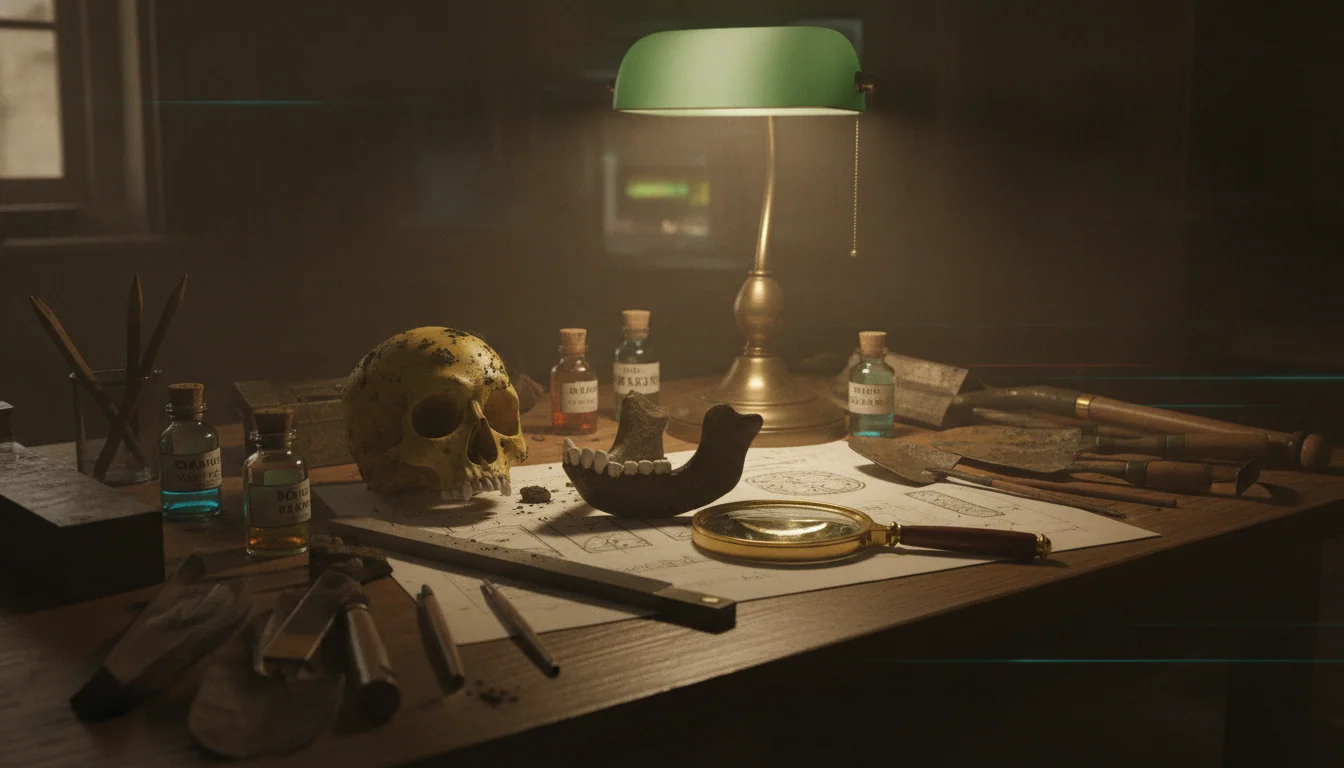
In December 1912, a packed room at the Geological Society of London leaned forward to examine a few stained bone fragments and a heavy, ape-like jaw. A Sussex solicitor and amateur fossil hunter named Charles Dawson told them he had found, in a gravel pit near the village of Piltdown, the missing link between apes and humans. For more than forty years, much of British science believed him. Then three researchers with a file, a microscope, and a chemical test proved the whole thing was glue, stain, and nerve.
The mark
The mark was not a person. It was a hunger. By the early 1900s, fossil hunters in France, Germany, and Java had turned up Neanderthals, Heidelberg Man, and Java Man, each discovery adding weight to Charles Darwin's case that humans had evolved from earlier primates. England had nothing to show. Its scientific establishment, proud and anxious about being left out of a story that felt like it should include the birthplace of Darwin himself, wanted an early human of its own. Ideally an old one, and ideally one with a big brain, since Edwardian scientists largely assumed that whatever separated humans from apes, intelligence had led the way.
That assumption was the exploit. A forger who understood what British paleontology wanted to find did not need to invent something wholly implausible. He needed to hand scientists a fossil confirming what they already suspected: that human evolution produced a brain first and a body later, and that it may well have happened in England. Prestige was the prize. A name attached to England's first early human stood to become permanently, comfortably famous, remembered as the man who found "Dawn Man."
The crew and the plan
Charles Dawson was a solicitor in Uckfield, Sussex, with a long-standing hobby collecting fossils and antiquities, respectable enough that he had already been elected a fellow of the Geological Society and the Society of Antiquaries. Around 1908, he later claimed, a workman digging gravel near Piltdown Common handed him a fragment of unusually thick, human-looking skull. Dawson dug at the site alone for a few years before bringing in Arthur Smith Woodward, keeper of geology at the Natural History Museum in London, around 1912.
Woodward lent the find scientific weight and, most historians now agree, appears to have been genuinely deceived rather than complicit, an eager collaborator rather than a co-conspirator. The deeper mystery is whether Dawson acted alone. Suspicion has fallen on several other names over the decades: Martin Hinton, a museum staffer whose initials turned up on a trunk of stained bones found in the museum's attic in the 1970s; the young Jesuit Pierre Teilhard de Chardin, present for one of the later finds and floated as a suspect before most researchers concluded he was likely unwitting; and, more colorfully, the writer Arthur Conan Doyle, who lived nearby, golfed with Dawson, and had recently published "The Lost World," a novel about hidden prehistoric survivals. The Conan Doyle theory rests on proximity and motive rather than direct evidence, and most historians treat it as an intriguing footnote rather than a solved question. Forensic work published since the early 2000s, examining the manufacturing technique across every Piltdown specimen, points toward a single, consistent hand, and most researchers now believe the evidence points to Dawson acting largely alone, though total certainty has never quite been reached.
Whoever assembled it, the method was patient and genuinely clever. The forger took a human skull, old enough to look weathered but not old enough to be a true ancient specimen, and paired it with an orangutan's jawbone, its shape close enough to a human jaw's that a casual skeptic could miss the mismatch. The orangutan's teeth, shaped differently from human teeth, were filed down by hand to flatten their distinctive cusps into something closer to human wear. Every bone was then stained with iron sulfate and, on some pieces, chromic acid, giving the fragments a uniform, aged, iron-rich color matching the reddish gravel of the pit, disguising both the age mismatch and the fact that the jaw had never sat in that ground at all.
The job
Piltdown was not one discovery. It was a sequence, spaced over several years, each new fragment arriving just in time to answer the last round of doubts. The skull pieces came first, presented by Dawson and Woodward to the Geological Society on December 18, 1912, alongside the jawbone and, crucially, a canine tooth that fit the jaw's missing gap almost too well. Dawson gave the specimen a formal name, Eoanthropus dawsoni, "Dawson's dawn man," putting his own name permanently inside the taxonomy of human evolution.
Almost immediately, a handful of scientists objected. The anatomist David Waterston and the American zoologist Gerrit Miller argued in 1913 that the jaw looked exactly like what it was: an ape's jaw with nothing to do with the skull beside it. Their objections might have unraveled the hoax within a year or two, except new "confirming" evidence kept arriving at the right moment. In 1915, Dawson announced a second site nearby, with further skull and tooth fragments closely resembling the first. This second find, later nicknamed Piltdown II, did enormous work for the hoax's credibility, suggesting the pattern was not a fluke but a genuine type of early human scattered across Sussex. Skeptics who had doubted one lucky jawbone found it harder to dismiss two sites telling the same story. For most of the establishment, the debate quietly closed. Piltdown Man took his place in textbooks and reconstructions of the human family tree, an English ancestor with a modern brain and a primitive jaw, exactly the shape early-brain-first theories had predicted.
The unravelling
Doubts about Piltdown never entirely vanished, they simply lost the argument for decades. Finds like the Taung Child in South Africa in 1924 and later specimens from China and East Africa showed early hominins with small brains and human-like bodies, the opposite pattern from Piltdown's big brain and ape-like jaw. Rather than sinking Piltdown, this left it an awkward outlier British scientists were reluctant to discard, since discarding it meant admitting the field's most celebrated English discovery had been wrong for a generation.
The real unraveling began quietly in 1949, when Kenneth Oakley, a geologist at the Natural History Museum, applied a fluorine absorption test to the Piltdown bones. Bones buried in soil slowly absorb fluorine from groundwater at a fairly predictable rate, making fluorine content a rough way to estimate how long a specimen has sat in the ground. Oakley's results were troubling: the skull and jaw contained far less fluorine than genuinely ancient fossils from comparable gravel deposits, suggesting both pieces were much younger than assumed. The finding did not immediately topple the theory, but it opened the door.
By 1953, Oakley teamed up with anthropologist Joseph Weiner and anatomist Wilfrid Le Gros Clark for a full re-examination. Weiner reportedly grew suspicious after realizing how implausible it was that no other Piltdown-style remains had ever turned up despite decades of searching. Under magnification, the team found file marks on the teeth, tool scars invisible to the naked eye but unmistakable under a microscope, evidence someone had physically ground the orangutan's molars down to resemble human wear. Chemical testing confirmed the staining was artificial, applied with iron salts and chromic acid rather than accumulated naturally over millennia. Further analysis established the skull belonged to a medieval or early modern human, only a few hundred to roughly a thousand years old, while the jaw and teeth belonged to a modern orangutan, likely from Southeast Asia. Piltdown Man was not a missing link. He was a jigsaw puzzle, cut from two species that had never been anywhere near each other, glued together and dyed to match. The team announced the fraud publicly in November 1953, and it made headlines across Britain and beyond.
Where are they now
Charles Dawson never answered for any of it. He died in 1916, thirty-seven years before Weiner, Oakley, and Le Gros Clark proved his find a fraud, and went to his grave as the celebrated discoverer of Dawn Man rather than as a suspect. No prosecution was ever possible, no confession ever extracted. Later research into his career turned up a long pattern of other dubious or fabricated finds attributed to him, convincing most modern historians Piltdown was not an isolated lapse but the capstone of a long habit.
Arthur Smith Woodward, who had staked much of his professional reputation on defending the specimen for over three decades, died in 1944, nearly a decade before he could learn how thoroughly he had been fooled; he spent his own final years still writing about Piltdown Man as genuine. For British paleoanthropology, the exposure was a lasting embarrassment, cited ever since as a textbook case of confirmation bias, of scientists finding exactly the evidence they wanted to find and testing it far less rigorously than they should have because the conclusion flattered them. It also became one of science's more hopeful cautionary tales, since it was, in the end, science that caught the fraud, using tools that simply had not existed or had not been trusted enough to apply in 1912. Piltdown Man was quietly removed from the human family tree, and the case is still taught today as the moment paleoanthropology learned, the hard way, to doubt its own most convenient discoveries.
For other cons that fooled institutions who should have known better, see how Victor Lustig sold the Eiffel Tower twice and the 1911 theft of the Mona Lisa.
Quick Answers
Common questions about this topic
Was Piltdown Man ever a real fossil?
No. It was a forgery combining a genuine but relatively young human skull with the filed-down jawbone and teeth of an orangutan, both stained to look like ancient bone found in the same gravel pit.
How was the Piltdown Man hoax exposed?
Between 1949 and 1953, Kenneth Oakley, Joseph Weiner, and Wilfrid Le Gros Clark used fluorine absorption testing, microscopic examination, and chemical analysis to show the skull and jaw were different ages, different species, and artificially stained and filed to match.
Who was responsible for the Piltdown Man hoax?
Most historians point to Charles Dawson, the amateur fossil hunter who presented the finds, as the main and likely sole culprit, though theories over the decades have also named Martin Hinton, Pierre Teilhard de Chardin, and even Arthur Conan Doyle as possible accomplices, none of it proven.
What happened to Charles Dawson after the hoax was exposed?
Nothing, because he died in 1916, thirty-seven years before the fraud was proven in 1953. He was never confronted, prosecuted, or forced to answer for it, and died believing his reputation as a great discoverer was secure.

Question the Thieves
Chat with the detectives and masterminds behind history's boldest heists.
Create your free account →No card required. Talk to anyone in history with 8 free credits a day. Some features require a paid plan.
Join the HistorIQly Club
Get smarter about the past.
Weekly stories, deep dives, and exclusive content straight to your inbox.