Inside the Plague Doctor Costume: Why 17th Century Physicians Wore Bird Masks
A French court physician's fix for 'miasma' produced the plague doctor costume: the beaked mask, waxed coat, and cane behind medicine's most iconic image.
Read Wikipedia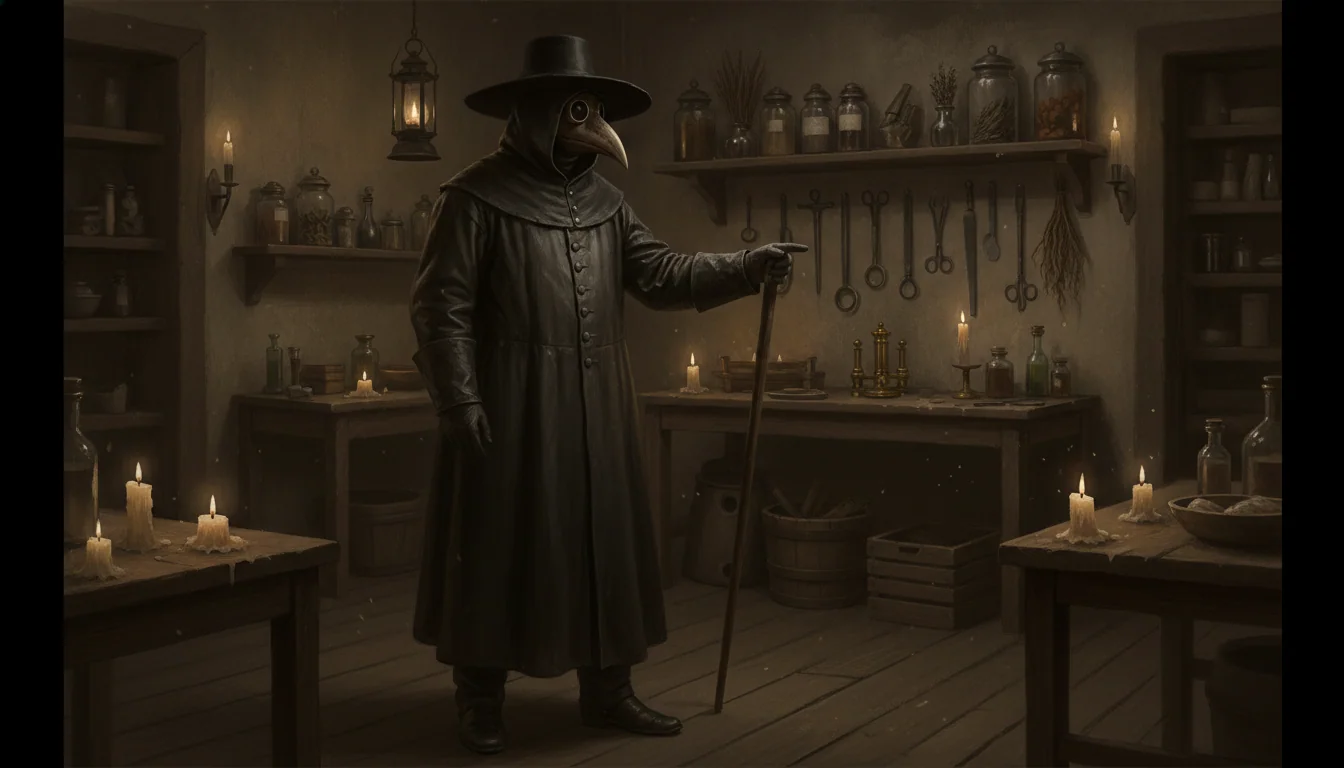
No image in the history of medicine gets reproduced, costumed, and merchandised more often than the plague doctor. The long leather beak, the wide-brimmed hat, the waxed floor-length coat, the wooden cane held out like a divining rod: it outsells the caduceus at every Halloween shop and Venice mask stall on earth. Ask most people when it comes from and they will say the Black Death, the fourteenth century catastrophe that killed a third of Europe. They would be wrong by nearly three hundred years. The costume did not exist when the Black Death struck, and the man usually credited with inventing it was not a quack cashing in on fear. He was trying, using the best science of his era, to build the first piece of dedicated protective equipment in Western medicine.
The arrival
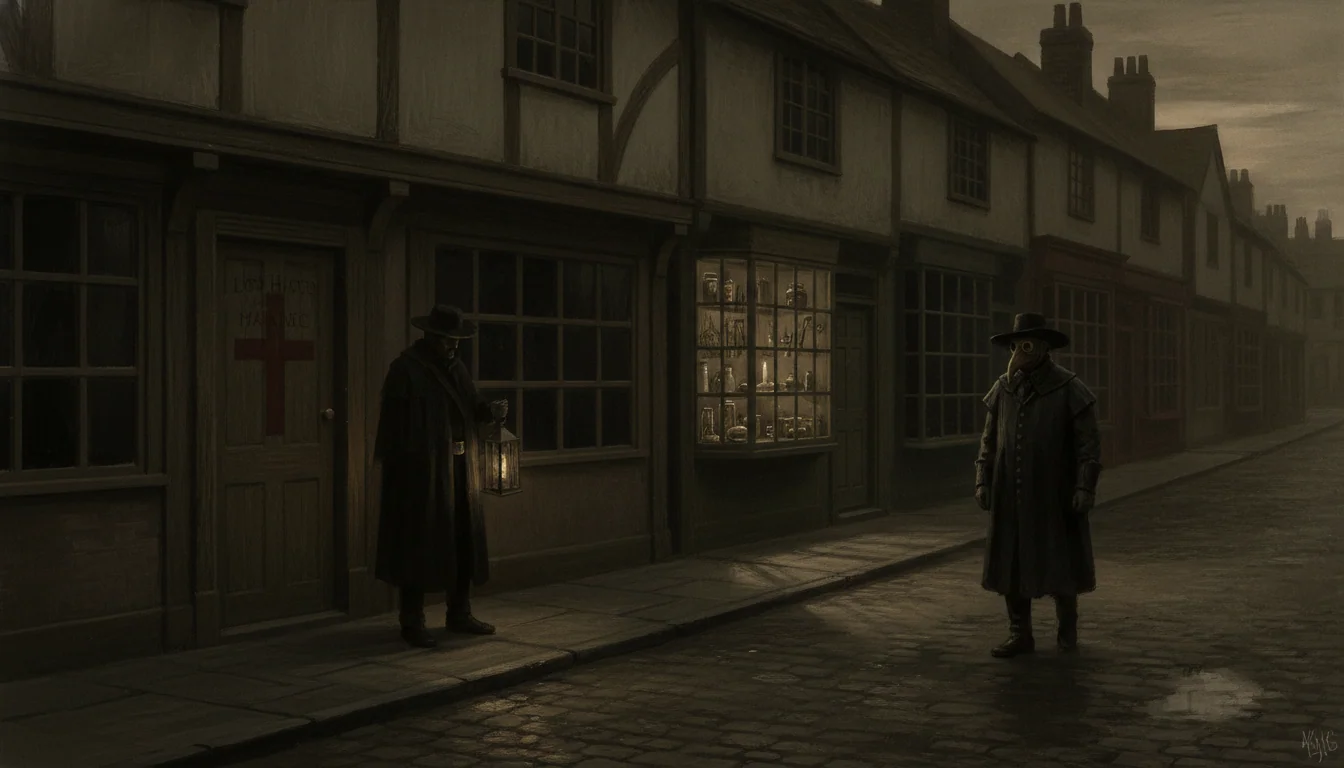
The Black Death of the 1340s never really left. Plague returned to Europe in wave after wave for centuries afterward, hitting Italian city-states, French ports, the Rhineland, and London on a grim and irregular schedule through the 1500s and 1600s. Physicians with the means to leave a stricken city generally did, which created an obvious civic problem: who treats the people left behind. The answer, in much of Italy and France, was a role invented specifically for outbreaks, the medico della peste, a plague doctor hired on contract by a city or parish. These posts paid well, sometimes as danger money, but they rarely went to a town's most senior or established physicians, since those men had already fled. Contracts more often fell to younger doctors trying to build a reputation, general practitioners willing to take the risk, or in some documented cases men with only partial medical training who were the only applicants left.
It was this specific, hazardous job that produced the costume. Most historical accounts credit Charles de Lorme, physician to the French royal court under Louis XIII, with designing the full ensemble around 1619 for use against plague outbreaks in Paris and beyond. Whether de Lorme invented every element himself or systematized protective gear that other doctors had already improvised is genuinely disputed among historians, but by the middle of the century the outfit was recognizable enough that a German engraver named Paul Fürst produced a widely copied print of a beaked figure nicknamed "Doctor Schnabel von Rom," Doctor Beak of Rome, tied to the plague that struck Italy in the mid-1650s. That print, more than any surviving garment, is why the world still recognizes the shape today.
What people believed
To understand why the costume looks the way it does, you have to accept the medical theory behind it on its own terms rather than mock it from hindsight. Seventeenth century physicians did not know that bacteria existed. They worked from a framework descended from Hippocrates and Galen's humoral medicine: disease traveled through miasma, corrupted and foul-smelling air rising from rotting matter, sewage, stagnant water, and unburied corpses, sometimes made worse by unlucky alignments of the planets. Under that theory, a bad smell was not simply unpleasant, it was the illness itself moving through the atmosphere. The logical defense, then, was not primarily to avoid touching the sick. It was to avoid breathing the same unfiltered air they did. Every part of the plague doctor's outfit follows from that single, sincerely held, and completely wrong premise.
What the doctors tried
The coat came first: an ankle-length overcoat, usually waxed linen or oiled leather, tucked into boots and gloves so that no bare skin was exposed to the surrounding air. The wide-brimmed black hat signaled the wearer's profession the way a white coat does today, and some contemporary accounts suggest doctors believed it offered a further layer of protection. Then the mask. The leather beak, typically five to six inches long, was packed with aromatic material meant to purify the air before it reached the lungs: dried roses and carnations, mint and other herbs, spices like cloves, and substances such as camphor or myrrh, sometimes bundled with straw or soaked cloth. Two round lenses, usually glass, sat over the eyes, because period medicine also treated the eyes as a vulnerable entry point for the disease. Finally the cane, a wooden rod the doctor used to examine a patient, lift bedding or clothing, take a pulse, or direct family members and gravediggers, all without the gloved hand making direct contact.
None of this worked for the reason it was designed to work. The actual culprit, the bacterium Yersinia pestis, spread mainly through the bites of infected fleas carried on rats, and in its pneumonic form through respiratory droplets passed between people at close range, not through bad-smelling air. That said, the costume was not useless by pure accident. A full-body barrier of waxed leather that fleas could not easily bite through, combined with gloves that kept a doctor from touching weeping buboes directly, plausibly cut down on some transmission even though nobody wearing it understood the actual mechanism. The doctors built the wrong theory into the right general shape: cover the body, avoid contact, keep a distance.
Who got blamed
Doctors in beaked masks were feared as much as they were welcomed. Because they alone had guaranteed, well-paid work during an outbreak, plague doctors were sometimes accused of profiteering, of drafting or altering the wills of dying patients they attended, or in the ugliest rumors, of prolonging the plague itself for financial gain. But the harsher and more organized scapegoating fell on people entirely outside medicine. In Milan in 1630, at the peak of a severe outbreak, city authorities prosecuted several men accused of being untori, deliberate "plague spreaders" who supposedly smeared a poisoned ointment on walls and doorposts to infect the healthy. Two men in particular, a health commissioner named Guglielmo Piazza and a barber named Gian Giacomo Mora, were tortured until they confessed and were then executed. A monument built on the site of Mora's demolished house, the Colonna Infame, stood in Milan for well over a century afterward as a public marker of their supposed guilt, before later Italian jurists and historians came to treat the entire case as a textbook example of a false confession extracted under torture. Jewish communities across Europe faced comparable accusations of well-poisoning and plague-spreading dating back to the Black Death itself, sometimes triggering violent pogroms, a pattern of blame that recurred, in varying intensity, whenever plague returned.
What finally worked
More than two centuries separate Charles de Lorme's beaked costume from anything resembling an actual answer. In the meantime, the interventions that genuinely slowed outbreaks had nothing to do with masks or aromatic herbs. Adriatic port cities including Dubrovnik had already pioneered mandatory isolation periods for arriving ships as early as the 1370s, first thirty days and later forty, the origin of the word quarantine, and that basic strategy of separating the sick and the newly arrived from the healthy did more real work than any garment ever would. The scientific breakthrough came in 1894, when the bacteriologist Alexandre Yersin identified the bacterium later named in his honor during an outbreak in Hong Kong, working nearly in parallel with the Japanese physician Kitasato Shibasaburo. Within a few years researchers had confirmed the flea-and-rat transmission cycle that miasma theory had never come close to guessing. Even then, an actual cure had to wait for twentieth century antibiotics; streptomycin, developed in the 1940s, was the first drug that let doctors treat plague rather than simply try to filter it out of the air.
The image that outlived the disease
There is a real irony sitting at the center of that plague doctor costume. It was engineered around a theory of disease that turned out to be entirely wrong, built by a real royal physician trying to solve a genuine emergency with the tools his century had, and it still somehow became the single most recognizable image connected to plague, more famous today than any picture of the actual bacterium or the antibiotic that finally beat it. It shows up on Halloween store shelves, on the "medico della peste" masks sold at the Venice Carnival, in video games and steampunk illustration, stripped almost entirely of the medical logic that produced it. A hollow-eyed, bird-faced figure standing over the sick with a cane held at arm's length, unable to fully explain why it worked when it worked and helpless when it did not, has outlasted the disease it was built to fight by more than four hundred years.
Quick Answers
Common questions about this topic
Why did plague doctors wear beak-shaped masks?
The beak was period medical equipment, not costume flair. It was packed with dried flowers, herbs, and aromatics such as camphor or myrrh to filter the air the wearer breathed, because seventeenth century medicine held that plague spread through foul-smelling miasma rather than through the flea bites and respiratory droplets that actually carried the bacterium.
Did plague doctors treat the Black Death?
No. The beaked costume is often pictured against Black Death imagery, but it did not exist during that outbreak in the 1340s. It emerged roughly three centuries later, credited by most accounts to the French physician Charles de Lorme around 1619, and was worn through the recurring plague waves of the 1600s that followed.
Did the costume actually protect doctors from the plague?
Not for the reason its designers thought. The miasma theory behind the herb-stuffed beak and glass eye lenses was wrong, but the full-body waxed coat and gloves incidentally blocked flea bites and direct contact with infected sores, so the outfit may have offered real protection almost by accident.
Who got blamed for spreading the plague?
Alongside suspicion of the plague doctors themselves, cities scapegoated outsiders and alleged 'plague spreaders.' In Milan in 1630, officials tortured and executed a health official and a barber accused of smearing poisoned ointment on city walls, a coerced confession that later became a famous case study in wrongful prosecution.

Consult the Physicians
Chat with the healers and survivors who lived through history's outbreaks.
Create your free account →No card required. Some figures and features require a paid plan.
Join the HistorIQly Club
Get smarter about the past.
Weekly stories, deep dives, and exclusive content straight to your inbox.