The Coded Notes of Ricky McCormick: The FBI's Unsolved Cipher
Ricky McCormick's coded notes - two handwritten pages found in his pockets after his 1999 murder - remain the FBI's most famous unsolved cipher.
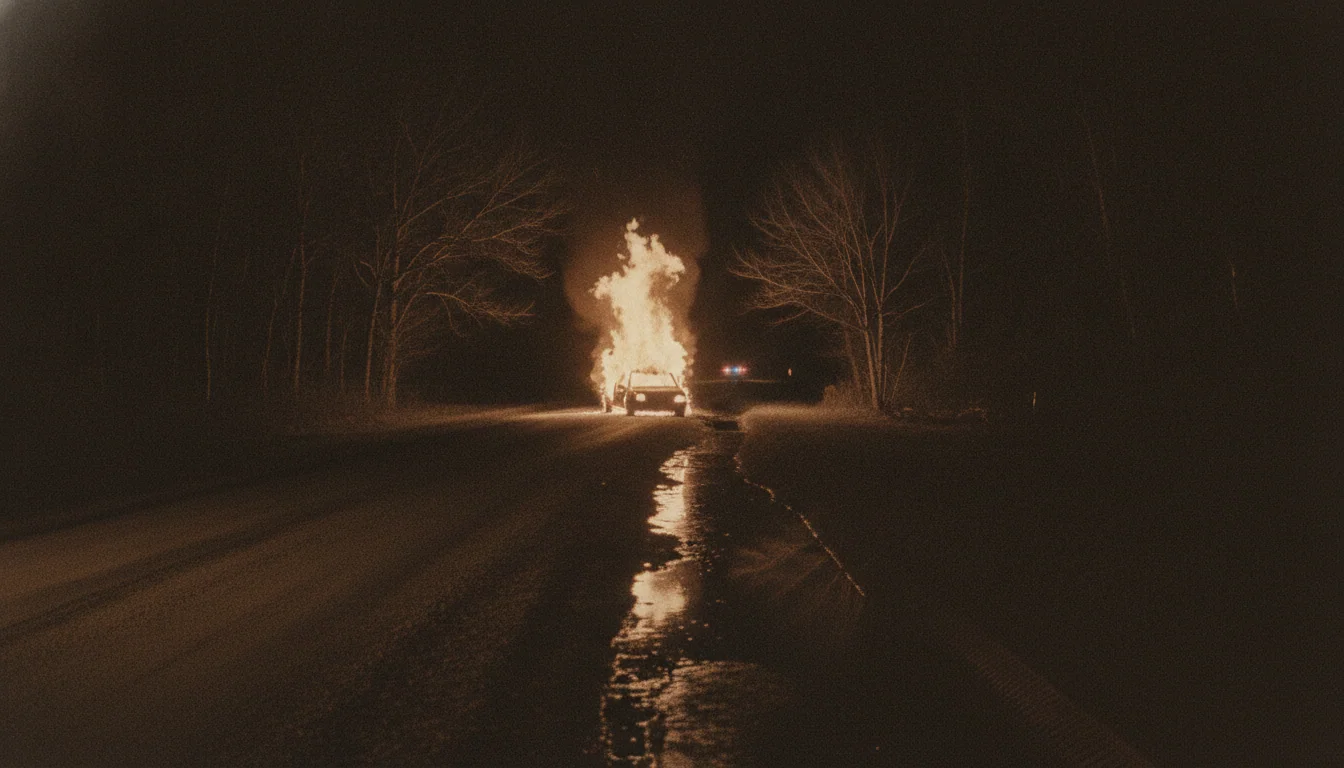
The cornfield in St. Charles County was working land, unremarkable, situated about 15 miles west of the city of St. Louis. On June 30, 1999, a body was discovered there. The man had been dead for several days, possibly close to a week in Missouri summer heat, which left forensic investigators with limited information about exactly how he had died.
He was identified as Ricky McCormick, 41 years old. He was unemployed. He lived with relatives in St. Louis city. He had a history of heart problems. He had no car. And the field where his body lay was nowhere near anything he had reason to visit.
That displacement was the first thing investigators noted: a city man, chronically ill, without transportation, found dead in a rural field miles from home, with no explanation for how he arrived. The case was classified as a homicide, though the mechanism was never established. No suspect was ever named. No arrest followed.
What moved McCormick's case from a routine cold case to an international cipher mystery was what investigators found in his pockets: two folded sheets of paper covered in handwriting that nobody could read.
The notes
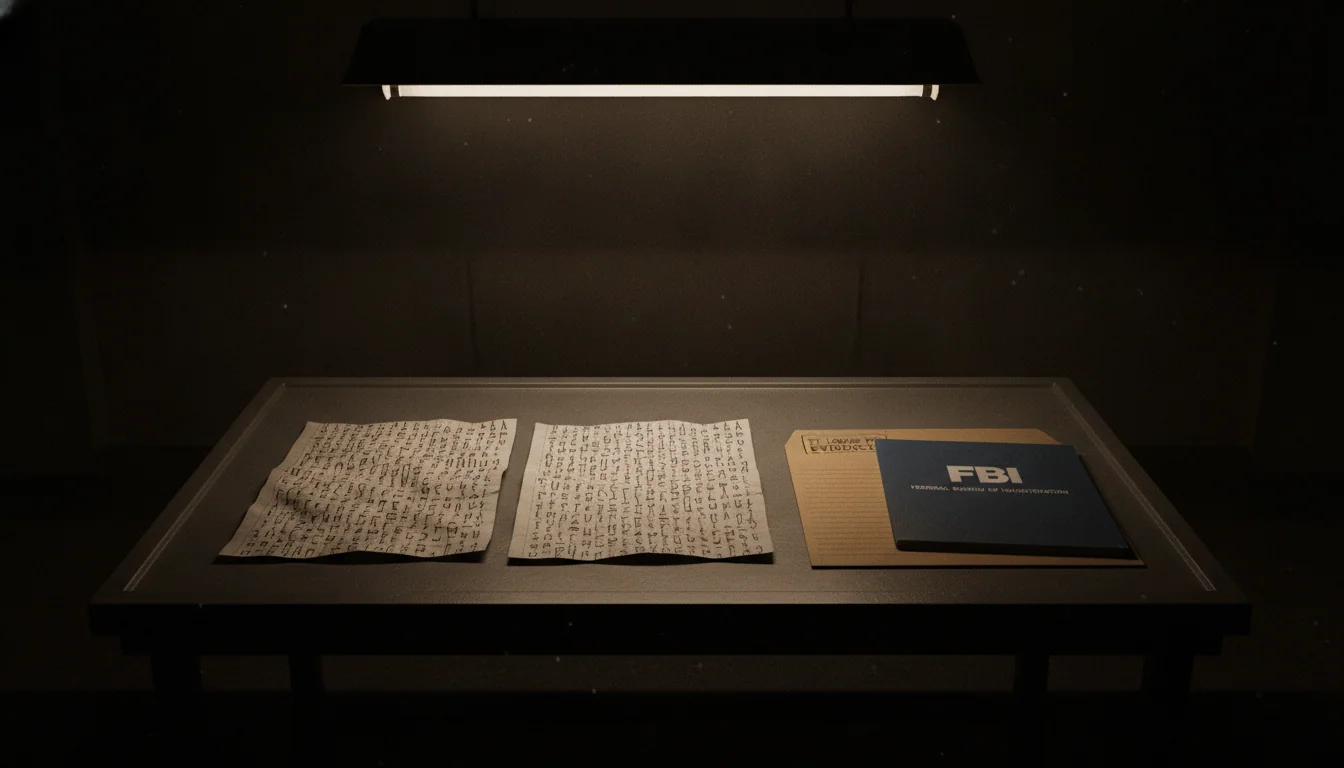
The two pages are dense. They are covered, front and back on at least one sheet, with a mixture of handwritten capital letters, lowercase letters, numerals, parentheses, plus signs, dashes, and geometric marks. The writing runs in lines but does not spell words in any recognizable language. It does not resemble a foreign script. It looks unmistakably like code.
McCormick's relatives, when interviewed, confirmed what the appearance of the notes suggested: McCormick had been writing in a private cipher since at least his teenage years. He used it for personal notes and possibly for correspondence. As far as anyone knew, he had never shared the key with another person. His family recognized the handwriting immediately. They could not read a word of it.
This detail changes the character of the mystery. The notes are not a message left for investigators. They are not a dying declaration. They are ordinary documents from a man who wrote in private code habitually, found in his pockets on the day of his death. Whether they relate to his murder or are simply the accumulated shorthand of a man's interior life is itself unknown.
The FBI's analysis
The FBI's Cryptanalysis and Racketeering Records Unit, known as the CRRU, is the bureau's in-house cipher operation. It handles encrypted criminal correspondence, coded ransom notes, and documents recovered from crime scenes that resist normal reading. The unit received the McCormick pages and began analysis.
Their conclusion, reached after extensive work and confirmed in their 2011 public statement, was that the notes could not be decoded using standard techniques. Frequency analysis - the standard attack on substitution ciphers, which looks for patterns that match the statistical distribution of letters in the target language - produced results inconsistent with English or with any other major language the team tested. The notes did not behave like a known cipher applied to a known language.
The CRRU's best hypothesis was that McCormick had developed an entirely personal system over decades - part substitution, part abbreviation, part phonetic shorthand, possibly with elements that varied between sections or between the two pages. Such a system, invented by one person and never formalized, has no defined key space. Standard cryptanalytic attacks require some assumption about the underlying structure. With a purely personal cipher, that assumption is unavailable from the outside.
The US Army's cryptanalytic specialists were also consulted. Their analysis reached similar conclusions. The notes are readable to exactly one person, and that person died in a cornfield in 1999.
Going public
For more than a decade, the McCormick notes were an internal FBI problem. In March 2011, the bureau made an unusual decision: it published photographs of the notes on its public website and formally asked for help.
The appeal was directed at anyone with relevant skills - professional cryptographers, amateur cipher enthusiasts, linguists, anyone who might recognize elements of the notation. The FBI noted that the notes were the only piece of physical evidence in the McCormick case that might, if decoded, illuminate what had happened to him. Every other investigative thread had either been exhausted or produced nothing useful.
The response was substantial. The American Cryptogram Association, founded in 1929 and representing some of the most experienced amateur code-breakers in the world, formally took up the challenge. Independent submissions arrived from cryptographers, academics, and civilians in multiple countries. None produced a result that decoded a consistent portion of the text or could be extended to explain other portions.
Several common difficulties emerged. Analysts who assumed English as the underlying language ran into frequency distributions that did not fit. Theorists who proposed the notes might contain segments written in reverse order found the suggestion unverifiable against the full text. One proposal suggested the numeral sequences encode dates or places rather than sounds. Another proposed that certain symbols function as phonetic units rather than alphabetic substitutes. Each was plausible as a partial explanation and none survived testing as a complete one.
What the notes might contain
Without a decode, the possible interpretations are wide open.
The most prosaic reading is that the notes are personal records - appointments, debts, names, transactions - in the private shorthand McCormick had always used. A man who codes his writing habitually will carry coded notes that have nothing to do with his death. If this is true, the notes are a biographical artifact with no connection to the crime, and the cipher leads nowhere.
A second theory holds that the notes are connected to whatever killed him. McCormick's presence in St. Charles County is unexplained. A man with heart problems and no car does not end up in a rural field by accident. If he had been meeting someone - if there was a transaction, a debt, a conflict that ended badly - and if he coded that information as a matter of habit, the notes might contain the names or the record of what passed between them. This interpretation is supported only by the suspicious circumstances of his death. It cannot be confirmed without the decode.
A third possibility, structurally unfalsifiable and therefore in some ways the most unsettling, is that someone else could read the code. McCormick might have taught his system to at least one other person. If that person received the notes' information, or knew what they said, they have not come forward in more than two decades. If they are also dead, the knowledge ends there.
The permanent problem
The McCormick cipher represents a specific category of unsolvable problem. Machine ciphers - commercial encryption, the Enigma, coded military traffic - are hard because the key space is mathematically large. Given sufficient computing power and ciphertext, they yield. A professional cipher designed by trained cryptographers is a different challenge but still a systematic one: it has defined structure.
A personal system invented over decades by one person is something else entirely. It is not professionally sophisticated. It is biographically opaque. The complexity comes not from mathematics but from the idiosyncrasy of a single mind, developing private shortcuts over thirty years, never writing down the rules because there were no rules - only habits. There is no computational method that recovers that.
The FBI has acknowledged, in its public materials on the case, that the notes may never be decoded. Without additional examples of McCormick's coded writing, without a key or a partially decoded sample to work from, standard cryptanalysis has no purchase on the problem.
The case today
McCormick's death was classified as a homicide and has never been officially closed. No suspect has been named. The investigation in St. Charles County is formally inactive. The notes, photographed and published in 2011, remain available on the FBI's cold case website.
Every few years the case attracts renewed attention: a true-crime podcast, a documentary segment, a new round of amateur cryptanalysts who locate the notes through the FBI's public files. The cycle of interest and failure repeats. The notes do not yield.
Two folded pages of personal shorthand, found in the pockets of a dead man in a cornfield, remain the last communication of Ricky McCormick. Whether they explain anything about who killed him or why, or whether they are simply the ordinary notes of a man who kept his thoughts coded since adolescence, is the question that defines this case. And it is a question that may never be answered.
This is a cold case defined not by the absence of a body or the absence of a crime, but by the presence of a document nobody can read. For other cases built on undecipherable documents, the Voynich manuscript offers a parallel from the medieval world, while the Beale ciphers show how a code without a confirmed key defeats even organized professional attempts at solution.
Quick Answers
Common questions about this topic
Who was Ricky McCormick?
Ricky McCormick was a 41-year-old unemployed man from St. Louis, Missouri. His body was found in a rural cornfield in St. Charles County on June 30, 1999, several days after his death. His case was classified as a homicide, but no suspect was ever named or charged.
What were the coded notes found with Ricky McCormick?
Two folded pieces of paper covered in handwritten letters, numbers, parentheses, dashes, plus signs, and geometric symbols. The writing appears to be a personal cipher system McCormick had used since his teenage years. Neither the FBI's Cryptanalysis and Racketeering Records Unit nor the American Cryptogram Association has decoded them.
Did the FBI ask the public for help decoding the notes?
Yes. In March 2011, the FBI's CRRU published the notes on the FBI website and formally requested help from amateur cryptographers and the general public. The American Cryptogram Association took the challenge formally. No verified solution has been submitted in the years since.
Why are the notes so hard to crack?
Standard cryptanalysis works when you know the cipher system or have enough text to detect statistical patterns from a known language. McCormick's notes appear to use a personal idiosyncratic system developed over decades, not a standard cipher. Without a key or a sample of decoded text, there is no known attack method.

Want to Interrogate the Suspects?
Chat with historical figures and uncover the truth behind history's greatest mysteries.
Start Your InvestigationJoin the HistorIQly Club
Get smarter about the past.
Weekly stories, deep dives, and exclusive content straight to your inbox.