Young Washington vs. History: How Real Is the Founding Father Drama?
Young Washington history: the Jumonville affair, Fort Necessity, and Braddock's defeat - the formative years that shaped the man who led the Revolution. Score: 7.5/10.
Read Wikipedia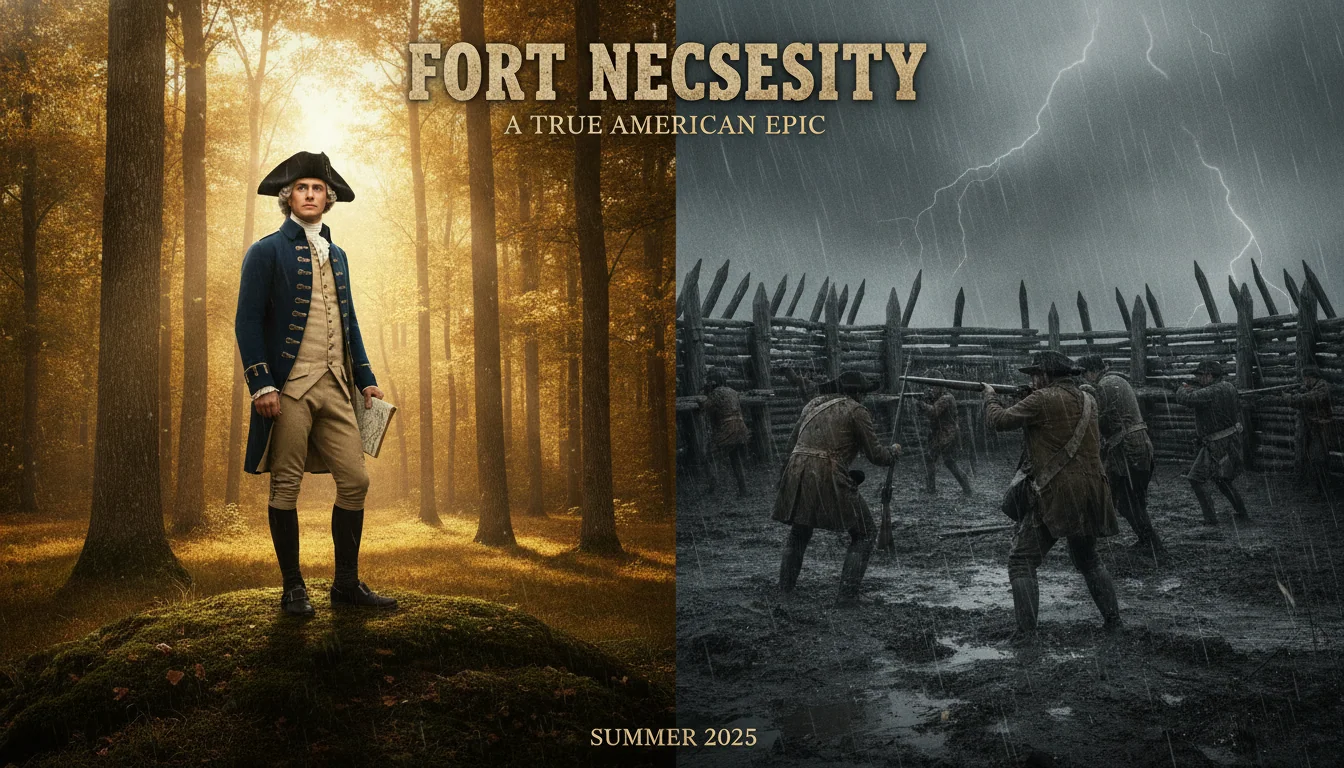
George Washington before the Revolution is not the figure on the dollar bill. He is a 21-year-old Virginia planter's son with a commission that doesn't outrank a British regular's officer, a burning ambition to prove himself to an empire that regards his militia regiment as slightly embarrassing, and a propensity for getting into serious diplomatic trouble. The dramatizations of this period tend to skip past it in favor of Valley Forge and Yorktown. That is a mistake. The early Washington is the more interesting one.
What the film has to work with
Washington was born in 1732 into a comfortable but not grand Virginia family. His father died when George was 11, which ended the prospect of an English education. The dominant figure in his early life became his older half-brother Lawrence, who had served with the British Navy and who ran the family's main estate - later renamed Mount Vernon - with a confident, military bearing George observed closely.
The Fairfax connection shaped everything. Lord Thomas Fairfax, the only English peer living in colonial Virginia, owned an enormous tract of land in the Shenandoah Valley and needed it surveyed. Washington, through Lawrence's friendship with the Fairfax family, got the work. At 16 he was crossing the Blue Ridge into territory that most Virginians had never seen, camping in the rain, crossing swollen rivers, and dealing with Indigenous traders. He was extremely good at it. By 17 he held an official surveying appointment for Culpeper County.
The frontier surveying trips are usually given short shrift in dramatizations. They shouldn't be. They made Washington physically capable, geographically knowledgeable about the exact terrain where he would later fight, and personally acquainted with a western Virginia that most Virginia gentry never encountered. He was comfortable with discomfort before he ever wore a uniform.
What Hollywood Gets RIGHT
The Jumonville affair is as explosive as it looks
In 1753, Virginia's governor Robert Dinwiddie sent Washington - now a provincial major - on a mission to the Ohio Country to warn the French they were encroaching on British-claimed territory. Washington traveled nearly 900 miles in winter, met the French commander at Fort Le Boeuf, delivered the ultimatum, received a polite refusal, and returned. He was 21.
The following year he went back with a small force to begin constructing a fort at the Forks of the Ohio (modern Pittsburgh). The French beat him there and took the site. On May 28, 1754, Washington's party and a group of Mingo warriors led by a chief known as Tanacharison surrounded a French camp in a wooded hollow near present-day Uniontown, Pennsylvania. In about fifteen minutes of fighting, ten Frenchmen were killed and twenty-one captured. The French commander, Joseph Coulon de Villiers de Jumonville, was among the dead.
The French position was that Jumonville had been a diplomatic envoy carrying a formal summons to British forces to leave the area - not a combat unit - and that his killing was an assassination. Washington maintained he was a legitimate military target. Tanacharison, who personally killed Jumonville during or after the battle, left no written record of his reasoning.
Voltaire wrote that a cannon shot fired in America set Europe ablaze. He was only slightly exaggerating. The Seven Years' War, which killed somewhere between 900,000 and 1.4 million soldiers and reshaped the colonial world, traces its European trigger in part to a skirmish in a Pennsylvania forest involving a 22-year-old who had been in command for weeks.
Fort Necessity and the signature that followed him
Washington's subsequent defeat at Fort Necessity on July 3, 1754 is one of the more uncomfortable episodes in the American founding mythology, which is why it is often handled quickly. He had built a small circular stockade in a wet meadow - a tactically terrible position - and held it against a French force roughly twice his size for a day of miserable fighting in the rain. When the French offered terms, Washington signed.
The articles of capitulation, written in French, described what had happened to Jumonville with the word "assassinat." Washington's Dutch interpreter apparently rendered this as "death" rather than "assassination." Washington signed. The French published the document in Paris and London as evidence that the colonial officer had admitted to murder.
Washington spent years insisting the translation was wrong. The incident is accurately dramatic without any embellishment. A dramatization that shows the signing scene straight is doing its job.
Braddock's march and what it taught him
General Edward Braddock arrived from Britain in 1755 with two regiments of regular infantry and a plan to take Fort Duquesne, the French stronghold at the Forks of the Ohio. Washington volunteered to join as an aide-de-camp, eager for exposure to professional soldiering.
On July 9, 1755, the British column crossed the Monongahela and was ambushed by a French and Indian force that used the forest terrain in exactly the way European linear tactics were not designed to counter. Within two hours, roughly half the British column was killed or wounded. Braddock was shot and died four days later. Washington, sick with fever and riding on a cushion, had two horses shot from under him and found four bullet holes in his coat when the retreat ended. He organized the withdrawal.
What Washington learned from Braddock's defeat informed his entire subsequent approach to conventional European battlefield doctrine: that the colonial American terrain demanded different tactics, and that British regular officers who hadn't fought in it would consistently underestimate that fact. He spent the next two decades being proven right.
What Hollywood Gets WRONG
He desperately wanted to be British
The most persistent misrepresentation of young Washington is to retroject his later American identity onto the young man. The pre-Revolutionary Washington was not chafing against British rule or nursing grievances on behalf of the colonies. He was chafing because the British Army would not give his Virginia Regiment commission the same rank as a regular officer's, which meant that any British captain could supersede him by virtue of holding a king's commission.
He wrote letter after letter to London trying to get a proper royal commission. He was denied every time. The British policy was to subordinate colonial officers to regulars as a matter of principle. Washington found this outrageous, not because he was a proto-revolutionary, but because he believed he had earned equal standing on merit and was being denied it by bureaucratic snobbery.
The transformation from ambitious British officer to American rebel took another decade after Braddock's defeat. Films that show the young Washington already oriented toward American independence are collapsing the timeline in a way that makes him easier to understand and less historically accurate.
The Sally Fairfax situation is more ambiguous than films suggest
Sally Fairfax - the wife of Washington's close friend and Fairfax cousin George William Fairfax - appears in dramatizations as either a romance Washington definitively acted on or one he definitively didn't. The historical record supports neither position with confidence.
What survives is a letter from September 1758, written by Washington to Sally while he was about to marry Martha Custis. The letter's language has been parsed by historians for decades. Washington wrote of feelings that surpassed "anything this world has to offer" and acknowledged being drawn into "an honest confession" of something he describes as a "simple fact." He then asked her not to misconstrue his meaning - which is exactly what someone means to say when they want the reader to construe precisely that meaning.
He also wrote to her in 1798, nearly forty years later, calling her the one who had made his happiness the primary ambition of his life.
Whether anything physical occurred between them is unknowable. What the letters show is emotional investment that Washington clearly could not or would not extinguish. Films that resolve the ambiguity one way or another are taking a position the evidence doesn't support.
He was pockmarked, not polished
Washington's appearance in popular culture runs toward the monumental: the wide jaw, the authoritative gaze, the general's bearing. The young Washington was all of that and also covered in pockmarks from smallpox he contracted in Barbados in 1751-52. He traveled to Barbados with Lawrence, who was ill with tuberculosis and hoped the climate would help. It didn't. George contracted smallpox, survived, and was immune for the rest of his life - which, given the smallpox epidemic that devastated the Continental Army in the 1770s, was among the most consequential immune systems in American history.
Most dramatizations leave out the pockmarks. It is understandable and wrong.
Historical Accuracy Assessment: 7.5/10
The pre-Revolutionary Washington is a rich subject that most dramatizations either rush past or romanticize into a clean origin story for the Revolution. The Jumonville affair, Fort Necessity, Braddock's catastrophe, and the Sally Fairfax letters are all as cinematic as anything in the more familiar chapters.
What the period most demands: A Washington who is British, ambitious, occasionally reckless, and genuinely capable - not yet the measured figure of the later years, but the man who had to fail badly, and more than once, before he became someone worth following.
Where dramatizations most often slip: Collapsing the long road from ambitious British officer to American revolutionary into a single moral awakening, and smoothing over the Jumonville affair's genuine moral complexity with the certainty of hindsight.
For more on Washington's later career, our fact-checks of the Revolutionary period cover the events most Americans recognize. The early chapters deserve at least as much attention.
For a fact-check of a later founding-era dramatization, see Lincoln vs. History. For a Hollywood treatment of the Revolutionary War itself, see The Patriot vs. History.
Quick Answers
Common questions about this topic
Did George Washington really start the French and Indian War?
Many historians argue that Washington's ambush of the French party at Jumonville Glen in May 1754 was the incident that ignited the conflict that became the Seven Years' War globally. French historian Voltaire wrote that 'a cannon shot fired in America gave the signal for a war that set Europe ablaze.' Washington was 22 years old and had been in command for weeks.
What happened at Fort Necessity?
On July 3, 1754, Washington surrendered Fort Necessity to a larger French force after a disastrous day-long battle in a rainy meadow near modern Farmington, Pennsylvania. The surrender document he signed contained the French word 'assassinat' to describe Jumonville's death. Washington later claimed he did not know the translation. It followed him for decades.
Was Washington really in love with Sally Fairfax?
His letters suggest it. In September 1758, while engaged to Martha Custis, Washington wrote to Sally Fairfax - his friend George William Fairfax's wife - in unmistakable terms about his feelings. The letter was not discovered until 1877. Whether the relationship went beyond correspondence is unknown and probably unknowable, but the emotional record is unambiguous.
How did Washington survive Braddock's defeat?
On July 9, 1755, a French and Indian ambush destroyed British General Braddock's column near the Monongahela River. Washington had two horses shot from under him and found bullet holes in his coat afterward. He was suffering from a severe fever that day and rode into the battle sitting on a cushion. He credited divine providence. Most historians credit luck.

Debate the Accuracy with the Real Figures
Ask the real people what Hollywood got wrong about their lives.
Create your free account →No card required. Talk to anyone in history with 8 free credits a day. Some features require a paid plan.
Join the HistorIQly Club
Get smarter about the past.
Weekly stories, deep dives, and exclusive content straight to your inbox.