Scott vs. Amundsen: The Race to the South Pole
In the Scott vs. Amundsen race to the South Pole, Amundsen's Norwegians won and came home in 1911. Scott's British party arrived a month late and never returned.
Read Wikipedia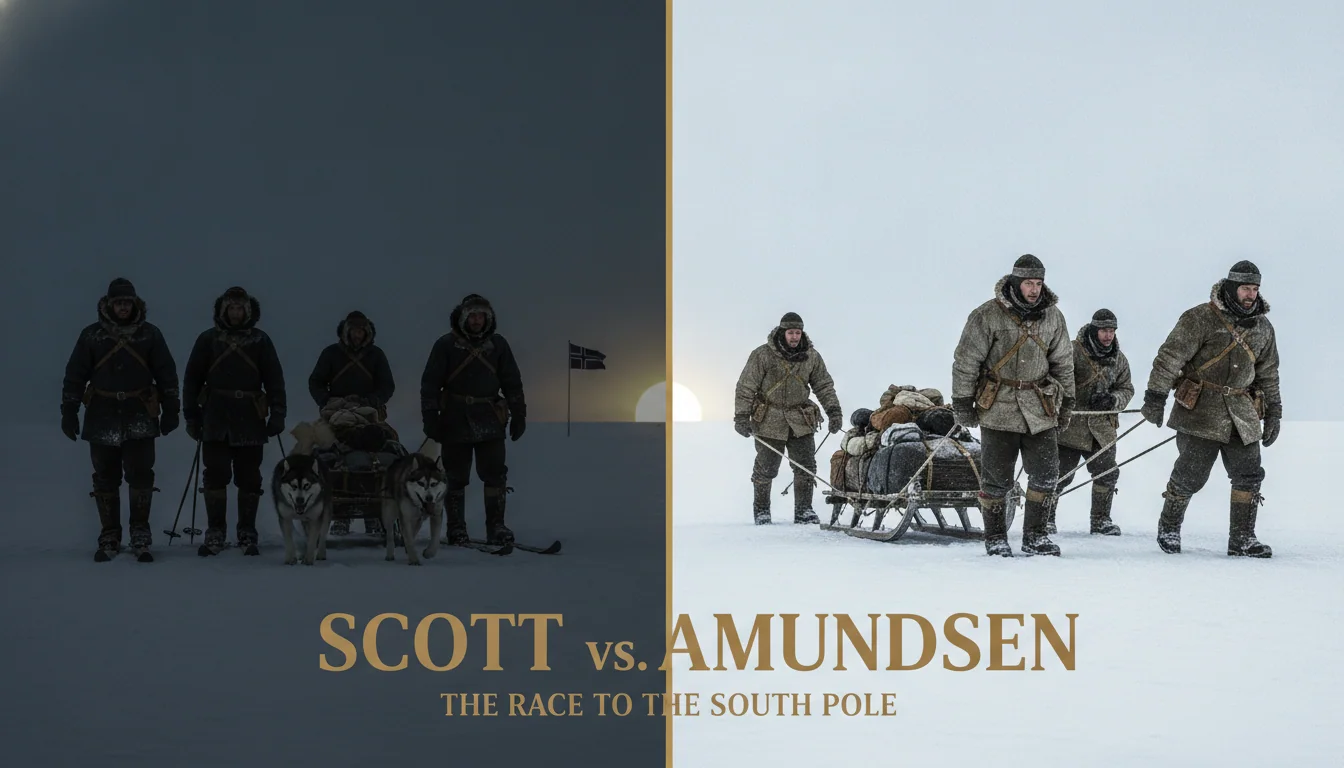
In the Antarctic summer of 1911, two teams of men set out for the same empty, featureless point on the map, a place with no strategic value, no resources, and no permanent inhabitants. They went anyway, because it was the last purely geographic prize left on Earth, and because national pride had quietly attached itself to a stretch of ice that had never seen a human footprint. One team came home to parades. The other did not come home at all.
The Scott vs. Amundsen race to the South Pole is one of history's most retold survival tragedies precisely because it refuses to resolve into a simple story. It is not just a tale of who got there first. It is a study in two completely different philosophies of exploration, one of them ruthlessly efficient and the other steeped in a kind of nobility that looked, in hindsight, a great deal like poor planning.
The Stakes
By 1911, both poles had become the last available trophies of the age of exploration. Robert Peary's disputed claim to the North Pole in 1909 had already soured that prize, so the South Pole became the remaining prestige objective, a chance for a nation to claim a genuine geographic first with no room for dispute. For Britain, still the world's dominant naval and imperial power, reaching the Pole was framed as a matter of national character, continuing a tradition of polar exploration that ran back through the Royal Navy's Arctic expeditions. For Norway, a small country that had only become fully independent from Sweden in 1905, a polar triumph offered something different: proof that a young nation could out-navigate the empires.
Neither side treated it as a small thing. Both expeditions were funded through a mix of government backing, private donors, and public subscription, and both left with the understanding that failure would be a national embarrassment.
Scott's Case
Robert Falcon Scott was a career Royal Navy officer who had already led one Antarctic expedition, the Discovery expedition of the early 1900s, which pushed further south than anyone before him and returned him home to genuine acclaim. By his own account and that of his supporters, Scott approached the 1910 Terra Nova expedition as a serious scientific enterprise as much as a race. His party carried out geological surveys, collected meteorological data, and gathered specimens, including a grueling side expedition to retrieve emperor penguin eggs in the depths of the Antarctic winter for embryological research.
Scott's supporters have long argued that his methods were not reckless but conventional for the era, and defensible on their own terms. Motor sledges, Siberian ponies, and dog teams were all tested and used in combination, with man-hauling as a fallback rather than the sole strategy from the outset. Scott had also publicly stated, before departure, that he did not intend the expedition to be primarily a race, and his journals suggest a man genuinely more invested in the scientific program than in beating a rival to a point on a map.
When Scott's polar party did learn, partway through their outward journey, that Amundsen was also in the field and headed for the same target, the psychological blow was real. By his own account in his journals, Scott took the news of a competing expedition badly, aware that all the planning in the world could now be undone by another team's head start and a different route.
Amundsen's Case
Roald Amundsen had already made his name in polar exploration by leading the first expedition to navigate the Northwest Passage in the early 1900s, and he had originally planned an assault on the North Pole. When news broke that Peary had reached it first, Amundsen quietly redirected his ambitions south, a decision he did not announce publicly until his ship was already at sea, a maneuver that some in Britain considered close to deceptive.
By Amundsen's own account and that of the men who sailed with him, the shift was less about gamesmanship than pragmatism. The North Pole no longer offered a first, so the South Pole was the only prize left worth the enormous cost of a polar expedition, and Amundsen believed that speed and secrecy were legitimate tools of competition, not violations of sporting conduct.
What set Amundsen apart was his method. He built his entire approach around what worked for people who actually lived in the Arctic. He used dog sledges almost exclusively, skied competently across the ice himself, dressed his men in animal-skin clothing modeled on Inuit design rather than heavier wool and cotton layers, and established his base, Framheim, on the Ross Ice Shelf at a point roughly sixty miles closer to the Pole than Scott's base at Cape Evans. Amundsen's supporters point out that none of this was luck. It reflected years of study, discipline, and a willingness to learn from indigenous Arctic expertise that many of his European contemporaries dismissed as unscientific.
The Clashes
The two expeditions actually crossed paths once, and briefly, in early 1911. Amundsen's ship, the Fram, anchored in the Bay of Whales not far from where Scott's men were preparing their own base, and the two camps exchanged courteous visits over several days. There was no confrontation. By multiple accounts, the mood was almost cordially formal, two groups of men aware they were rivals for the same prize, choosing correct manners over open hostility. Scott himself was not present at the Bay of Whales for this encounter, having remained occupied with his own expedition's preparations elsewhere.
The real contest played out separately, hundreds of miles apart, over the following months. Amundsen's team, five men and four sledges pulled by dog teams, departed their base in October 1911 and made rapid progress across the ice shelf and up a previously unmapped glacier route through the Transantarctic Mountains, reaching the Pole on December 14, 1911. They planted the Norwegian flag, took navigational readings to confirm their position, and began the return journey days later, arriving back at Framheim in good health with all five men still alive and their dog teams largely intact, some dogs having been deliberately used as food for the others along the way, a brutal but calculated element of Amundsen's supply strategy.
Scott's party set out later and followed a longer route up the Beardmore Glacier, a route already partly explored during the earlier Discovery expedition. Scott had also made the fateful decision to bring a five-man polar party to the final push rather than the four he had originally planned and provisioned for, stretching food and fuel calculations that had been based on smaller numbers. His party reached the Pole on January 17, 1912, more than a month after Amundsen, and found the Norwegian tent, flag, and a letter Amundsen had left for Scott to carry back as proof of the Norwegian achievement, in case Amundsen himself did not survive to report it.
The return journey became the tragedy that defines the story. Man-hauling their own sledges rather than relying on dogs, weakened by malnutrition and cumulative frostbite, and hit by a stretch of unusually low temperatures that slowed their progress far below their planning margins, Scott's party died one by one over the following weeks. Edgar Evans collapsed and died first. Lawrence Oates, suffering from severe frostbite and believing he was endangering the others, reportedly walked out of the tent into a blizzard with the words "I am just going outside and may be some time," a moment that has become one of the most quoted lines in the history of exploration. Scott, Henry Bowers, and Edward Wilson died in their tent in late March 1912, roughly eleven miles short of a supply depot that might have saved them. Their bodies, along with Scott's journals, were found by a search party the following spring.
The Verdict
By the plain measure of the race itself, Amundsen won decisively. He reached the Pole first, by more than a month, and brought every one of his men home alive and largely healthy, a testament to a strategy built on discipline, indigenous knowledge, and a route chosen for speed rather than scientific value. Judged purely as a logistics and planning exercise, the Norwegian expedition is close to a model case study in how to do polar travel right.
But the cost of winning fell almost entirely on Scott's side, and history has, somewhat perversely, been generous to the loser. Scott's death, and the composed, literary journals he kept until nearly his final hours, transformed a planning failure into a national legend of stoic sacrifice, celebrated in Britain for generations as an example of character triumphing even in defeat. Amundsen, despite the greater achievement, never received quite the same mythic treatment, and he died in 1928 during a rescue mission in the Arctic, his own body never recovered.
The honest accounting is this: Amundsen won the race, and won it well, through superior method rather than luck. Scott lost the race and paid for it with his life and the lives of four companions, in part because of decisions (the five-man party, the reliance on man-hauling, the tight depot margins) that a more ruthless competitor would not have made. Winning cost Amundsen relatively little. Losing cost Scott everything, and it is the manner of that loss, not the loss itself, that has kept his name equally famous more than a century later.
It's a pattern echoed elsewhere in history's great rivalries: the Tesla vs. Edison War of the Currents and the Michelangelo vs. Leonardo da Vinci rivalry in Renaissance Florence both ended in similar split verdicts, where being right and being remembered turned out to be two different prizes.
Quick Answers
Common questions about this topic
Who won the race to the South Pole?
Roald Amundsen's Norwegian party reached the South Pole first, on December 14, 1911. Robert Falcon Scott's British party arrived roughly a month later, on January 17, 1912, and found the Norwegian flag and a tent already waiting for them.
Why did Scott's team die on the return journey?
Scott's five-man polar party died from a combination of exhaustion, malnutrition, frostbite, and an unusually severe cold snap that slowed their march, compounded by depot placement decisions and the physical toll of man-hauling their own sledges rather than using dogs.
Did Scott and Amundsen ever meet?
The two men never met in Antarctica or, as far as the record shows, anywhere else. Amundsen's ship, the Fram, briefly anchored near Scott's expedition in the Bay of Whales in early 1911, and the two camps exchanged polite visits, but Scott himself was not present for the encounter.
What did Amundsen do differently from Scott?
Amundsen relied on dog sledges, skis, a shorter route from a base closer to the Pole, and lighter, simpler food and clothing modeled on Inuit practice. Scott used a mix of motor sledges, Siberian ponies, dogs, and man-hauling, and his party ultimately pulled their own sledges for most of the journey.

Hear Both Sides
Chat with history's fiercest rivals and decide who was right.
Create your free account →No card required. Some figures and features require a paid plan.
Join the HistorIQly Club
Get smarter about the past.
Weekly stories, deep dives, and exclusive content straight to your inbox.