The Six Triple Eight vs. History: How Accurate Is Tyler Perry's WWII Drama?
Six Triple Eight accuracy: Tyler Perry's Netflix film on the all-Black WWII postal unit fact-checked. What it gets right and where Hollywood takes liberties.
Read Wikipedia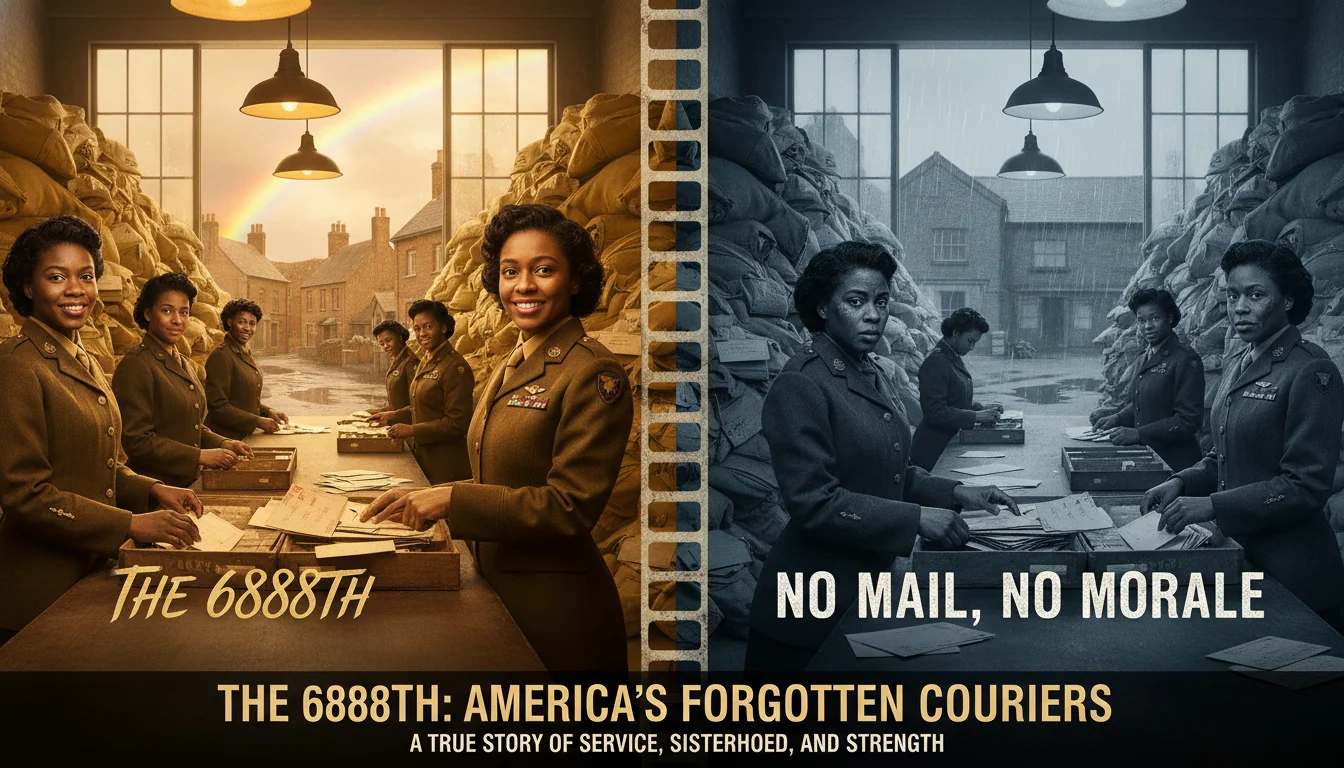
The mail had been piling up since before D-Day. Warehouses in Birmingham, England held an estimated 17 million pieces of undelivered correspondence - letters from mothers, packages from wives, birthday cards from children - addressed to American soldiers and intended for the front. The Army had no adequate plan to sort and forward it. Mail officers had tried and failed. By late 1944, some men at the front had not received a letter in months. For units that had been in Europe since 1942, some packages had been sitting in crates for years.
The Army's solution was the 6888th Central Postal Directory Battalion - approximately 855 Black women of the Women's Army Corps, commanded by Major Charity Adams, sent to Birmingham in February 1945 to fix what nobody else had managed to fix.
Tyler Perry's 2024 Netflix film tells that story with genuine admiration for its subjects and a fair amount of Hollywood scaffolding. The question, as always, is how much of the scaffolding was necessary.
The film, released on Netflix in December 2024, draws partly on Adams' own 1989 memoir, "One Woman's Army," and on the unit's own records. It was a story that had been almost entirely absent from popular culture - despite the 6888th processing millions of pieces of mail that reached servicemen fighting at Bastogne, in the Hurtgen Forest, and along the Rhine, the women themselves had received no formal recognition for seven decades. The Congressional Gold Medal for the unit did not pass until 2022.
Historical accuracy score: 7/10
What Hollywood got RIGHT
The mission was real and the scale was staggering
The film's central premise is accurate in every significant detail. The 6888th was the only all-Black, all-female WAC unit sent overseas in World War II. They arrived in Birmingham in February 1945 and inherited a mail crisis that had been allowed to fester for years. The warehouses depicted - cold, poorly lit, damaged by wartime bombing, filled with rats and mountains of unsorted mail - match historical accounts from the women themselves.
The unit's sorting methodology is also faithfully represented. Because many senders misspelled the names of servicemen, the 6888th developed a system of phonetic groupings, sorting Smith alongside Smyth and Smithe, Brown alongside Braun, to catch the inevitable errors of wartime correspondence written in haste. Charity Adams described this system in detail in her memoir, and the film depicts it accurately.
Charity Adams' command was historically exceptional
Kerry Washington's portrayal of Charity Adams reflects a figure whose historical record is genuinely remarkable. Adams was the first Black woman commissioned as an officer in the Women's Army Auxiliary Corps, and by the time of the overseas deployment she was the highest-ranking Black woman in the WAC. She commanded 855 women in a foreign country while navigating discrimination from American military structures that had only reluctantly agreed to send the unit at all.
One of the film's most satisfying confrontations - Adams standing her ground when a general proposes replacing her with a white officer - is rooted in documented accounts. Adams wrote in her memoir that she told the general she was the commanding officer and expected to be treated accordingly. The scene plays slightly more dramatically than Adams' own restrained account, but the substance is real.
The racial double standard was documented and pervasive
The film does not overstate the discrimination the 6888th faced. Black WAC soldiers were segregated from white WAC soldiers, received inferior accommodations, and operated under Army regulations that had been designed without their service in mind. British civilian attitudes varied - some accounts describe warmer treatment from the British public than from the American military command structure - but the institutional racism the film depicts is drawn from the unit's own testimony.
The women also faced the particular absurdity common to segregation-era military service: being asked to fight for a democracy that denied them full citizenship, in uniform, while being formally excluded from the facilities and recognition available to white women doing equivalent work.
The three-shift operation and the timeline
The film's depiction of the unit working around the clock in three rotating shifts is accurate. The 6888th ran continuous operations and cleared the Birmingham backlog in approximately three months, where Army planners had estimated six. They subsequently moved to processing backlogs in Rouen, France, and then Paris, before the end of the war in Europe rendered their postal mission complete.
What Hollywood got WRONG
Key characters are composites or invented outright
Standard Hollywood practice, but worth naming. Several significant characters in the film are composites of multiple real women or entirely fictional constructions. The romantic subplot involving one of the soldiers has no documented historical basis; it exists because 130 minutes of wartime mail sorting needs narrative tension beyond the institutional kind.
Adams herself, while accurately portrayed in the broad strokes of her command, is given a slightly more cinematic arc than her own memoir records. She wrote about the Birmingham assignment with characteristic understatement - focused on logistics, unit discipline, and the challenges of command - rather than the more personal emotional register the film emphasizes.
The unit's French service is underrepresented
The 6888th's work did not end in Birmingham. After clearing that backlog they moved to Rouen and then to Paris, processing mail backlogs in France before the German surrender in May 1945. This subsequent chapter, which involved navigating a different country, a different language, and a different set of conditions, receives minimal screen time. The film treats Birmingham as the complete story when it was actually the first chapter.
Some confrontations are dramatized past the historical record
The film includes several face-offs between Adams or her soldiers and white American officers or civilians that are vivid, dramatically satisfying, and not fully traceable to specific documented incidents. The individual moments may reflect the general atmosphere accurately, but the consolidation of months of accumulated friction into a handful of sharp confrontations is a narrative device, not a historical record.
The framing device is invented
The film wraps its central story in a framing narrative involving letters and a contemporary voice that places the historical events in context. This device is entirely fictional and occasionally slows the momentum of the actual history, which is strong enough to carry the film on its own.
The verdict
The Six Triple Eight is a film about people and events that deserve to be widely known, and it handles its core material with genuine respect. The mission was real, the discrimination was real, the women were exceptional, and the film captures all of that with enough fidelity that it functions as a reasonable introduction to a chapter of American military history that had been almost entirely absent from popular culture for eight decades.
The invented romance, the composite characters, and the dramatized confrontations are a Hollywood tax on a story that did not need embellishment. But unlike many biopics, the Six Triple Eight pays that tax without mortgaging the history itself. The bones of what happened in Birmingham in 1945 are intact.
Major Charity Adams died in 2002, four years after the Congressional Gold Medal was proposed for the 6888th - a recognition that did not actually pass until 2022, twenty years after her death. She would have appreciated the accuracy. She would probably have had notes on the rest.
For other films that centre Black Americans in wartime, see Glory vs history and Selma vs history.
Quick Answers
Common questions about this topic
What was the 6888th Central Postal Directory Battalion?
The 6888th Central Postal Directory Battalion was the only all-Black, all-female unit of the Women's Army Corps (WAC) to serve overseas during World War II. Approximately 855 women, commanded by Major Charity Adams, arrived in Birmingham, England in February 1945 and were tasked with clearing a massive backlog of undelivered military mail - estimated at around 17 million pieces - that had been accumulating since the early years of the war.
How accurate is The Six Triple Eight on Netflix?
The film is broadly faithful to the unit's actual mission and the documented racial discrimination the women faced. The core history - the mail backlog, Charity Adams' command, the three-shift operation, and the unit exceeding its timeline - is real. Some confrontations and plot incidents are dramatized or invented, and a romantic subplot is wholly fictional, but the bones of the story are accurate. A fair score is 7 out of 10.
Who was Major Charity Adams?
Charity Adams (later Charity Adams Earley) was born in 1917 in Kittrell, North Carolina. She was the first Black woman commissioned as an officer in the Women's Army Auxiliary Corps and rose to become the highest-ranking Black woman in the WAC during the war. She commanded the 6888th overseas, returned to civilian life after the war, earned a graduate degree from Ohio State, and later wrote a memoir, One Woman's Army, published in 1989. She died in 2002.
Did the 6888th really clear the mail backlog that fast?
Yes. Military planners estimated the Birmingham backlog would take six months to clear. The unit cleared it in roughly three months by running three eight-hour shifts around the clock, seven days a week, in cold, poorly lit warehouses that had previously been damaged by German bombing. They used a system of sorting mail by sound-alikes and phonetic variations of surnames to handle the many misspellings in addresses accumulated over years of wartime mail.

Debate the Accuracy with the Real Figures
Ask the real people what Hollywood got wrong about their lives.
Create your free account →No card required. Talk to anyone in history with 8 free credits a day. Some features require a paid plan.
Join the HistorIQly Club
Get smarter about the past.
Weekly stories, deep dives, and exclusive content straight to your inbox.