The Testament of Ann Lee vs. History: How Real Is the Shaker Biopic?
A Testament of Ann Lee accuracy review: the 2026 Shaker biopic gets the grief and imprisonments right but softens how absolute her claim to be a female Christ really was.
Read Wikipedia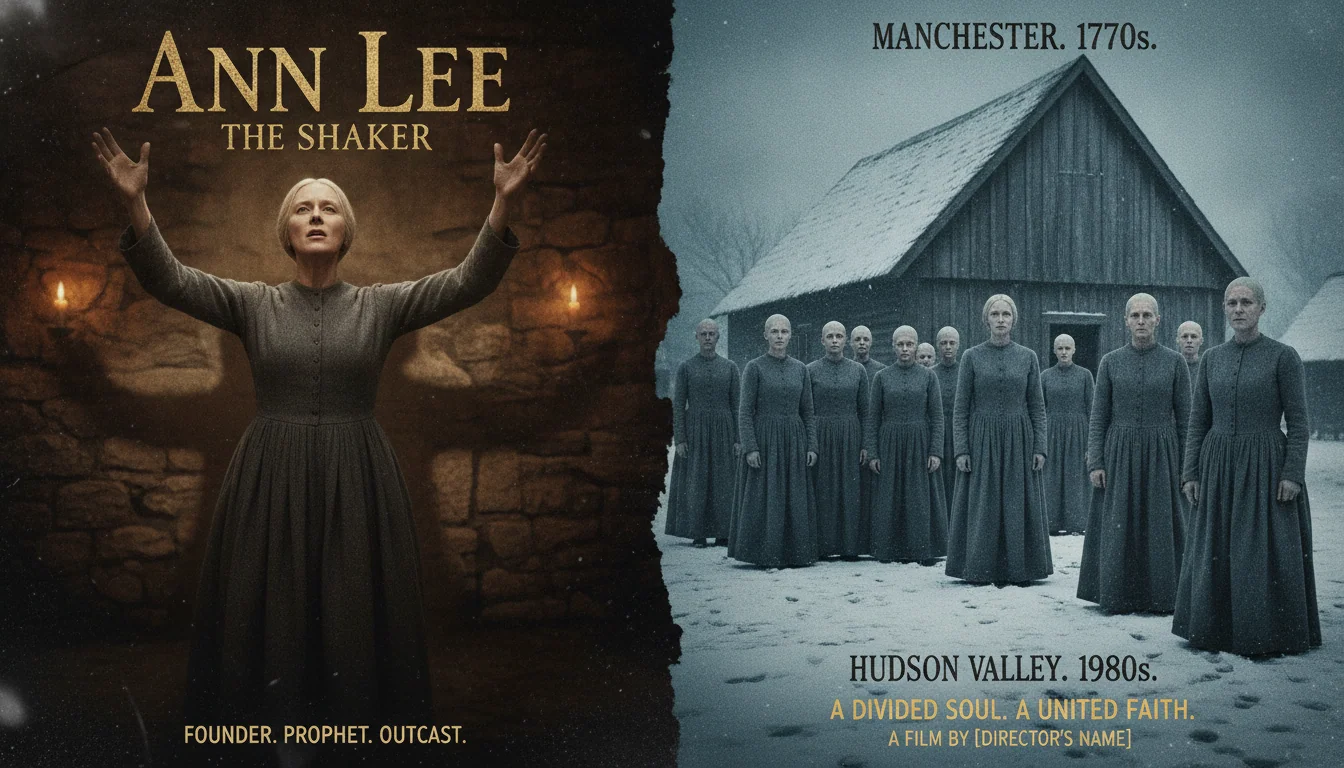
There is something almost impossibly cinematic about Ann Lee's life, and something almost impossible to film faithfully. The woman who founded American Shakerism was a Manchester blacksmith's daughter who had four children die in infancy, concluded that carnal union was the source of all human corruption, got imprisoned multiple times in England for preaching in the streets, crossed the Atlantic on a leaking ship with eight followers, built a celibate communal movement in the Hudson Valley, and died at 48 having been beaten by mobs, interrogated as a British spy during the Revolution, and still claimed by her followers to be the female manifestation of Christ.
A biopic about Ann Lee is necessarily a biopic about faith, coercion, and grief. The question is how much of the actual theology it is willing to show.
What Hollywood Got RIGHT
The Manchester origins
Ann Lee was born in 1736 in the Toad Lane neighborhood of Manchester, one of the most densely populated and impoverished quarters of one of England's most industrializing cities. Her father John Lee was a blacksmith. She received no formal education and could not read. She worked in textile factories and as a cutter of hatters' fur before her early adulthood.
Films about religious figures have a persistent temptation to clean up the working-class origins, to show poverty as a kind of noble simplicity rather than the grinding material grind it actually was. The Edwardian era had similar aesthetic tendencies. If the film commits to the actual texture of mid-18th-century Manchester, the crowding, the noise, the industrial stench, the absolute poverty of a laborer's family, it is capturing something historically accurate that often gets smoothed away.
The children's deaths
Between 1762 and approximately 1766, Ann Lee married Abraham Stanley, a blacksmith like her father, and bore four children. All four died in infancy. The deaths are historically documented and central to her theology. She herself spoke of them as the events that convinced her sexual union was sinful. The grief was real, and its theological translation into absolute celibacy was direct and documented.
Most biographies of Ann Lee treat the infant deaths as the pivotal biographical event. A film that places them at the center of her spiritual transformation is being historically faithful to how Ann Lee described her own conversion.
The English imprisonments
Ann Lee was imprisoned multiple times in England during the 1770s. The charges varied: preaching on the Sabbath, public disorder, blasphemy. The Shaking Quakers, as her group was called before they adopted the Shaker name, attracted hostile attention partly because their worship was genuinely alarming to observers - loud, physical, ecstatic, with shaking, speaking in tongues, and collective movement that bore no resemblance to the contained religiosity of the established church.
The imprisonments are documented, and they were formative. Ann Lee reportedly received a vision during one imprisonment that solidified her belief in celibacy. The historical record supports showing her persecution in England as real and sustained, not as mere backstory.
The emigration and Niskayuna
In May 1774, Ann Lee and eight followers sailed from Liverpool aboard a ship called the Mariah, bound for New York. The voyage, by her account and the accounts of her followers, was terrifying. They arrived in New York in late July and eventually settled at Niskayuna, near Albany, which later became Watervliet.
For the first several years in America the community was largely silent, consolidating its land and organization. Ann Lee did not begin active public preaching in America until around 1780. A film that shows the gradual, difficult process of establishment, not an instant flowering but years of patient obscure work, is being accurate about how the movement actually developed.
What Hollywood Got WRONG (or Likely Softens)
The full messianic claim
Ann Lee did not merely lead a religious community. She claimed, or allowed her followers to believe, that she was the second manifestation of Christ's spirit, the female element of a dual divinity. This was not a metaphor. Early Shaker theology held that Jesus had been the first manifestation of the Christ spirit in male form, and Ann Lee the second in female form.
Biopics about religious founders in the 20th and 21st centuries have a consistent habit of presenting their spiritual claims in the softest possible framing, turning doctrine into intuition, prophecy into self-knowledge, and revealed religion into personal growth. If the film frames Ann Lee primarily as a reformer or a feminist pioneer, it is softening a figure whose actual claim was considerably more absolute. She did not say she had good insights about gender equality. She said the Holy Spirit was in her. These are not the same thing, and the difference is what made her dangerous to established society and compelling to her followers.
The power dynamics within the community
The film's trailer material and early press suggest it focuses substantially on Ann Lee's relationship with individual followers. The early Shaker community was not a democracy. Ann Lee held absolute authority, and the movement she created was organized around total submission to leadership. Followers who questioned her were rebuked or expelled. She traveled with a close inner circle that controlled access to her.
This is not a portrait that diminishes Ann Lee's significance, but it is one that complicates any straightforward reading of her as a simple progressive icon. Communities organized around charismatic authority and total celibacy have a complicated relationship with the freedoms of their members, including the freedom to leave. A film interested in the full picture has to grapple with what that authority actually looked like from the inside.
The Revolutionary War years
Ann Lee's community was suspected of British loyalism during the American Revolutionary War, and with some reason. She was English-born, had English followers, opposed violence in all forms, and refused to take oaths of loyalty to the colonial cause. She was arrested in 1780 and imprisoned for several months in Albany on suspicion of treasonous activity. The charge was eventually dropped.
This is a politically complex episode that has no clean narrative valence. It is neither purely a story of religious persecution nor a story of political guilt. The Shakers genuinely opposed the war on pacifist grounds while being genuinely English in origin. A film that handles this episode well will be doing something narratively difficult. Films that handle it poorly tend to flatten it into a simple oppression story, which misses the geopolitical specificity.
The physical reality of Shaker life
Later Shaker communities became famous for their elegant craftsmanship and clean architecture. The oval boxes, the ladder-back chairs, the spare meeting rooms, have become an aesthetic shorthand for a certain kind of principled austerity. The actual Niskayuna settlement of the 1770s and 1780s was nothing like the polished Shaker aesthetic of the 1820s and 1830s. It was a rough frontier community on unimproved land, doing hard agricultural labor while managing winter conditions that killed animals and collapsed buildings.
Films set in the Shaker tradition have a persistent tendency to aestheticize their visual design, importing the 19th-century refinement into the 18th-century founding. The founding period was materially much harder and visually much plainer, in the sense of being genuinely poor rather than elegantly spare.
Historical Accuracy Score: 7/10
Ann Lee's story is well enough documented that a faithful biopic does not have to invent major events. The arc from Manchester to Niskayuna to her death in 1784 is real, the imprisonments are real, the children's deaths are real, the theological claims are real.
Where such films typically lose accuracy is in softening the messianic extremity of the central figure and in importing later Shaker aesthetics and values back into the founding generation. Ann Lee was not primarily a designer of beautiful furniture and a voice for quiet simplicity. She was a woman who told her followers she carried the spirit of Christ, that sexual union was the origin of sin, and that the way to God required giving up everything that ordinary life in England or America was organized around. That is a genuinely strange and radical project. It is also, faithfully portrayed, a more compelling film.
For the colonial American world Ann Lee entered in 1774, see Visiting Colonial Philadelphia in 1776. For another religious history film accuracy review, see The Passion of the Christ vs. History.
Quick Answers
Common questions about this topic
Who was Ann Lee?
Ann Lee (1736-1784) was an English-born religious leader, born in Manchester to a blacksmith family, who founded what became the United Society of Believers in Christ's Second Appearing - the Shakers. After imprisonment in England for her beliefs, she emigrated to colonial New York in 1774 with eight followers and established the movement that eventually grew to roughly 6,000 members across 19 communities.
Did the Shakers really practice celibacy?
Yes, complete celibacy was a founding requirement of Shaker life. Ann Lee taught that sexual union was the root of human sin, a theology shaped in part by the deaths of her four infant children. Shaker communities were structured around strict gender separation. The movement grew through conversion and the adoption of children, not reproduction.
Was Ann Lee really seen as a female Christ?
Yes. Ann Lee taught that Christ's spirit had manifested in both male and female form - in Jesus and then in herself. Her followers called her 'Mother Ann' and believed her to be the second appearing of Christ promised in scripture. This was the theology's most radical and controversial claim, and it led to her imprisonment and persecution both in England and in colonial America.
What happened to the Shakers?
The movement reached its peak of about 6,000 members in the mid-19th century across 19 communities from Maine to Indiana and Kentucky. Celibacy meant the communities could only grow through conversion, and as religious enthusiasm and charity toward Shaker communities declined in the late 19th and 20th centuries, the membership shrank. As of 2026, the Sabbathday Lake Shaker Village in Maine remains the last active Shaker community, with a small number of members.

Debate the Accuracy with the Real Figures
Ask the real people what Hollywood got wrong about their lives.
Create your free account →No card required. Talk to anyone in history with 8 free credits a day. Some features require a paid plan.
Join the HistorIQly Club
Get smarter about the past.
Weekly stories, deep dives, and exclusive content straight to your inbox.