A Time Traveler's Guide to Confederate Richmond, 1863
Your guide to Confederate Richmond in 1863: Chimborazo Hospital, the April bread riot, wartime scarcity, and the machinery of slavery in the wartime capital.
Read Wikipedia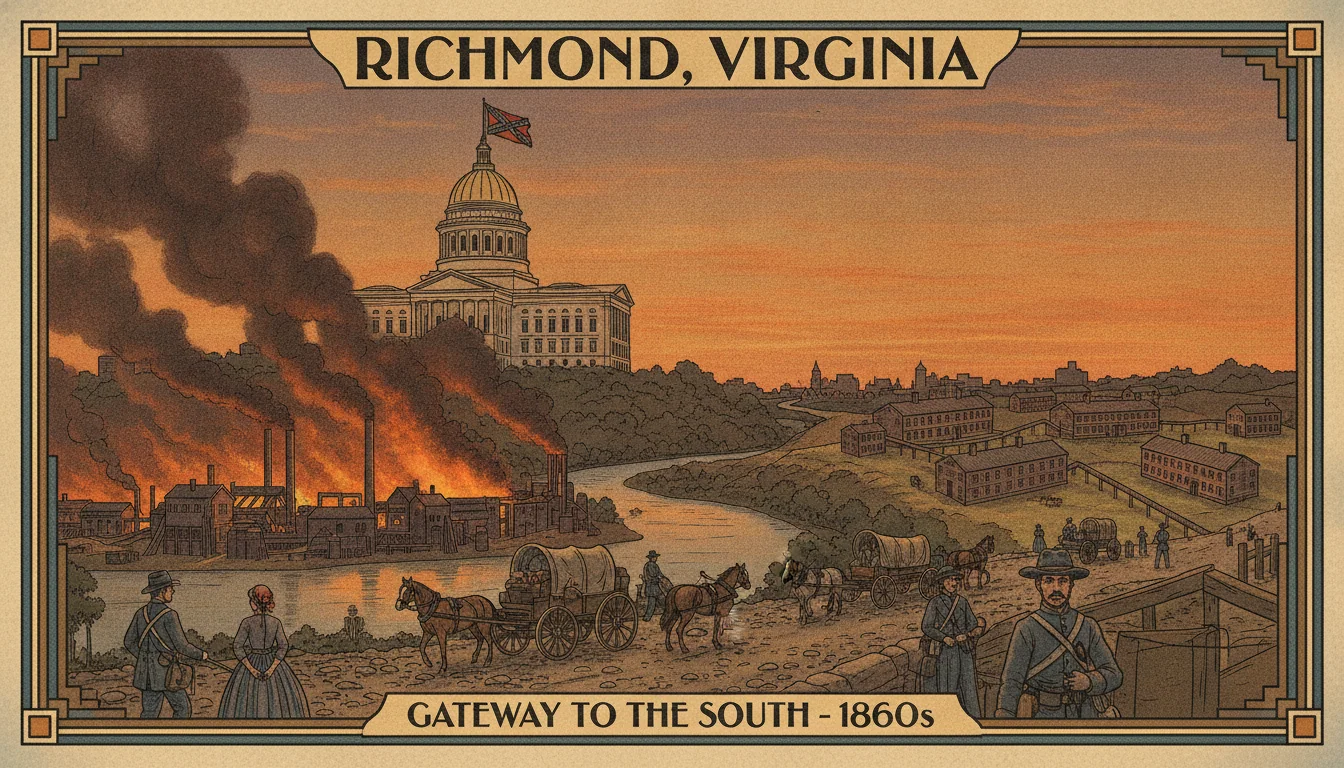
Set your dial for Confederate Richmond in 1863 and you will land in the single most consequential city of the entire war. This is the Confederate capital, the seat of Jefferson Davis's government, the home of Robert E. Lee's supply lines, and a city that will spend this particular year watching its army win at Chancellorsville in May and then march north toward a Pennsylvania town called Gettysburg in June and July. Richmond does not yet know how that campaign ends. Neither should you act like you do.
It is also a city stretched past its limits: overcrowded with refugees and soldiers, running short of bread, and still operating one of the largest slave markets in North America in full view of a war being fought, at least officially, over exactly that institution. This guide will help you move through Confederate Richmond without getting arrested, without starving, and without losing sight of what the city actually was.
What kind of place you are entering
Richmond's prewar population was under 40,000. By 1863 it has swollen to somewhere over 100,000, and some residents believe the real number, counting soldiers, hospital patients, government clerks, and refugees fleeing Union advances, runs even higher. The city sits on the fall line of the James River, its hills crowned by the Virginia State Capitol (designed decades earlier with help from Thomas Jefferson), its waterfront dominated by the furnaces of Tredegar Iron Works, and its eastern edge given over almost entirely to hospitals and army encampments.
This is a government town at war. The Confederate War Department, the Treasury, and the President's household are all here. So is a garrison, a growing prison system for captured Union soldiers, and a railroad network that Lee's army depends on for food and ammunition. Every train, every warehouse, and every able-bodied clerk exists to keep an army in the field roughly a hundred miles away.
Your safest cover story is a foreign observer, ideally British, here on business or as a journalist sympathetic enough to the Confederate cause to be granted a pass. European visitors, particularly the British, are common enough in wartime Richmond that an accent will draw curiosity rather than suspicion. Carry a plausible letter of introduction. You will need a pass from the provost marshal's office to move freely, and checkpoints on the roads out of the city are real and staffed by soldiers who take their job seriously.
Dress, and what scarcity does to fashion
By 1863 the Union naval blockade has been squeezing Southern ports for two years, and it shows in every closet in Richmond. Homespun cloth, woven at home or on small local looms, has replaced imported cotton and wool for most residents. Dyes are inconsistent. Buttons are often carved from bone or wood. Shoes are a genuine luxury; leather is scarce enough that some soldiers and civilians wrap their feet in cloth or improvise sandals.
At the same time, a strange contradiction runs through Richmond high society. Blockade runners slipping past Union warships out of Wilmington and Charleston bring in small, valuable cargoes: silk, lace, hoop skirts, French shoes, coffee, tea, quinine, and other medicines, sold at auction for prices only the wealthy can afford. A pound of tea can run to sixteen dollars in Confederate currency, real coffee is nearly unobtainable at any price, and a plain wool suit that cost a few dollars before the war can cost fifty or more by 1863. Wear practical, plain, dark clothing that could pass as either homespun or a modest prewar garment kept in careful repair. Do not show up looking freshly outfitted from a department store; nothing marks you as an outsider faster than clothing that looks too new.
Money, prices, and the bread riot
Confederate paper currency has been losing value steadily since 1861, and by 1863 inflation is severe enough to reshape daily life. Flour, salt, and meat have all risen to several times their prewar cost, and wages for ordinary clerks and laborers have not kept pace. This is the backdrop for the event you should know about before you arrive.
On April 2, 1863, a crowd of women, many of them soldiers' wives and war refugees, gathered near Capitol Square to demand relief from Governor John Letcher. When no satisfactory answer came, the crowd, which grew into the hundreds and by some accounts into the thousands, marched on the shops of Main Street and began taking food, shoes, and bolts of cloth. Jefferson Davis himself came out to address the crowd, emptied his own pockets of money and threw it toward the women, and finally climbed onto a wagon, pulled out his watch, and gave the crowd five minutes to disperse before troops would be ordered to fire. They dispersed. City officials tried hard to keep the riot out of the newspapers, worried about the effect on army morale, but word leaked out through Union prisoners held in the city and the story ran in Northern papers within a week.
If you time your visit for early April, keep your distance from Capitol Square and Main Street on the second, and do not carry visible valuables. If you arrive later in the year, the shortages that caused the riot have not gone away; they have only become the normal condition of the city.
Three places worth the risk of visiting
Chimborazo Hospital, on a hill east of downtown, is one of the largest military hospitals anywhere in the world at this point in the war, organized into roughly 150 wards across five divisions with capacity to treat several thousand wounded and sick soldiers at once. It has its own bakeries, ice houses, and a herd of cows kept for milk. If you can arrange it through a legitimate introduction, a walk through the hospital grounds, not the wards themselves, will show you the scale of what this war is costing in human terms more clearly than any battlefield.
Tredegar Iron Works, along the James River, is the industrial heart of the Confederacy, producing cannon, armor plate, and rail for an army and navy that cannot function without it. Hundreds of workers, enslaved, free Black, and white, labor here under dangerous, loud, and physically brutal conditions. Do not attempt to enter the works themselves; it is a guarded military production site. Watch it from a respectful distance along the riverbank instead.
Capitol Square, with the Virginia State Capitol at its center and the Confederate White House, the Davis family residence, just a few blocks away, is the political heart of the city. Soldiers, clerks, and civilians pass through constantly. It is also, by 1863, ringed with the informal camps of refugees and near enough to hospitals that ambulance wagons are a common sight.
The system that never stopped running
Richmond's Shockoe Bottom neighborhood was already, before the war, one of the largest centers of the domestic slave trade in the United States, and it did not close down for the war. Auction houses and jails, including one run by a trader named Robert Lumpkin, continued to buy, sell, and imprison enslaved people through 1863, even as the city filled with wounded soldiers and hungry refugees. This is not a sight to seek out for spectacle. If your route takes you near it, understand what you are looking at: an active market in human beings operating in the capital of a nation fighting, by its own founding documents, to preserve that market. There is no way to visit Confederate Richmond honestly without acknowledging this.
What not to do
Do not discuss the outcome of Gettysburg, the eventual fall of Richmond, or anything about the war's ending. The city in 1863 does not know its army will be turned back in Pennsylvania this July, and residents are anxious enough about the war's direction without a stranger hinting at catastrophe. Do not photograph military installations or fortifications; cameras are rare enough to draw immediate suspicion on their own. Do not travel without your pass. Do not express doubt about the Confederate cause in public, and do not express enthusiasm for it either in a way that invites deeper questioning about your background. Avoid Libby Prison and the other prisoner-of-war facilities unless you have a specific, well-documented reason to be near them; guards there are on edge and unsympathetic to lingering visitors.
The moment worth having
If you want one scene that captures 1863 Richmond whole, stand near Capitol Square at dusk and watch the city's contradictions move past each other on the same street: a wounded soldier on crutches being helped toward Chimborazo, a hoop-skirted woman in blockade-run silk stepping around him, a clerk hurrying newspapers to the War Department, and somewhere beyond the rooftops, the glow of the Tredegar furnaces still running through the night. This is a capital that knows the war might be lost and keeps working anyway.
For more on how slavery shaped Southern city life before the guns started, see our guide to antebellum New Orleans in 1850. For a very different American city racing toward the twentieth century in the same decades, try our guide to Gilded Age New York in 1890.
Quick Answers
Common questions about this topic
What caused the Richmond Bread Riot of 1863?
On April 2, 1863, a crowd of mostly poor women, swollen by war refugees and soldiers' wives, marched on Governor John Letcher demanding relief from food shortages and runaway prices, then broke into shops along Main Street and took food, shoes, and cloth. Jefferson Davis personally addressed the crowd, offered them money from his own pockets, and eventually threatened to have troops fire if they did not disperse within five minutes.
How big was Chimborazo Hospital?
Chimborazo, built on a hill east of downtown Richmond, was one of the largest military hospitals in the world at the time, with around 150 wards organized into five divisions and capacity for several thousand patients at once. Over the course of the war it admitted tens of thousands of soldiers.
Was Richmond a center of the slave trade during the Civil War?
Yes. Richmond's Shockoe Bottom district was already one of the largest domestic slave-trading centers in the United States before the war, and the trade continued to operate openly through 1863, even as the city filled with wounded soldiers and hungry civilians.
How dangerous was Richmond in 1863?
Very. The city held thousands of Union prisoners of war in places like Libby Prison, food and fuel were scarce and priced far above prewar levels, fires and explosions were a constant industrial hazard around Tredegar Iron Works, and Confederate provost guards stopped and questioned anyone without a proper pass.

Need Advice from Someone Who Lived There?
Get firsthand accounts from people who actually lived through these moments in history.
Create your free account →No card required. Some figures and features require a paid plan.
Join the HistorIQly Club
Get smarter about the past.
Weekly stories, deep dives, and exclusive content straight to your inbox.