A Time Traveler's Guide to Edwardian London, 1905
Your practical guide to Edwardian London 1905: how to dress, navigate the Underground, avoid coal fogs, and move through a city run on coal, class, and empire.
Read Wikipedia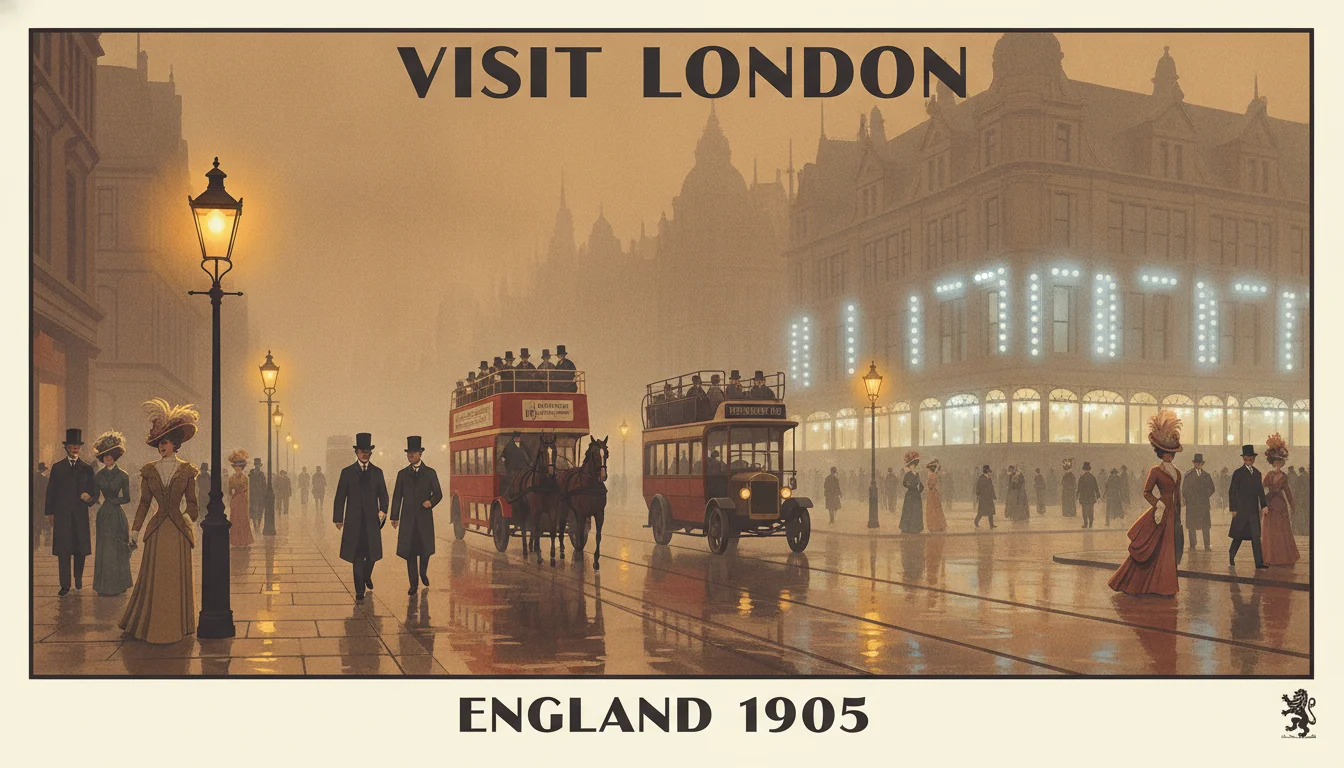
If Edwardian London looks like paradise from a distance, it is partly because you are looking at it from outside the smell. The city in 1905 runs on coal - residential coal, industrial coal, railway coal - and the accumulated smoke of six and a half million people and their factories sits in the Thames valley in layers that give the air a particular weight on winter mornings. Locals call the worst of it a "London Particular," a pea-green fog so dense that gas lamps are lit at noon. It tastes like a fireplace and smells worse.
This is also the most powerful city in the world, the nerve center of an empire covering roughly a quarter of the earth's land surface. The Bank of England is here, and so are the docks that move a third of global trade. The music halls are packed every night. The private clubs of St James's are the actual machinery of foreign policy. Cricket is played at Lord's and The Oval, and the country has not yet fought a major European war in ninety years.
Coming in 1905 is excellent timing. You will miss the war by nine years. The full Edwardian summer is in progress. Here is how to survive it.
First, know which London you're visiting
There are approximately four Londons operating simultaneously in 1905, and they barely speak to each other.
The first is the West End and Mayfair - the London of titled aristocracy, season balls at great houses, private clubs, and the kind of wealth that requires a staff of thirty just to maintain the house. These families summer in Scotland and winter in London. They are currently presiding over the last era in which the old landed class will dominate everything that matters socially.
The second is the professional and commercial middle class - lawyers, accountants, doctors, managers, successful tradespeople - who live in the new suburbs of Hampstead, Clapham, and Ealing and commute by train. They are comfortable, proper, and aspirational.
The third is the working class - factory hands, dockers, costermongers, servants, and the millions who do the actual physical labor of keeping the city running. They live east of the City in places like Whitechapel, Stepney, and Poplar. Their children often work.
The fourth, overlapping with the third, is the very poor: the casual laborers, the unemployed, the recent immigrants, the people sleeping in doss-houses or on the Embankment. Charles Booth's survey of London poverty, published in seventeen volumes between 1889 and 1903, estimated that roughly 30 percent of the city lived below what he defined as the poverty line. That survey is still recent news in 1905, and it is still being argued about in Parliament.
Your cover story as a visitor - which you must have - is that you are a prosperous visitor from the British colonies, Canada or Australia being the easiest options. This explains mild accent deviations, unfamiliarity with street names, and the habit of looking the wrong way before crossing the road.
Dress for 1905 or be noticed
Modern clothing will mark you out before you have walked fifty yards.
For men, the minimum necessary kit is a dark lounge suit (beginning to replace the frock coat for daytime wear), a stiff white collar, a tie, and a hat. The hat is not optional. A bowler for business, a top hat for formal occasions in the evening, a flat cap or straw boater for more casual outings. Pocket watch. No wristwatch - they are just beginning to be worn, and the association is with military officers or people trying too hard.
For women, the requirements are more demanding. The Edwardian silhouette is the S-curve: a long-line corset that pushes the chest forward and the hips back, creating the pigeon-chest posture you will have seen in illustrations. Over this goes a long skirt, a blouse with a high neck, and an enormous hat. Edwardian women's hats in 1905 are at peak elaboration: wide brims, piled with ribbons, feathers, artificial flowers, and occasionally actual taxidermied birds. You need one. Gloves in public, always. An umbrella is appropriate any month of the year and doubles as a walking stick.
Synthetic fabrics, zippers, visible elastic, rubber-soled shoes, and anything with a logo will get you stared at.
Getting around
The Underground is your friend, within its limits. The sub-surface Metropolitan and District lines are steam-hauled on some sections and full of smoke, but the deep tube lines running the City and South London, Waterloo and City, and Central lines use electric trains and are relatively clean. The fare is fixed and cheap. The Bakerloo and Piccadilly lines are not yet open.
Above ground, the horse-drawn era is ending but not over. London still has about 100,000 working horses. Horse-drawn omnibuses and cabs share the streets with the new motor buses, which are louder, more reliable over a long day, and terrifying to the horses still sharing the road with them. When catching a cab, negotiate the fare before you get in and verify the driver knows the address you want. Addresses in the older parts of the city are not always logical.
Walking is efficient for anything under a mile and a half in the central districts, assuming you are wearing appropriate footwear and do not mind the condition of the pavement. The streets are swept, but the horse traffic means they are never entirely clean.
Three places you must go
The music halls
The music hall is the dominant popular entertainment of 1905, and nothing else in London puts you as immediately inside the period. The Oxford Music Hall on Oxford Street, the Alhambra in Leicester Square, and the Empire in Leicester Square are all at their peak. The format is variety: comedians, singers, jugglers, acrobats, specialty acts of bewildering variety. The audiences are mixed, loud, and participatory. They throw things at bad acts and sing along with good ones.
You will hear Marie Lloyd if you time it right - the defining figure of the music hall, a performer of extraordinary wit and working-class charisma who could communicate more in a raised eyebrow than most performers manage in a full set. If you get a chance to see her, take it. She has about fifteen years left at the top of her profession.
The National Gallery and the new museums
South Kensington has been transformed in the previous decades by the construction of the Natural History Museum, the Science Museum, and the Victoria and Albert Museum. These are all operating in 1905 and admission is free, as it was designed to be from the beginning. The collections are largely as you would find them now in broad outline, without the benefit of a century of subsequent acquisitions.
The National Gallery is in Trafalgar Square, where it belongs. The National Portrait Gallery is just around the corner. Neither charges admission. These are the places where the upper-middle class spends its improving leisure hours, and you will not be questioned if you look the part.
The East End on a Sunday morning
This is more complicated advice. The Whitechapel Road on a Sunday morning is one of the most vivid and intense sensory experiences available in any city in the world. The street market runs for blocks: cloth merchants, food stalls, secondhand goods of every description, a babel of languages including Yiddish from the substantial Jewish immigrant community that arrived fleeing Eastern European pogroms in the 1880s and 1890s.
You will be obviously from outside. Do not carry valuables. Do not try to participate in commerce unless you can bargain in Yiddish, English, or some combination. Do not take photographs on any equipment that looks exotic. Just walk through and observe the actual living conditions of a significant portion of the city's residents. The contrast with Mayfair is not subtle.
What is in the air right now
It is 1905 and the educated classes of London are reading about several concurrent crises they do not yet recognize as leading anywhere particular.
The Russo-Japanese War has just ended badly for Russia, which was supposed to be the invincible European land power. The First Morocco Crisis is beginning, a diplomatic confrontation between Germany and France over colonial rights in North Africa that will bring Europe close to conflict before being negotiated down. The suffragette movement has been organized for two years - Emmeline Pankhurst founded the Women's Social and Political Union in 1903, and the WSPU is beginning to move toward direct action.
The Labour Representation Committee, which will rename itself the Labour Party in 1906 after a strong general election showing, represents a new political force. The trade unions are growing. The old Liberal Party under Campbell-Bannerman is about to win a landslide election.
There is no sense of impending catastrophe. The Edwardian years feel, to the people living through them, like a prosperous and cultured continuation of the Victorian era. The war that is coming in nine years will be the event that splits the world into before and after. For the moment, it has not arrived.
The one thing you cannot fake
Edwardian London is a city of sharp social codes, and those codes are enforced constantly through small signals of language, dress, manner, and knowledge. You can dress correctly and still be identified as an outsider immediately if you do not know how to speak to the several specific classes of person you will encounter.
The key rule is simpler than it sounds: do not over-explain. Edwardian social interaction is built on the assumption that the correct people already know the relevant things. Lengthy self-introduction, explicit explanation of your business, and enthusiastic warmth toward strangers are all American habits that mark you out. The British middle and upper class in 1905 operates on understatement, indirection, and the implicit. If you are uncertain what to do in a given social situation, be quiet, observe what others do, and do that.
If you are going to be mistaken for anything, let it be Canadian.
For the London that came before, see the guide to Victorian London in 1850, or go further back to Georgian London in 1780.
Quick Answers
Common questions about this topic
What was London like in 1905?
In 1905, London was the largest city on earth, home to around 6.5 million people, the capital of the world's largest empire, and a place of extreme contrasts between Mayfair luxury and East End poverty. Motor cars had arrived but were still rare. The Underground was well established. Pea-souper fogs from coal smoke were a seasonal hazard. The Edwardian summer of extravagance was in full swing, with no visible sign of the war that would end it nine years later.
How did Edwardians dress?
Edwardian women wore the S-curve silhouette produced by a specific corset design, with the chest thrust forward and the hips back, under elaborate skirts and large ornate hats. Men wore frock coats or lounge suits, always with a hat in public. Bare heads on either sex in public were a social marker of the lower working class. Anyone appearing in modern dress would be noticed immediately.
Was the London Underground running in 1905?
Yes. The Underground network was substantial by 1905, with multiple lines including the Metropolitan, District, Central, City and South London, and Waterloo and City lines. The deep tube lines used electric trains from around 1900. The Bakerloo and Piccadilly lines were not yet open. The tube was noisy, smoky on the sub-surface sections, and unreliable by modern standards, but usable.
What were the main dangers in Edwardian London?
The coal fogs were a genuine health hazard. Horse-drawn traffic was still heavy and the streets were covered in manure and constantly wet. Typhoid was still a risk in cheaper accommodation. Cholera outbreaks had been rare since the 1860s but the East End's water quality remained poor. Pickpockets were common in crowds. Women traveling alone, especially in certain areas, faced harassment that the police would not prioritize.

Need Advice from Someone Who Lived There?
Get firsthand accounts from people who actually lived through these moments in history.
Create your free account →No card required. Talk to anyone in history with 8 free credits a day. Some features require a paid plan.
Join the HistorIQly Club
Get smarter about the past.
Weekly stories, deep dives, and exclusive content straight to your inbox.