Time Traveler's Guide to Roman London 200 AD
A time traveler's guide to Roman London 200 AD: Londinium, the largest city in Britannia, crammed with merchants and soldiers. How to arrive, survive, and get out.
Read Wikipedia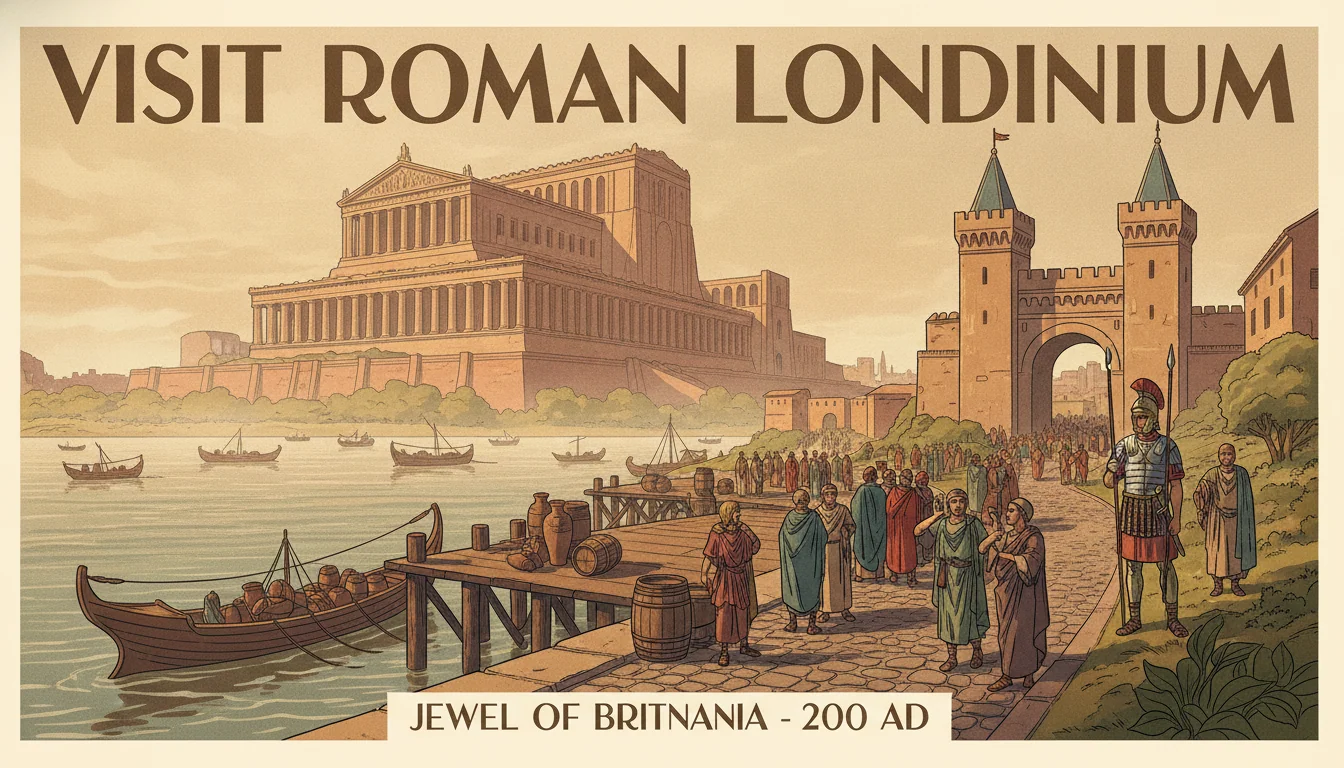
You land, somehow, in Roman London 200 AD, in the summer heat of Britannia. The first thing you notice is the smell of the river. The second is the noise. Londinium in the Severan period is neither a wild frontier outpost nor a pale shadow of Rome. It is a working provincial capital with roughly 30,000 to 50,000 inhabitants, a harbor handling imported wine and olive oil and exported lead and wool, and the largest administrative building north of the Alps. It is dirty, loud, crowded, cosmopolitan, and entirely indifferent to your arrival.
Here is how to get your bearings without getting killed.
Arriving by river
The sensible approach is by water. The Thames at this period is wider and shallower than you know from any modern map, its banks marshier, the tidal influence extending farther inland. Flat-bottomed river craft ply the channel constantly, hauling amphorae from Mediterranean ships anchored downstream and returning with tin, lead, hides, and slaves.
Londinium's waterfront runs along the north bank. The timber wharves are substantial - Roman engineers drove oak piles into the riverbed and built out platforms that give merchants direct access to the largest vessels the Thames can accommodate. If you arrive by this route, you pass through a working port. The quayside reeks of fish sauce and rotting wood and the particular sweetness of spilled Gaulish wine.
Aim for the area around the bridge. The bridge is timber, wide enough for two wagons to pass, and it is the only crossing of the Thames for several days' walk in any direction. This geographic fact explains why Londinium exists here and not somewhere more defensible. The Walbrook stream enters the Thames nearby. You want to be north of it.
What you are walking into
By 200 AD, Londinium has been rebuilt twice. Boudicca burned the settlement to the ground in 60 AD, slaughtering its inhabitants in what Roman sources describe as one of the bloodiest episodes of the conquest. The rebuilt city was larger and better planned. Then there was another substantial fire, possibly in the early 2nd century, and the city was rebuilt again on an even grander scale. What you find in 200 AD is the result of that second rebuilding: a city that has had decades to settle into its current shape.
The centerpiece is the forum-basilica complex on the ridge above the waterfront. It is enormous. The basilica alone runs roughly 160 meters in length, making it the largest building in Roman Britain and, by some reckonings, the largest basilica north of the Alps. It functions as a combined courthouse, town hall, and commercial exchange. The forum in front of it is the economic and social heart of the city: merchants with stalls, officials posting notices, citizens doing business. If you want to understand where you are in the city hierarchy, find the forum.
The governor's palace is southwest of the forum, down toward the waterfront. You won't be going in there.
The amphitheater
Northeast of the forum, set into the natural slope of the ridge, is the amphitheater. It was rebuilt in stone probably in the early 2nd century and can hold around 7,000 spectators. On a games day it is the loudest place in Londinium by a significant margin.
The question of what is happening in the arena when you arrive has several possible answers. Gladiatorial combat is the famous one, but the arena also hosts animal hunts, public executions, and military training exercises. The gladiators you might encounter are unlikely to match the Hollywood version: professional fighters with fixed contracts and medical care, more professional athlete than condemned prisoner, though the condemned do appear in the arena as well and their presence is exactly as grim as you imagine.
Go. The crowd is the show as much as the arena.
Eating and drinking
Londinium has thermopolia - street-food counters with sunken ceramic containers keeping cooked food warm. You want these. Sit-down dining in someone's home requires a social connection you probably don't have.
The staples are bread, oysters (Londinium sits on some of the best oyster grounds in Britannia), and whatever the legumes of the season are. Wine arrives from Gaul and the Rhine valley in wooden barrels rather than amphorae by this period, which keeps the price reasonable. Garum, the fermented fish sauce that Romans put on essentially everything, is made locally and imported from Spanish and North African sources. You will taste it in every cooked dish you eat. You will develop an opinion about it quickly.
The water situation is more complicated. Londinium has a water supply system - channels and wooden pipes feeding public fountains - but the Walbrook stream that runs through the city is also a dumping ground for refuse, including the offerings and occasional human remains that Romans deposited in sacred streams. Drink the fountain water. Avoid the Walbrook.
Languages and navigating the population
Londinium is not a Latin-only city. You will hear Latin in official contexts, in the forum, among the soldiers and administrators. You will also hear various dialects of British Celtic, Old Germanic from soldiers and traders off the Rhine frontier, Greek (the international language of educated commerce), and whatever the sailors from the eastern Mediterranean are speaking among themselves.
The population is genuinely cosmopolitan. Tombstones from Roman Londinium record people from Gaul, the Rhineland, Greece, Asia Minor, North Africa, and Syria. Some were slaves, some freedmen, some merchants, some veterans who settled after discharge. The military garrison that rotates through Londinium is not uniform - it draws on auxiliaries from across the empire.
If you speak modern English, nothing in this city will help you. If you have any Latin, even badly pronounced tourist Latin, you will manage in the forum district. On the waterfront, you may find traders who speak something approximating a proto-Frankish or Gaulish dialect if you have anything in that direction.
What to avoid
The streets are narrow outside the main axes and unlit at night. After dark, you are dependent on your own lamp or torch if you venture away from the main public spaces, and the side alleys near the waterfront are worth avoiding whether or not you are a time traveler. This is true of every Roman city and doubly true of a port district.
Disease is the more serious concern. The mid-2nd century had been visited by the Antonine Plague, a smallpox or measles epidemic that killed millions across the empire between roughly 165 and 180 AD. Londinium was not spared. The epidemic's worst years are behind you in 200 AD, but the city's sanitation - adequate by ancient standards, catastrophic by modern ones - means gastrointestinal illness is a persistent risk. The Romans understood something about clean water; they did not understand germ theory. Mind what you eat and where you sleep.
The legal system operates entirely on Roman law, which is more formal and more coherent than most people expect, but has concepts of citizenship and property that will not apply to you in ways you can quickly explain. Don't get into legal trouble.
Getting out
The road network is your exit route. Watling Street runs northwest toward Verulamium (St Albans) and eventually into the midlands. Ermine Street runs north toward Eboracum (York) and eventually to the frontier. Both are well maintained in this period, regularly used, and safer than the river in winter.
If you are heading south and want passage back across the Channel, Richborough in Kent - Rutupiae in Latin - is the main military and commercial port for traffic to Gaul. It is roughly two to three days by road from Londinium, depending on your pace and the weather.
Britannia in 200 AD is quiet by the standards of the 3rd century that follows. The Severan dynasty will bring a renewed military campaign in the north in a few years' time, but you are, for now, in a provincial city during an unusually stable interval. The empire functions. The road out is clear. Use it while that is still true.
Quick Answers
Common questions about this topic
What was Londinium like in 200 AD?
In 200 AD, Londinium was at or near its peak population of roughly 30,000 to 50,000 people, making it the largest city in the Roman province of Britannia. It had a massive forum-basilica complex, a governor's palace along the Thames, an amphitheater, public bathhouses, a working harbor, and a cosmopolitan population drawn from across the empire.
How big was Roman London compared to other Roman cities?
Londinium was the largest city in Britannia but a provincial city by Mediterranean standards. Its forum-basilica was reputedly the largest north of the Alps. Rome itself had perhaps a million inhabitants by this period. Londinium was closer in size to a prosperous regional capital like Lyon or Cologne than to the great Mediterranean metropolises.
What happened to Londinium after its peak?
Londinium declined significantly after the late 3rd century. Population fell, public buildings fell into disrepair, and archaeological evidence shows a reduction in economic activity. By the time the Roman legions withdrew in 410 AD, the city's population had dropped dramatically from its 2nd-century peak. The city's ghost persisted into the early medieval period.
Was Hadrian's Wall near Londinium?
Not particularly. Hadrian's Wall, completed around 128 AD, ran roughly 400 kilometers north of Londinium, across the neck of Britain from the Solway Firth to the mouth of the Tyne. A traveler from Londinium heading north would spend several days on Ermine Street or the road toward Eboracum (York) before coming anywhere near the Wall.

Need Advice from Someone Who Lived There?
Get firsthand accounts from people who actually lived through these moments in history.
Create your free account →No card required. Some figures and features require a paid plan.
Join the HistorIQly Club
Get smarter about the past.
Weekly stories, deep dives, and exclusive content straight to your inbox.