A Time Traveler's Guide to Occupied Paris, 1942
Occupied Paris 1942: a practical guide to navigating German occupation, food rationing, curfews, and the moral compromises of daily life in Vichy-era France.
Read Wikipedia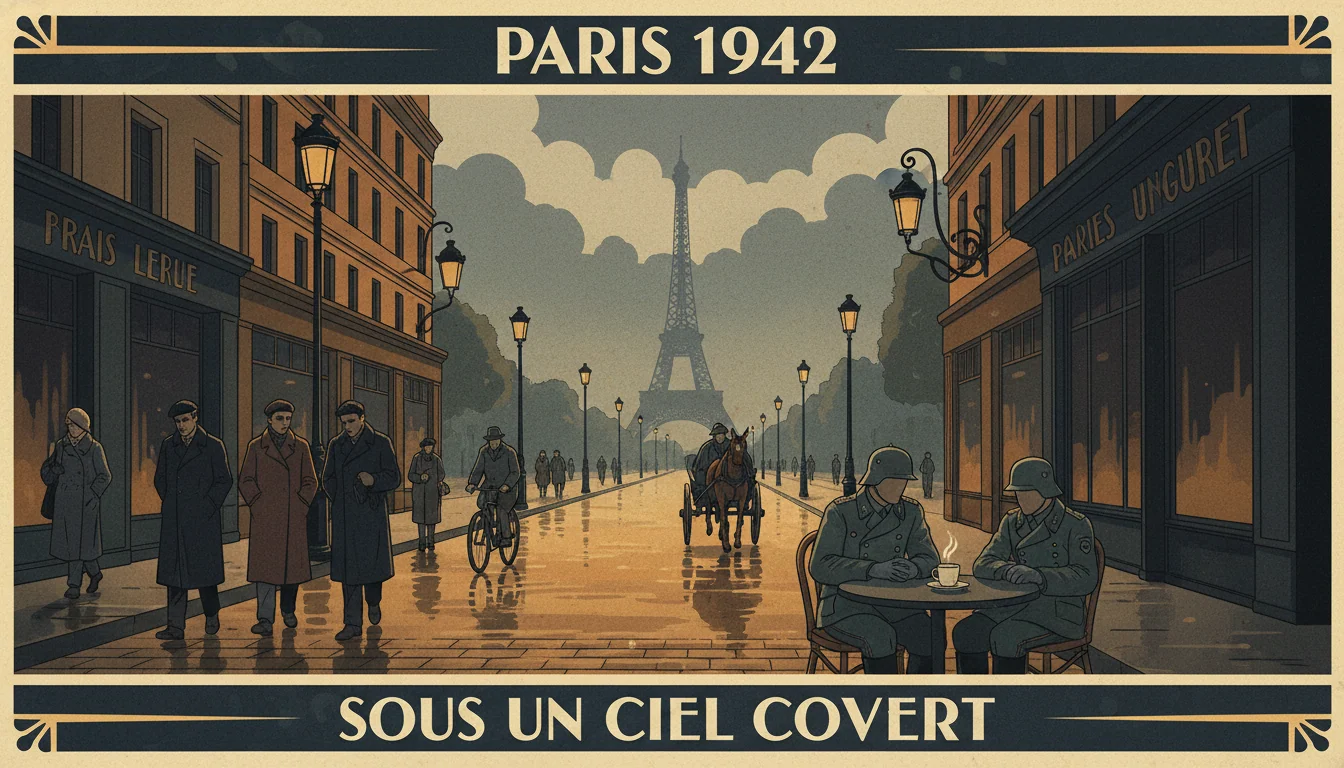
Occupied Paris in 1942 is still, obstinately, beautiful. The Eiffel Tower still stands. The cafes are still open, the theaters are running, and the city still smells of bread and cigarette smoke and the Seine at low water. The Occupation has not destroyed Paris. It has simply moved in, rearranged the furniture, eaten most of the food, and brought a new set of rules enforced by men in grey-green uniforms carrying rifles.
Before you arrive, you need to understand two things: what Paris looks like from the outside, and what it feels like from the inside. They are not the same city.
What kind of place you're entering
Germany occupied Paris beginning June 14, 1940, after the fall of France in roughly six weeks of fighting. By the summer of 1942, the occupation has been running for two years. The initial shock has settled into routine - a grimly specific routine governed by shortages, curfews, identity papers, and the constant negotiation between personal survival and moral compromise.
The city is physically intact. Hitler visited Paris in June 1940 and chose not to destroy it - a decision of vanity, not mercy. The great monuments, bridges, and boulevards remain. But the city's rhythms are distorted by occupation in ways that become obvious within hours of arrival.
German soldiers are everywhere: at sidewalk cafes on the Champs-Elysees, at the restaurants near the Palais Royal, on the Metro, at the Avenue de l'Opera. They are not, for the most part, visibly menacing to French civilians who make no trouble. They are simply there, occupying the best seats, drawing the best food, and reminding everyone who owns the city right now.
The French tricolor has been replaced by the swastika flag at all major public buildings. The Arc de Triomphe flies a German banner large enough to see from the river. Directional signs throughout the city are in German. Clocks have been advanced an hour to align with Berlin time.
Your cover identity
The safest cover for a foreign visitor is a neutral-country citizen with documented business in Paris: Swiss, Swedish, Spanish, or Portuguese. These nationalities circulate in occupied Paris with far less scrutiny than British or American citizens, who face immediate arrest and internment. If your French is imperfect, a Swiss identity is the most plausible explanation for a French speaker with an unusual accent.
You will need identity papers. In occupied France, papers are everything. Checking papers at streets, Metro stations, bridges, and building entrances is routine. Papers must include: a carte d'identite with photograph, a laissez-passer with any relevant travel authorizations, and - critically - your cartes d'alimentation (food ration cards). Without ration cards you cannot legally buy food. With forged ration cards you can buy reduced amounts of food. The black market fills the gap, at a price.
Do not carry anything printed in English. Not a novel, not a magazine, not a newspaper. These mark you immediately as a suspicious foreigner and will produce a prolonged conversation with the German military police that you do not want.
Dress and appearance
Paris under occupation maintains the city's sartorial standards under significant difficulty. Leather has been requisitioned for German military use. Wool is rationed. New clothing requires coupons. The practical result is a city where most people wear the same clothing they owned before the occupation, now somewhat more worn, repaired, and creative in its adaptations.
Men should wear: dark or grey wool trousers, a jacket, a proper shirt with collar, and a hat. Hats are universal and conspicuous by their absence. A beret marks you as a working-class Frenchman; a felt fedora or homburg reads as bourgeois. Both are acceptable. Do not wear military anything: surplus, camouflage, any garment that reads as foreign military. It will end badly.
Women's fashion has adapted pragmatically to wartime: narrower silhouettes to conserve fabric, wooden-soled shoes because leather is unavailable, turbans and scarves substituting for the elaborate hats that are now too expensive to replace. The typical Parisienne of 1942 is resourceful, well-put-together under the circumstances, and exhausted.
Bicycles are everywhere. Motor cars are scarce - German vehicles and those of official French collaborators excepted. The streets that once carried motor traffic are now filled with cyclists, horse-drawn vehicles, and the Velo-taxis that carry passengers for a fee. If you have business anywhere in Paris, a bicycle is your best transport.
What to eat, and how to get it
Food is the central preoccupation of daily life in occupied Paris. The German occupation requisitioned a substantial fraction of French agricultural production - estimates suggest Germany extracted roughly half of France's domestic food supply during the occupation years. What remained was rationed by category: bread, meat, dairy, fats, and sugar all required coupons, and the official ration was barely enough to sustain an adult doing manual labor.
The official daily bread ration in 1942 is around 280 grams - roughly one small baguette. The official meat ration is approximately 300 grams per week. In practice, these allotments often went unfulfilled because supply couldn't meet even the reduced official quotas.
The black market - le marche noir - is how most Parisians supplement their rations. Farmers, truckers, and a network of intermediaries move food from the countryside to the city at prices many times the official rate. A side of pork that would cost 20 francs officially might cost 200 on the black market. For a visitor with access to foreign currency or gold, the black market is accessible and reasonably well-supplied. For a working-class Parisian on French wages, it is a luxury beyond most budgets.
Restaurants are open and range from the very good to the technically legal. Higher-end establishments serve what they present as normal menus, often substituting rutabaga, Jerusalem artichoke, and other vegetables for pre-war ingredients. Avoid anything presented as meat unless you have reliable knowledge of the establishment. Horse, cat, and unidentifiable protein have all been documented in occupation-era Parisian menus.
Coffee has been replaced by ersatz: roasted chicory root, acorn flour, and various grain substitutes that produce a hot brown liquid with some of coffee's color and none of its stimulant effect. Real coffee exists on the black market. If you need caffeine, budget accordingly.
The Metro and movement
The Paris Metro is still running, though at reduced frequency and with cars that are perpetually overcrowded. Platform lighting is dimmed to conserve electricity. Certain lines and stations are reserved for German military use. The price is modest. Checking papers at Metro entrances is common.
Curfew for civilians is enforced nightly from 11pm (though the exact timing has varied across the occupation and may be subject to change depending on the security situation). Being on the street after curfew without a German-issued nocturnal pass (laissez-passer de nuit) is grounds for immediate arrest. The German military police, the Feldgendarmerie, patrol in pairs with heavy-metal gorget discs on chains around their necks - the nickname for them among Parisians is "chain dogs."
Bridges across the Seine are guarded. Moving between the Right and Left Banks requires passing a checkpoint. Have your papers ready at all times.
What to see, and at what cost
The Louvre remains open, its most important pieces evacuated to chateaux in the Loire Valley but its galleries still functioning. The Eiffel Tower is there but the elevators have been disabled - the Germans have the only working elevator key - so reaching the top requires climbing the stairs, which the German command has been notably unenthusiastic about. The cafes of Saint-Germain-des-Pres are functioning, full of writers, intellectuals, German soldiers, and collaborationist journalists in degrees of proximity that would be uncomfortable to contemplate in normal times.
What to avoid completely
You must understand what is happening in Paris in 1942 and stay clear of it.
On June 7, 1942, the yellow star became compulsory for all Jews in the occupied zone over the age of six. French Jews had already been stripped of civil rights, positions in government and the professions, and much of their property under the Vichy statutes of October 1940 and June 1941. The yellow star makes visible what the statutes had already accomplished legally.
On July 16-17, 1942, French police under German orders will conduct what becomes known as the Vel' d'Hiv roundup, arresting approximately 13,000 Jews in Paris and its suburbs. The arrests are carried out by French police, not German soldiers - a fact that France did not officially acknowledge until President Chirac's statement in 1995. If your visit falls anywhere near this date, stay off the streets in the Jewish neighborhoods of the Marais and stay away from any activity that involves police or gendarmes moving in organized groups.
Do not engage with or assist the French Resistance unless you are prepared for the consequences. The Gestapo's Paris headquarters at 11 rue des Saussaies and the SD (Sicherheitsdienst) at 72 avenue Foch are the institutions that handle suspected resistance activity, and their methods are not subjects for casual curiosity.
The gray zone
The thing about Paris in 1942 that no survival guide can prepare you for is the moral arithmetic of daily life. Most Parisians are not heroes. They are not collaborators either. They are people trying to feed their children, keep their apartments warm, and get through a day without attracting the attention of men with guns.
That gray zone - the accommodation, the looking away, the decision not to know who lives behind the wall next door - is the defining feature of occupied Paris and the thing that haunted France's collective memory for generations afterward. A visitor who stays only a few days will see the beautiful city, the open cafes, the Seine in summer. They will also see the yellow stars on people's coats, and the faces of people who see the stars and look away.
Pack your papers carefully. Keep your cover story simple. And do not stay past July 16.
For what Paris looked like before the occupation arrived, see our guides to Paris in the Belle Epoque and Paris in the 1920s.
Quick Answers
Common questions about this topic
What was daily life like in Paris during the German occupation?
Severe food rationing was the defining feature of everyday life. Germans requisitioned a large share of French agricultural production, leaving Parisians with reduced rations of bread, meat, and dairy. Coal shortages made winters brutally cold. The black market became essential for anyone who could afford it. German soldiers were highly visible in cafes, cinemas, and restaurants that remained open.
Were Parisians mostly resistant or mostly collaborative during the occupation?
Most Parisians occupied a gray zone between active resistance and active collaboration. Open opposition was extremely dangerous and relatively rare. Active collaboration - informing on neighbors, working for German authorities, joining Vichy propaganda organs - was also a minority position. The large middle majority adapted, survived, and preferred not to think too hard about the choices being made around them.
When was the yellow star introduced in occupied Paris?
The yellow star became compulsory for Jews in the German-occupied zone of France on June 7, 1942. All Jews over the age of six were required to wear a visible yellow star of David on their outer clothing. Violations were punishable by arrest. The requirement was not enforced in the Vichy unoccupied zone, which maintained its own discriminatory laws.
What was the Vel' d'Hiv roundup?
On July 16-17, 1942, French police under German orders arrested approximately 13,000 Jews in Paris and its suburbs, including more than 4,000 children. They were held at the Velodrome d'Hiver cycling stadium before being transferred to the transit camp at Drancy, northeast of Paris, and then deported to Auschwitz. The roundup was carried out by French police, not German soldiers. France formally acknowledged state responsibility in 1995.

Need Advice from Someone Who Lived There?
Get firsthand accounts from people who actually lived through these moments in history.
Create your free account →No card required. Talk to anyone in history with 8 free credits a day. Some features require a paid plan.
Join the HistorIQly Club
Get smarter about the past.
Weekly stories, deep dives, and exclusive content straight to your inbox.