A Time Traveler's Guide to Merovingian Paris, 600 CE
Everything you need to survive in Merovingian Paris - navigate the dark-age Frankish capital and witness it before it reinvents itself as the center of medieval Europe.
Read Wikipedia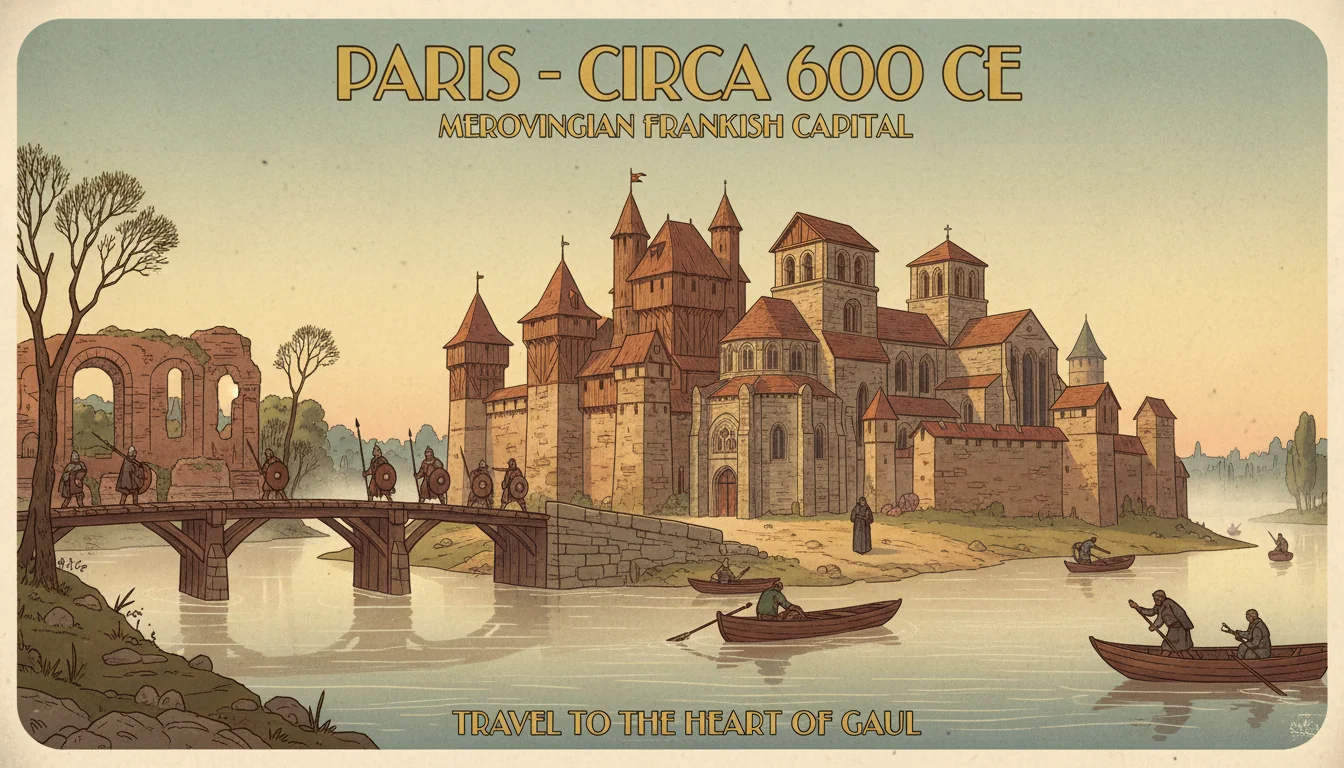
Merovingian Paris in the year 600 is not the city of the Revolution, the Impressionists, or even the crusading Capetians. It is something earlier, stranger, and considerably less comfortable: the political center of a Germanic kingdom superimposed on the ruins of a Roman provincial capital, governed by a dynasty whose internal politics make medieval succession crises look orderly, and slowly converting from a world that still remembers the legions to one that will, eventually, produce Charlemagne. The Franks call it Parisius. If you have read your Roman writers, you know it as Lutetia, though that name is fading. Whatever you call it, bring wool.
What kind of city you are entering
Parisius in 600 is a city of two overlapping populations. The Gallo-Roman inhabitants - descendants of the Celtic tribe the Romans called the Parisii - still form the majority of the urban population and speak a late Latin that is already bending noticeably toward something that will one day be recognizable as French. The Frankish ruling class, who arrived roughly 120 years ago when Clovis led them to victory over the last Roman governor of Gaul, speak a Germanic dialect among themselves and Latin in formal contexts. The two communities have been merging for three generations, but the class hierarchy remains visible: Franks own the large landholdings, command the military, and fill the royal household; Gallo-Romans dominate trade, skilled crafts, and the lower clergy.
The city's political situation in 600 is tense in the specific way that Merovingian cities are always tense. Chlothar II - son of the assassinated king Chilperic I, raised under regents since infancy - is still consolidating his authority over Neustria. The decades before his reign were marked by the devastating civil war between his mother Fredegund and his aunt Brunhild of Austrasia, a conflict documented in extraordinary gory detail by the bishop and historian Gregory of Tours. Fredegund died in 597. The political atmosphere has not fully settled. Do not discuss court politics with anyone you have not known for a long time.
Dress like a Frank
Arriving in anything resembling modern clothing will mark you within seconds. The Frankish wardrobe has a specific grammar.
Men wear woolen tunics belted at the waist, falling to the knee or mid-thigh, over linen undershirts. Below the knee go close-fitting trousers, held by leg-wraps or simple bindings. Cloaks are essential - wool, usually undyed or brown, pinned at the right shoulder with a brooch. That brooch is your most important accessory. Frankish metalwork is sophisticated and socially legible: an iron pin says laborer, a silver or gilded fibula says someone worth speaking to. You do not need to own armor or weapons to be plausible as a minor provincial from somewhere north of the city.
Women wear a long linen undergarment close to the body, topped by a looser woolen overdress falling to the ankle. Headcovering is expected for adult women in public - a simple linen veil or wrapped cloth. Jewelry is worn daily and visibly: amber beads, colored glass, and metal pins signal social standing in a way that is immediately readable to anyone on the street. Do not leave your beads at home. Leave your synthetic fabrics, your zippers, your logos, and your rubber-soled shoes wherever you came from.
The island
Cross one of the wooden bridges onto the Ile de la Cite and you are in the political core of the Frankish world. The royal palace occupies the western end of the island - not a stone castle but a sprawling complex of timber halls and outbuildings, with a sharp boundary between the public zones where petitioners and merchants wait and the interior chambers where the king and his household live. Approaching without business or an escort is inadvisable and may be interpreted as trespass.
At the island's eastern end stands the early cathedral, a large timber-and-stone structure occupying the site where Merovingian bishops have built and rebuilt since the conversion of the Franks under Clovis in the late 5th century. It is not Notre-Dame - that building will not be begun for five and a half more centuries - but its predecessor stands on the same ground, and Sunday mass draws the city's entire nearby population. The space immediately outside the cathedral on a feast day is the closest thing Parisius has to a public square, and the most useful place to observe without attracting attention, because strangers gather there routinely.
Eating and drinking
The basic diet of the non-elite is grain and legumes. Bread, porridge, and thick pottage are what most people eat on most days. Pork is the prestige meat - Frankish culture organizes much of its agricultural economy around pigs - and a household that can salt a pig in autumn is comfortably provisioned through winter. Fish from the Seine is abundant and sold fresh at the riverbank from early morning. Eels are a staple and a trade good.
Do not drink the Seine water. The river is simultaneously a sewer, a fishery, and a commercial highway, and the combination is not wholesome by any era's standards. Weak ale, brewed from grain, is the standard daily drink for adults. Wine is available - imported from Burgundy and the Moselle valley through river trade - and is a status marker rather than a daily option. If you are offered wine, your host considers you worth impressing. Eat with a personal knife and wooden bowl you have brought yourself. Forks, as individual eating implements, do not exist here.
What to see
The Basilica of Saint Denis, a short walk north of the city proper, is already a major Merovingian religious site and royal necropolis. Clovis and several of his successors are buried nearby. The current structure is modest but the pilgrimage traffic is steady and the atmosphere distinctly weighted with Frankish royal mythology. It is one of the few places where a stranger's unexplained presence is entirely plausible - pilgrims arrive from considerable distances.
On the left bank, the ruins of the Roman forum and the amphitheater are visible from the streets and accessible on foot. They are being quarried for stone, slowly and informally, so the structures are diminishing year by year. The Roman baths in what will later be called the Cluny district still have substantial walls standing and are used for storage. Standing in those vaulted rooms, built when Hadrian was emperor, gives you the city's clearest sense of the enormous civilization that preceded it.
The Seine itself is the city's main artery and its best entertainment. River commerce moves constantly: grain barges, timber rafts, livestock, pottery, stone. The boatmen's guild, whose ancestors the Romans recorded as the nautes parisiacii on a stone altar now preserved in fragments, operates the river trade with guild discipline that has survived the fall of one empire and the rise of another. Watching the traffic from the bank is free and requires no explanation.
Dangers
The Merovingian court is a place of genuine political violence, not ceremonial menace. The civil wars of the previous generation produced executions, assassinations, and the kind of factional brutality that Gregory of Tours documented with clerical horror and unmistakable relish. In 600, the immediate political violence has subsided, but the factional tensions remain. Keep your opinions about the king, the queen mother, and any member of the Frankish aristocracy entirely to yourself. Express no opinion. If pressed, say you are a pilgrim passing through and change the subject to the Basilica of Saint Denis.
Disease is the quieter, more reliable danger. Plague - probably Yersinia pestis - swept through Gaul in the 540s and returned in waves through the second half of the 6th century. Crowded areas near the river during warm months carry the highest risk. The city's relationship between sewage and drinking water would trouble a modern public health officer considerably. Bring whatever medical precautions your century provides.
A stranger without local patronage is legally vulnerable. The Frankish legal code, the Lex Salica, assigns monetary compensation for injuries depending on the social status of both parties - but a foreigner without a documented lord to vouch for them has no obvious legal standing. The safest posture is to attach yourself to a church precinct, which provides neutral ground, and avoid the kind of loud public dispute that invites intervention from anyone with a weapon.
Getting around
The left bank street grid still follows Roman lines in places, which helps with navigation. The Ile de la Cite is compact enough to walk end to end in twenty minutes. Most people walk everywhere. Horses are for the military and the wealthy; oxen pull heavy freight carts along the muddy roads between the river and the market areas.
The Seine is faster than the streets for any journey of substance, and boatmen will take paying passengers. Agree the price before you step in. The river runs north and slightly west as it curves through the city, and the current makes downstream travel noticeably faster than upstream.
Parisius in 600 is not elegant. It is loud, muddy, politically volatile, and intermittently lethal. It is also the seed of every city that Paris will become, already sitting on the island that will anchor it for the next fourteen centuries. That is worth seeing, if you can manage the wool and the ale.
For the civilizations that frame this era, see our guides to Carolingian Aachen in 800 and Viking Scandinavia in 900.
Quick Answers
Common questions about this topic
What was Paris like in 600 CE?
In 600 CE, Paris was the principal royal city of the Merovingian Franks, known as Parisius. It was centered on the Ile de la Cite island in the Seine, with a royal palace, an early cathedral, and a ring of monasteries. The old Roman streets and some Roman structures were still visible on the left bank. The population was a mix of Gallo-Roman inhabitants and Frankish newcomers.
Who ruled Paris in 600 CE?
The Merovingian king Chlothar II held Neustria, the western Frankish kingdom that included Paris. His father Chilperic I had been assassinated in 584, leaving Chlothar as an infant king under regency. By around 600 he was entering young adulthood and beginning to exercise real authority. He went on to reunify all the Frankish kingdoms in 613 CE.
What language did people speak in Merovingian Paris?
The bulk of the urban population spoke a late form of Gallo-Roman Latin that was already evolving toward early Old French. The Frankish ruling class and their soldiers spoke a Germanic dialect among themselves. Latin remained the language of the Church, of legal documents, and of formal correspondence. A visitor comfortable in Latin could navigate most administrative and religious contexts.
What remains of Merovingian Paris today?
Very little Merovingian construction survives above ground. The most accessible evidence is the Crypte Archeologique beneath the plaza in front of Notre-Dame cathedral, which contains foundations from the late Roman and Merovingian periods. The site of the Roman baths on the left bank, now occupied by the Cluny Museum, preserves significant Roman-era walls that would still have been standing in 600.

Need Advice from Someone Who Lived There?
Get firsthand accounts from people who actually lived through these moments in history.
Create your free account →No card required. Talk to anyone in history with 8 free credits a day. Some features require a paid plan.
Join the HistorIQly Club
Get smarter about the past.
Weekly stories, deep dives, and exclusive content straight to your inbox.