Time Traveler's Guide to Havana, 1959: The Last Night of the Old Cuba
Havana in 1959 was glamorous casinos meeting a revolution rewriting everything. Your guide to the most dangerous, dazzling year in Cuban history.
Read Wikipedia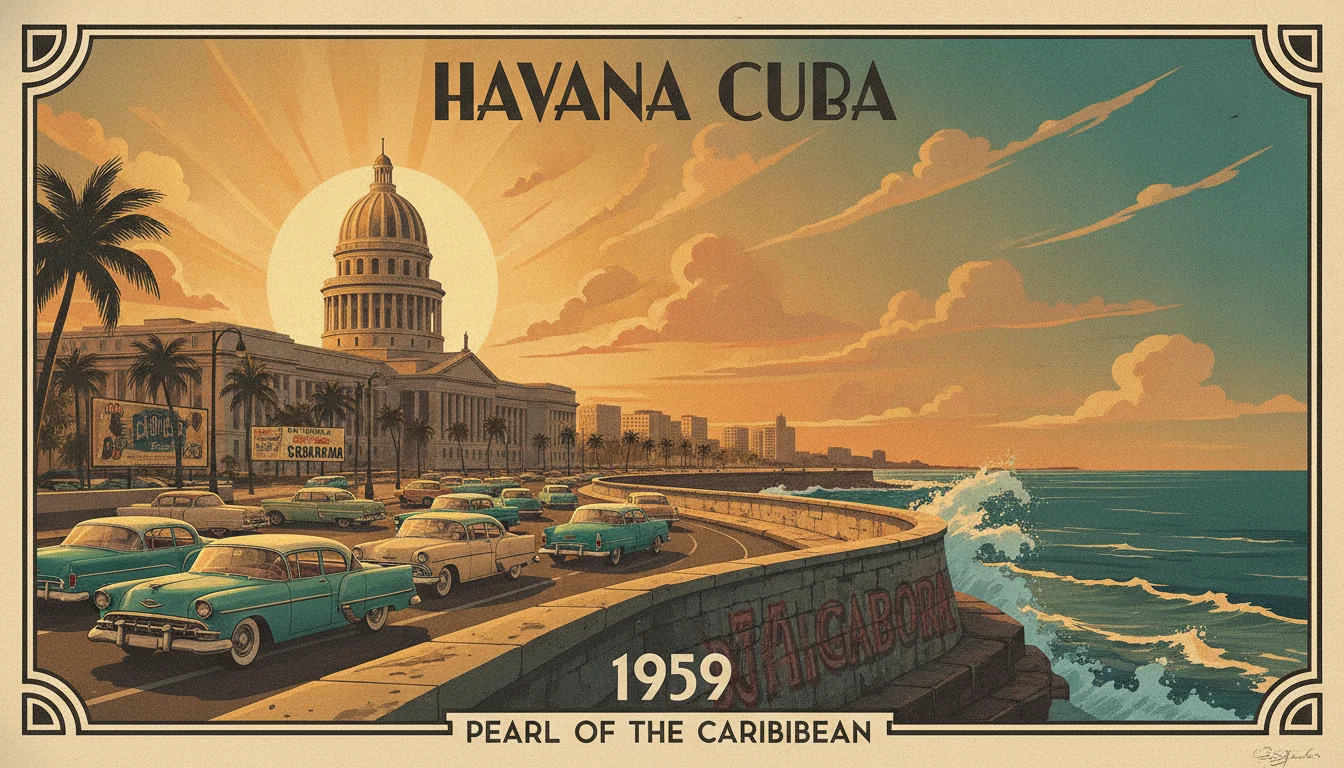
You have picked the most consequential year in Cuban history, and the most logistically demanding. Havana in 1959 is two cities running simultaneously. One of them has American cars, casino hotels built on Meyer Lansky's investment, a Malecon seafront that smells of sea salt and exhaust and something almost tropical-Mediterranean, and a nightclub called the Tropicana that seats 500 under an open sky. The other city has checkpoints, nervous American businessmen quietly clearing out bank accounts, and a young man with a beard who is about to rewrite everything.
Your timing matters more here than in almost any other year you might choose to visit. January 1959 is not the same as December 1959.
When to arrive
Fulgencio Batista, the dictator who had run Cuba since 1952, flies out of Havana in the early hours of January 1, 1959. He does not say goodbye to many people. He takes a significant portion of the national treasury with him.
Arrive in late December 1958 if you want to see the old Havana at its most itself - a city that has managed, somehow, to run nightclubs through a revolutionary war being fought in the countryside, that has maintained the fiction of normalcy while the roads out of the city carry people and cash in both directions. The Hotel Nacional is full. The Riviera, completed in 1957 with American organized crime money and Ginger Rogers at the opening, is operating normally. The Capri has George Raft's famous glass-enclosed casino on the roof.
Arrive in January 1959 if you want to see the moment of transition. The Rebel Army enters Havana, and there is very little violence in the capital itself. The city is bewildered rather than jubilant, or jubilant in a way that is trying to figure out what it is celebrating. Most of the casino hotels stay open. The revolution needs the tourist dollars and is not sure yet what it intends to do with the economy.
Arrive in mid-to-late 1959 if you want to watch a city reorganizing itself from the ground up. This is intellectually fascinating. It is not comfortable.
Where to stay and what it costs
The major hotels of the Vedado neighborhood are still the safest choice through most of 1959. The Hotel Nacional, built in 1930 on a low cliff above the Malecon, has weathered everything Cuba has thrown at it for three decades. Its rooms are not cheap by Cuban standards but are reasonable by American ones. The casino operates. The service is formal in the old manner.
Avoid the cheapest accommodation in central Havana if you are not Cuban. Foreigners who appear to have money attract attention, and in a city where political alignment is shifting fast, being the wrong kind of foreigner at the wrong kind of establishment is a complication you don't need.
Bring American dollars. Cuban pesos are in circulation but the tourist economy runs on dollars through most of 1959. By late in the year, the official exchange rate and the street rate are beginning to diverge, which is a sign of things to come.
How to get around
Havana in 1959 is a city of American automobiles. The cars you see are almost exclusively imported from the United States - Chevrolets, Buicks, Fords, Chryslers - many from the late 1940s and 1950s, many in extraordinary condition because Cuban mechanics have become experts at extending the life of machines they cannot easily replace. The unofficial taxi system involves an informal negotiation that is faster if you speak Spanish.
The Malecon, the eight-kilometer seafront road that curves along Havana's northern edge from the harbor mouth through Vedado, is the social spine of the city. People walk it in the evening. Fishermen sit on the seawall. The spray from Atlantic swells comes over the road in winter. If you walk it from the harbor end to the Vedado end you will understand why Havana has held onto a fraction of its visitors across every political transformation since.
Buses exist. They are crowded and slow and will take you to parts of the city where foreigners are less common. This is recommended if you want to understand what the city is actually like rather than what the hotel district presents.
What to eat and drink
Pre-revolution Cuban cuisine in the city of Havana is better than its historical reputation in American food writing, which has largely been shaped by exile nostalgia and tourist menus from the 1950s. The base is Spanish - rice, beans, pork, plantains - with African and indigenous influences in the seasoning and in the slow-cooked preparations that bars and neighborhood restaurants serve through the afternoon.
Ropa vieja, the shredded beef stewed with tomato and peppers, is the dish most likely to be available in most places that are serving food. It is also genuinely good. Arroz con pollo appears everywhere. Moros y cristianos - black beans and white rice cooked together - is the side that will appear whether you ask for it or not.
The daiquiri as a mixed drink was codified at El Floridita on Obispo Street, which Hemingway helped make famous in the decade before your visit. He is not in Havana in 1959, having left for Idaho, but El Floridita is still there and still making them with maraschino liqueur in the Hemingway version. The mojito, rum and mint and lime and soda, is available everywhere and is better here than it will be anywhere else for the rest of your life.
Cuban rum is available in quantity and at prices that make any alternative seem absurd.
What to see
The old city, La Habana Vieja, is the colonial core. The cathedral on Plaza de la Catedral was completed in the late 18th century. The fortifications - the Morro Castle on the harbor mouth and the Cabana fortress opposite - are Spanish military architecture from the 16th through 18th centuries. During your 1959 visit, the Cabana is being used as a revolutionary tribunal and prison. This is worth knowing before you book a tour.
El Capitolio, the government building on the Paseo del Prado modeled loosely on the American Capitol in Washington and completed in 1929, is temporarily uncertain about its institutional identity. It will eventually become a scientific academy. In 1959 it is simply a very large building being figured out.
The Malecon at night is the social performance that Havana puts on for itself. Couples, families, musicians, teenagers, fortune-tellers, people arguing, people ignoring arguments: the seawall holds all of it simultaneously, lit by the lights of the Vedado hotels on one side and the darkness of the Florida Straits on the other. Do not miss it.
What to avoid
The countryside outside Havana is not safe for foreign visitors through early 1959. The guerrilla conflict of 1956 to 1958 ended with the fall of Batista, but the consolidation of control in the provinces took months and involved armed groups whose affiliations and intentions were not always legible to outsiders.
Do not discuss politics in hotel lobbies, restaurants, or bars. In early 1959 this is because you don't know who is listening. In late 1959 this is because you really don't know who is listening. The situation with informants and political surveillance is developing fast in a direction that will define the next six decades of Cuban life.
If someone at a bar tells you they are planning to leave Cuba, do not ask where or when. Several hundred thousand Cubans will leave in the first few years after the revolution, most of them to Miami. Their plans are private and in some cases dangerous to discuss publicly.
American organized crime figures who have not already evacuated their Havana casino interests will be doing so through 1959. This makes certain hotel bar environments more tense than their velvet curtains suggest. Sit further from the phone.
Clothing and customs
Havana in January runs at around 24 to 26 degrees Celsius. Light clothing, cotton, linen. The humidity is manageable by Caribbean standards. Evenings cool slightly but not dramatically.
The pre-revolution Havana upper class wore what you would wear in Miami or Coral Gables at the same time - American styles, formal in the evenings, lighter in the afternoons. The revolutionary cadre are in olive green. The gap between these two dress codes is also a social map. Know which register you are operating in before you walk into a room.
Spanish is non-negotiable for anything beyond the major tourist hotels. American English is understood in those hotels and in some restaurants near the Vedado, but once you leave the tourist zone you will need Spanish or the goodwill of someone who has it.
What you are actually watching
Havana in 1959 is the moment when a city that had spent decades performing modernity for American tourists - the cars, the casinos, the nightclub shows with feathered costumes and synchronized choreography - collides with a political transformation that is going to reorder every social arrangement the performance was built on.
The glamour is real. The Tropicana is genuinely extraordinary. The daiquiris at El Floridita are everything their reputation promises. The Malecon at night is as good as any waterfront promenade anywhere in the world.
But the glamour is also a skin, and in 1959 you can watch the skin and the transformation happening at the same time, in the same city, often in the same room. That is what makes it worth visiting. Not the casinos, not even the history, but the specific quality of a place suspended between two completely incompatible versions of itself.
For other politically charged years in the Time Traveler's catalog, see Time Traveler's Guide to Cold War Berlin, 1961 and Time Traveler's Guide to Stalinist Moscow, 1937.
Quick Answers
Common questions about this topic
What was Havana like in 1959?
In January 1959 Havana was in the final hours of the Batista era - the casino hotels were still running, the Malecon was packed with American cars, and the Tropicana nightclub was operating in full. By late 1959 the city was transforming rapidly under the revolutionary government, with casinos closing, American businesses nationalizing, and the social hierarchies of pre-revolution Cuba being dismantled.
What happened to Havana's casinos after the revolution?
Most of Havana's major casino hotels, including the Hotel Nacional, the Riviera, and the Capri - many built with American organized crime investment in the mid-1950s - were initially kept open after the revolution to preserve tourism revenue. By 1961 most were closed or nationalized as relations with the United States collapsed and the tourist market that had sustained them disappeared.
Was Havana really controlled by the American mob?
In the mid-to-late 1950s, American organized crime figures including Meyer Lansky held significant interests in Havana's major casino hotels, facilitated by Batista's government. The arrangement gave the mob a Caribbean base for gambling revenue while giving Batista a cut and a glamorous international profile. This did not mean the mob 'controlled' Cuba in a comprehensive sense, but the casino economy was deeply enmeshed with American organized crime investment.
What should you know before visiting Havana in 1959?
The key practical challenge in 1959 Havana is that the political situation changes week by week. Batista flees on January 1. The revolutionary government is consolidating through 1959. If you arrive in January you are in the final hours of one system; by December you are in the early months of another. The city's geography is stable; its rules are not.

Need Advice from Someone Who Lived There?
Get firsthand accounts from people who actually lived through these moments in history.
Create your free account →No card required. Some figures and features require a paid plan.
Join the HistorIQly Club
Get smarter about the past.
Weekly stories, deep dives, and exclusive content straight to your inbox.