A Time Traveler's Guide to Shanghai, 1930
Shanghai 1930 history: Art Deco banks, jazz clubs, three competing legal systems, and a criminal syndicate running everything below the surface. Your guide to the city at its peak.
Read Wikipedia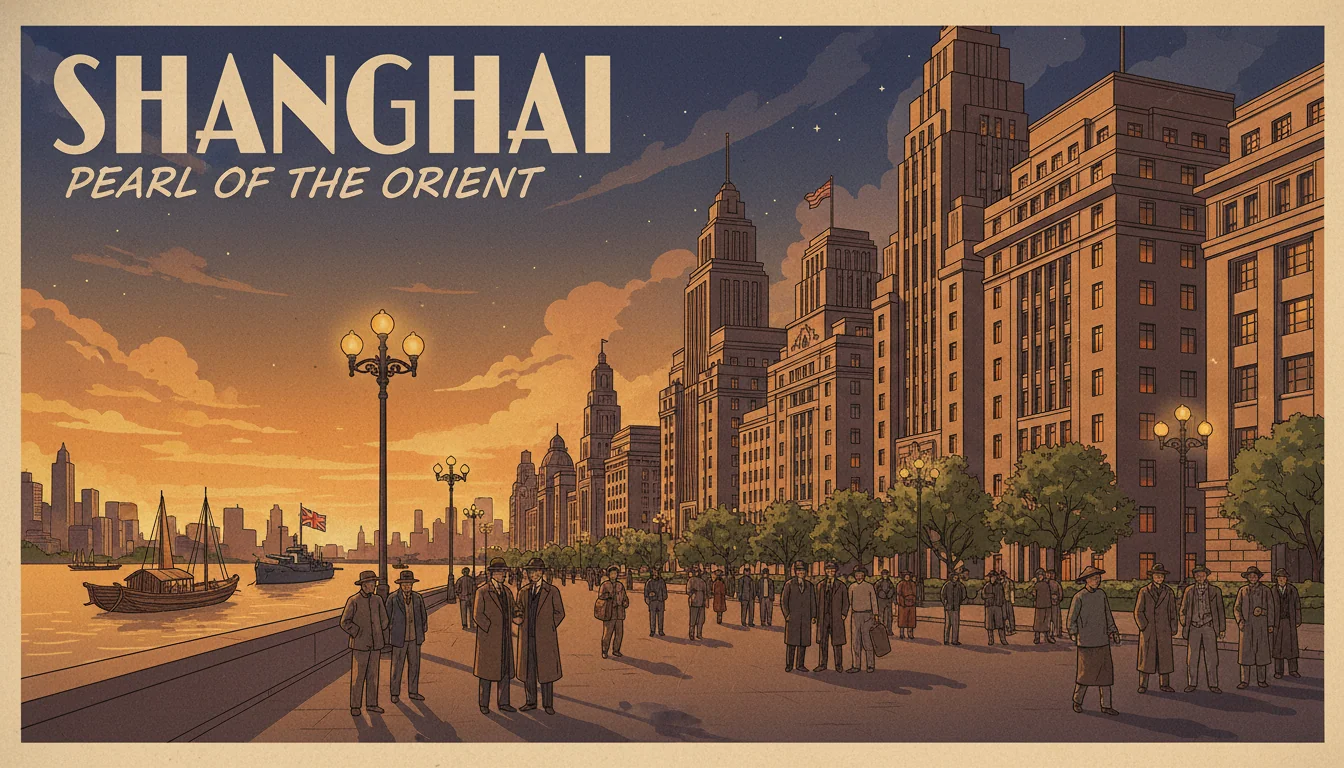
Few cities in history have packed as many contradictions into a single square mile as Shanghai did in 1930. On the Bund, European banks three stories tall in Art Deco stone face the Huangpu River, their brass fittings polished every morning by Chinese staff in white uniforms. Two blocks west, in a lane house barely wider than a handcart, a family of six shares one room. A jazz band is playing at the Cathay Hotel. A rickshaw puller has been working since four in the morning and will not stop before midnight. A Russian countess who fled St. Petersburg in 1917 sells cigarettes from a booth on Avenue Joffre and reads Chekhov in French at night.
Shanghai in 1930 is simultaneously glamorous, brutal, inventive, and deeply unstable. It is also genuinely unlike anywhere else on the planet, which makes it one of the most rewarding stops on any time-travel itinerary - as long as you know what you are walking into.
First, understand what kind of city this is
Shanghai in 1930 is not one city. It is three administrative zones sharing a geography.
The International Settlement, governed by the Shanghai Municipal Council with heavy British and American influence, covers the northern and eastern waterfront districts, including the Bund and much of the commercial district. It has its own police force, its own court system, and its own set of rules for foreign nationals - which is to say, considerably fewer rules than you might expect.
The French Concession runs south and west, with its own French-appointed administration, its own police (staffed partly by Vietnamese officers from French Indochina), and a reputation as the more fashionable and slightly more permissive of the two foreign zones.
The Chinese Municipality covers the majority of the actual city - most of the population, most of the poverty, and the Old City in the south with its traditional temples and markets. The Nationalist government's writ runs here in theory; in practice, the Green Gang syndicate led by Du Yuesheng has more operational control over labor, policing, and the informal economy than anyone in Nanjing.
As a visitor, your easiest cover is a foreign tourist or business traveler. Foreigners are numerous enough in both zones to attract little attention.
Your cover story and your papers
Shanghai in 1930 is a city that runs on paperwork and on connections. The good news is that foreign nationals move between the three zones with minimal friction - the treaty-port system has made cross-border commerce the city's entire reason for existence.
Your safest identity: a foreign commercial traveler or the representative of a trade company, visiting from London, Paris, New York, or Yokohama. The city receives hundreds of such visitors every month. Carry a business card identifying a firm plausible enough not to invite detailed questions. Do not claim to be a journalist unless you are prepared to explain which publication and to have your answers checked.
If you speak no Chinese, this is unremarkable in the foreign zones. If you speak a little, use it carefully - Shanghai dialect (Shanghainese) is mutually unintelligible with Mandarin, and claiming fluency you don't have will expose you immediately.
Dress like you belong
The International Settlement and French Concession in 1930 follow European fashions with a six-month to one-year delay from Paris or London. For men: a linen or light wool suit with a soft collar and tie, leather shoes, a hat (a fedora or boater, depending on the time of day and season). For women: a dropped-waist dress or a tailored skirt and blouse, heels, gloves for formal occasions, and a hat that gestures at the current silhouette without being obviously avant-garde.
The qipao (also called cheongsam) is at this moment crossing from traditional dress into modern fashion for urban Chinese women. A foreign woman wearing one will be read as either fashion-forward or eccentric, but not as offensive. A foreign man in a Chinese scholar's gown will attract stares. Stick to European cut.
Do not wear anything with visible Western brand logos. Do not wear rubber-soled athletic shoes. Do not carry a backpack; a leather briefcase or a small handbag is correct.
Transport across the city
Move by rickshaw for short trips and by taxi for longer ones. Agree on the fare before you board - the negotiation happens first and is understood to be theater on both sides. The Shanghai tramway runs through the Settlement: cheap, crowded, and safe for a traveler with coins. Do not walk at night in the Chinese sections south of the old walled quarter without a local guide, not because violence against foreigners is common but because you will be comprehensively lost within three minutes.
Three places you must experience
The Bund at dusk
The Bund is Shanghai's showpiece - a mile-long waterfront of European banks, shipping offices, hotels, and clubs facing the Huangpu River. The Sassoon House (later the Cathay Hotel) opened in 1929 and is already the most fashionable address in Asia. At dusk, the river is busy with junks, cargo steamers, Royal Navy gunboats, and flat-bottomed sampans moving between them. The lights come on across the facades. Across the river, the Pudong side is still mostly fields and warehouses.
Walk the Bund in the late afternoon, have a drink at the hotel bar, and watch Shanghai's commercial aristocracy conduct business over cocktails. It is one of the more extraordinary sights of the era.
A jazz evening at a dance hall
By 1930, Shanghai's dance halls and jazz clubs are operating at full pitch. The Del Monte Club, the Paramount Ballroom, and a dozen smaller venues employ jazz orchestras that include Black American musicians, Filipino bandleaders, and Russian emigre violinists. The music is contemporary - Louis Armstrong and Duke Ellington are current, not classic. Admission is modest. The clientele is mixed in ways that would be impossible in most cities in either the United States or Europe: Chinese businessmen, foreign sailors, White Russian women in evening gowns, and every gradation of the city's extraordinary social layers.
Do not refuse a dance if invited politely. It is social currency and costs you nothing.
The old city and Yu Yuan Garden
South of the foreign settlements, the old walled city and the Yu Yuan classical garden offer a completely different Shanghai. The garden, built in the 16th century, is serene and formal, with rockeries, pavilions, and ornamental pools. The lanes around it are a sensory overload: street food vendors, fabric merchants, medicine sellers with dried specimens in glass jars, a fortune-teller with a parrot trained to select cards.
Do not eat from street stalls without watching the cooking process. The food is not dangerous because it is Chinese; it is dangerous because sanitation in open-air markets is variable. A vendor using a well-maintained fire and clean water is safe. One whose stock has been sitting in warm air since morning is not.
Politics, gangsters, and what not to say
Shanghai in 1930 is politically radioactive. The Nationalist government massacred thousands of Communist labor organizers in Shanghai in April 1927, and the city's working-class politics remain explosive beneath the surface of prosperity. The Green Gang, which helped organize that massacre and was rewarded with official tolerance, operates openly alongside the police.
Du Yuesheng, the Green Gang's leader, is the most powerful private citizen in Shanghai. He appears at charity events and sits on the boards of banks. Do not make jokes about him in public or comment on the Nationalist government's relationship with organized crime. The city's social fabric depends on everyone pretending certain arrangements do not officially exist.
Do not express sympathy for the Chinese Communist Party in any conversation with anyone you do not know extremely well. The labor unions were crushed; survivors are underground or in jail. Expressing solidarity with them will at minimum end the conversation.
Health and survival
Get every available vaccination before you arrive. Shanghai's water supply is improving but not reliable. Drink bottled mineral water, beer, or tea made with boiling water. Cholera is no longer epidemic but typhoid is present. The heat from June through September is serious; wear light linen and rest between noon and three.
Carry clean paper currency in small denominations. The currency system is complex: multiple kinds of silver yuan, bank notes from different issuers, and foreign currencies all circulate. Change money at a Bund bank, not from street changers. Mexican silver dollars and Shanghai Municipal Bank notes are accepted at larger hotels and restaurants.
What not to do
Do not photograph the poor districts or street children without thinking carefully about who might see you. Foreign photographers documenting Chinese poverty attract occasional hostility in 1930.
Do not wander into opium establishments. They exist, they are not hidden, and a naive foreign visitor entering one will be charged ten times the correct price and possibly robbed.
Do not mention the Japanese occupation of Manchuria - it has not happened yet in 1930, but Japanese-Chinese tensions are already high, and a careless comment can erupt unexpectedly.
Do not assume that foreign nationality in a treaty port makes you entirely safe. The foreign zones are generally orderly. But the city is large, the night is long, and overconfidence is its own kind of danger.
The moment you should not miss
On a warm Saturday evening, take a taxi to the Paramount Ballroom on the western end of the French Concession. The band will be playing something recognizable. The floor will be full. Through the tall windows, Avenue Joffre is lit by electric streetlights and neon signs in both Chinese characters and French. A tram goes past. Someone is arguing outside in three languages simultaneously.
Shanghai in 1930 is a city that should not work and clearly does - a negotiated arrangement between incompatible interests that has produced, briefly, one of the most interesting urban cultures in modern history. It will not last: the Japanese military will see to that in 1937, and the revolution will see to the rest in 1949. But right now it is at its peak.
Pack light, carry small bills, and find a table near the dance floor.
For another great Asian capital at a pivotal historical moment, see our guide to Visiting Meiji Tokyo, 1880. For a European counterpart in the same fin-de-siecle era, see Fin-de-Siecle Vienna, 1900.
Quick Answers
Common questions about this topic
What was Shanghai like in 1930?
Shanghai in 1930 was one of the largest, wealthiest, and most chaotic cities in Asia - a treaty port divided between a Chinese-governed municipality, a British-American International Settlement, and a French Concession, each with its own laws, police, and culture. The city had Art Deco skyscrapers, jazz nightclubs, a sophisticated Chinese middle class, enormous wealth inequality, and a criminal underworld that effectively governed the labor markets.
Was Shanghai really called the Paris of the Orient?
The phrase was used by foreign residents and travel writers in the 1920s and 1930s, comparing the French Concession's tree-lined boulevards, cafes, and nightlife to Paris. The city was also called less flattering names by those who noticed the extreme poverty alongside the glamour. Both descriptions were accurate and existed on the same street.
Who controlled Shanghai in 1930?
Nominally, the Chinese Nationalist government (Kuomintang), which had its capital in Nanjing, governed greater Shanghai. The International Settlement was governed by the Shanghai Municipal Council, controlled by British and American commercial interests. The French Concession had its own French-appointed administration. The criminal Green Gang, led by Du Yuesheng, informally controlled much of the labor force and many police in all three zones.
Was opium legal in Shanghai in 1930?
Opium was technically suppressed under Nationalist government policy, but enforcement was selective and widely ignored. The French Concession had historically tolerated opium dens as a revenue source. The Green Gang controlled most of the opium trade in the city. Smoking opium was common across classes, and foreigners in the International Settlement operated in a legal grey zone that made prosecution unlikely.

Need Advice from Someone Who Lived There?
Get firsthand accounts from people who actually lived through these moments in history.
Create your free account →No card required. Talk to anyone in history with 8 free credits a day. Some features require a paid plan.
Join the HistorIQly Club
Get smarter about the past.
Weekly stories, deep dives, and exclusive content straight to your inbox.