A Time Traveler's Guide to Sydney Cove, 1788
Your guide to Sydney Cove in 1788, when the First Fleet arrives to found a prison colony on land that already belongs to the Gadigal people.
Read Wikipedia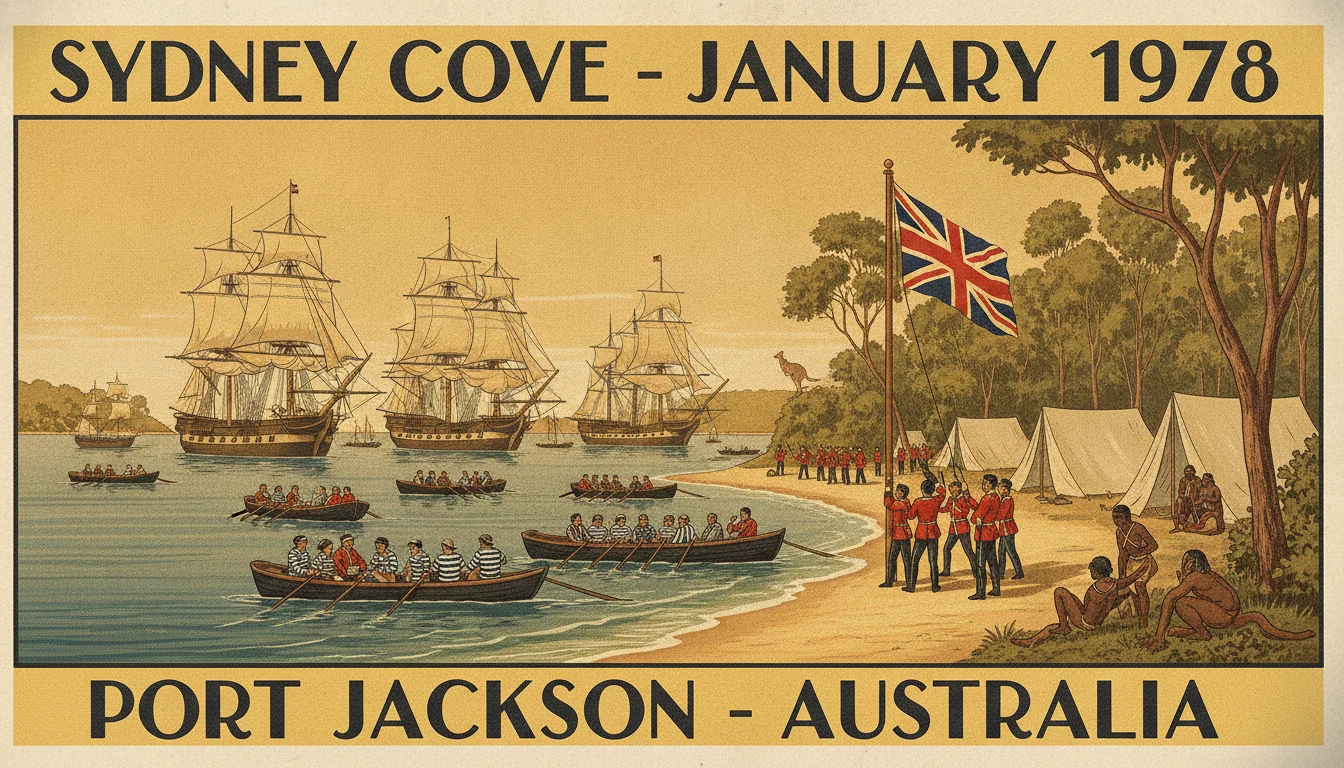
If you have any instinct for self-preservation, July through December 1788 in Sydney Cove is not when you want to be. The rations will be bad by then, the crops will be failing, the convicts will be half-starved, and a smallpox epidemic will be ravaging the Gadigal people who have inhabited this harbour for longer than recorded European history extends. The sweet spot, if such a thing exists in a penal colony at the edge of the known world, is January or early February of 1788, when the First Fleet has just arrived and before the reality of what everyone has gotten themselves into becomes fully apparent.
Here is your guide to surviving it.
First, understand what you are walking into
Sydney Cove is not a town. It is not yet even a settlement. When Governor Arthur Phillip guides his eleven ships into Port Jackson on January 26, 1788, they are arriving at a harbor that the British have never seen before and that they have chosen over the originally intended destination of Botany Bay, which turned out to be too shallow, too exposed, and not nearly as promising as Joseph Banks had suggested after accompanying James Cook here in 1770.
The fleet carries approximately 736 convicts - around 568 men and 191 women, though the numbers vary slightly by source - along with 211 marines, their wives and children, a handful of civil officers, and Governor Phillip himself. The total population of the settlement on day one is roughly 1,000 people. They have brought seeds, livestock, hand tools, and enough provisions to last about two years if everything goes well.
Everything will not go well.
Your cover story: you are a naturalist, attached unofficially to the expedition. Naturalists were a feature of late 18th-century voyages, and the strange flora and fauna of New South Wales will give you a perfectly plausible reason to wander the harbour edges, make notes, and ask questions without arousing suspicion. Do not claim to be a convict. Do not claim to be a marine officer, as the hierarchy is tight and everyone knows everyone. Naturalist is vague enough to be safe.
Dress like someone who just survived eight months at sea
The First Fleet left Portsmouth in May 1787 and arrived in Botany Bay in January 1788 - eight months aboard ships in tropical heat and Southern Ocean cold. Everyone looks worn, which works in your favour.
For men, a plain linen shirt, a wool waistcoat, and rough canvas or woollen trousers will do. Heavy boots that can handle mud - and there will be a great deal of mud. A hat with a brim. If you are posing as a naturalist or minor officer, a dark coat helps, but keep it well-worn.
For women, the situation is more fraught. Female convicts and the wives of marines occupy different social strata, and the colony is small enough that everyone notices everything. A long skirt, a linen blouse, a cap or bonnet, and sturdy shoes are your basics. Avoid anything that looks too clean or too new. Fabric this clean does not exist eight months after leaving Portsmouth.
Do not bring synthetics, zippers, modern waterproofing, or anything with visible text. Your boots should look like they have been resoled at least once.
Know the social geography
The cove is divided almost immediately into zones of status, and crossing them without credentials is noticed.
The marine officers occupy the slightly elevated ground to the east. Governor Phillip has his marquee tent there, and the more senior officials are establishing themselves nearby. This is the social apex of the colony.
The marines and their families are in the middle tier, occupying the flat ground near the stream that runs down from the hills.
The convicts are to the west, in tents or crude brush shelters, under armed guard at night. They are not, by and large, hardened criminals. Most were transported for property crimes: theft of a bolt of cloth, stealing a handkerchief, sheep-stealing, minor fraud. They are poor working-class people of the 1780s who had the bad fortune to be caught. Many are skilled: carpenters, cobblers, sailors, seamstresses. Phillip was shrewd enough to recognize this and assign them accordingly.
If you have arrived as a naturalist you will have some freedom of movement, but be cautious about being found in the convict area after dark. The marines are jumpy and the punishments for disorder are severe.
Three things you absolutely must do
Watch the raising of the flag
On January 26, 1788, at the cove Phillip has named for Thomas Townshend, 1st Viscount Sydney, the British flag goes up. Speeches are made. Toasts are drunk. A volley of muskets is fired. It is a modest ceremony for an act of enormous historical consequence, and the people performing it are mostly just relieved to have arrived alive.
Stand back enough to observe without being press-ganged into official duties. What is interesting is not the ceremony itself but the faces of the convicts watching it, and the faces of the Gadigal people who have begun appearing on the opposite shore of the cove, watching the whole operation with a wariness that hindsight makes devastating.
Find Phillip before the situation deteriorates
Arthur Phillip is one of the more remarkable British colonial administrators of the 18th century, which is a low bar in some respects but genuinely high in others. He ordered that convicts not be treated with unnecessary brutality and gave strict orders against unprovoked violence toward the Eora people. He was 49 years old in 1788, slight, precise, and operating under the constant pressure of knowing that if he failed to establish this colony, there was no cavalry coming.
He is worth speaking to if you can arrange an introduction. He is preoccupied with supply manifests and site surveys, but he will talk to a naturalist if the conversation is about plants or birds. He is also privately worried about the soil, which is sandy and thin and not what the colony needs to grow enough food to survive.
He is right to worry.
Walk the harbour headlands before the trees come down
The trees will start coming down almost immediately, and the native landscape of the Sydney area will begin disappearing from the moment the convicts get axes. In early 1788, Port Jackson is still largely intact: open eucalyptus woodland on sandstone ridges above the harbour, banksias and casuarinas along the foreshore, the smell of salt and the alien sweetness of Australian bush.
You will see animals that make no sense by European frames of reference. The kangaroos have already been observed by the crew - they were the subject of extensive discussion during the Endeavour voyage in 1770 - but they are still startling in person, large and oddly graceful, retreating into the treeline when the settlement noise reaches them.
The people to ask about the local fauna are the Gadigal, who know every animal on this harbour intimately - a conversation that is both harder and more valuable than it sounds.
The thing everyone underestimates
This colony is going to nearly starve. Not as a distant possibility but as a near-certainty that is already embedded in its supply situation.
The fleet has brought seeds appropriate for English conditions that will struggle in the sandy soil around Sydney Cove. The livestock brought as breeding stock will be dispersed, lost, or consumed before they can multiply. The water source is adequate but not abundant. And the supply ships from England - the ones that are supposed to come with reinforcements and provisions - will be very late.
By mid-1788, rations will be reduced. By early 1789, they will be reduced again. By late 1789, the colony will be living on half-rations and the marine officers will be eating their horses. The Second Fleet does not arrive until June 1790, and when it arrives it brings more convicts than supplies, many of the new arrivals already sick and dying after appalling conditions at sea.
If you intend to be in the colony through this period, you need to know where the additional food sources are. The harbour is rich with fish, and the Gadigal know how to catch them; the problem is that the colonists' nets are inadequate and most of the convicts have no fishing experience. Native plants supplement the diet only if you know which ones are edible. A naturalist who can identify local food sources will be extremely popular.
The warning you cannot ignore
A disease is coming. In April 1789, what is almost certainly smallpox will begin killing the Eora people around Sydney Harbour at catastrophic speed. The epidemic moves through communities that have no immunity and wipes out a large fraction of the population in months. Bodies are found on the beaches. The settlement sends people out to look for survivors.
The exact source of the epidemic remains debated. There was no smallpox among the settlers themselves, which rules out direct transmission from the settlers. Smallpox virus was held in the colony's medical stores as a vaccination material. The epidemic's origin is a historical question that has not been definitively resolved.
What is not in question is the scale of the devastation. The Gadigal, who numbered perhaps 50 to 100 people before 1788, are reduced to a handful within a few years. The Eora nation around the harbour loses the majority of its population in the first two years of contact.
You cannot prevent this. You are a visitor, not an agent. But you can, before April 1789, spend time with the people who have lived on this harbour for thousands of years, learn the names they have for the places the settlers are now naming after English lords and politicians, and understand that the history you are witnessing is not only the founding of a colony. It is also the beginning of something else entirely.
Come for the harbour. Come for the brief window in which two worlds are in uncertain and not yet entirely hostile contact. Leave before the rations run out.
For more time-travel guides to the British world at pivotal moments, see A Time Traveler's Guide to Victorian London, 1850 and A Time Traveler's Guide to Restoration London, 1665.
Quick Answers
Common questions about this topic
Who arrived at Sydney Cove in 1788?
The British First Fleet, consisting of 11 ships under Governor Arthur Phillip, arrived at Sydney Cove in Port Jackson on January 26, 1788. The fleet carried approximately 736 convicts, 211 marines and their families, and various officials and crew, all dispatched to establish Britain's first penal colony in New South Wales.
Who were the indigenous people of Sydney Cove?
The Gadigal people, part of the larger Eora nation, had inhabited the south shore of Sydney Harbour for tens of thousands of years before 1788. They called the area Warrane. The arrival of the First Fleet brought smallpox, dispossession, and catastrophic population collapse within the first two years of contact.
Why did Arthur Phillip choose Sydney Cove over Botany Bay?
The First Fleet initially sailed for Botany Bay, as recommended by Joseph Banks after the 1770 Cook expedition, but Phillip found it too shallow, too exposed, and short of fresh water. He scouted northward and found the harbor at Port Jackson - one of the finest natural harbors in the world, he reportedly said - and chose Sydney Cove for the settlement.
What was life like in the first year of Sydney Cove?
Brutal. The colony nearly starved. Crops failed in the sandy soil. Supply ships were late. Rations were cut repeatedly. Disease spread through the convict population. By 1789 the colony was reduced to half-rations and Arthur Phillip was writing increasingly desperate letters to London. The Second Fleet did not arrive until June 1790.

Need Advice from Someone Who Lived There?
Get firsthand accounts from people who actually lived through these moments in history.
Create your free account →No card required. Talk to anyone in history with 8 free credits a day. Some features require a paid plan.
Join the HistorIQly Club
Get smarter about the past.
Weekly stories, deep dives, and exclusive content straight to your inbox.