A Time Traveler's Guide to Venice at Its Peak, 1500
Venice 1500 history, on the ground: the richest city in the Western world, a maritime republic with no king and more gold than most kingdoms.
Read Wikipedia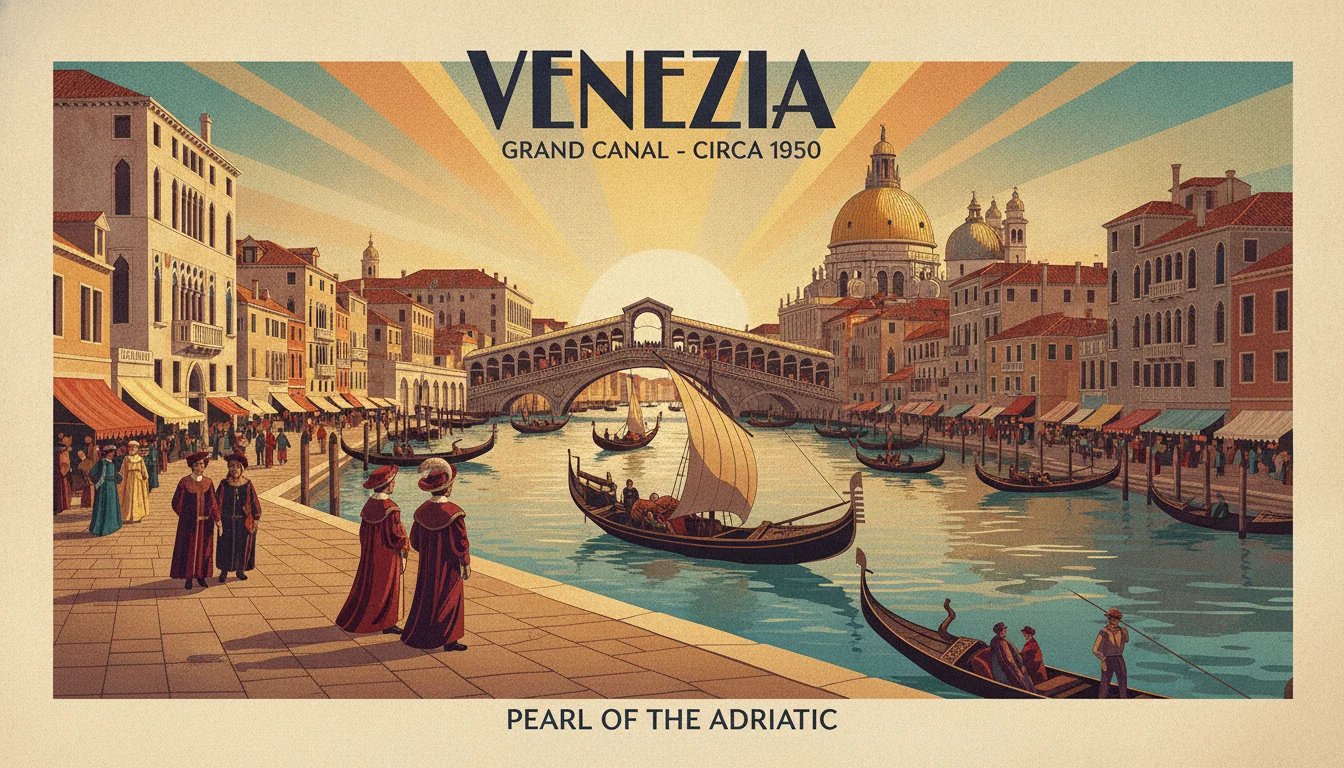
Venice in 1500 has no streets. It has 150 canals, 400 bridges, and a city of 100,000 people packed onto 118 small islands in a saltwater lagoon at the top of the Adriatic Sea. Nothing in your previous travel experience has prepared you for this. The city does not walk; it floats.
It also happens to be the most sophisticated trading republic in the Western world, at approximately the peak of its power, during a cultural flowering that has produced Giovanni Bellini, Vittore Carpaccio, and a young painter named Tiziano Vecellio - better known later as Titian - who is still a teenager working in the Bellini workshop and has not yet made his name. If you want to compare notes with the other great Renaissance city of the era, see A Time Traveler's Guide to Renaissance Florence, 1490.
This is the version of Venice you want. But you will need to be prepared.
Understand what you are entering
The Serenissima - the Most Serene Republic - has been an independent state for more than seven centuries by the time you arrive. It has no king, no hereditary nobility in the usual sense, no feudal obligations to any external power. It has a Doge, currently Agostino Barbarigo, but the Doge is an elected office hemmed in by extraordinary constitutional constraints. He cannot leave the city without Senate approval. He cannot open his mail alone. When he dies, five committees of patricians elect the next one through a balloting process so elaborate it takes almost two days.
Power belongs to the patrician class, roughly 2,000 men whose families are listed in the Libro d'Oro, the Golden Book. They sit in the Great Council, elect the Senate, and in turn elect the Council of Ten, the inner executive body that handles security, foreign intelligence, and anything the Senate cannot debate without causing a scandal. The system has survived since the 12th century largely because it manages factional competition without anyone being able to dominate it for long.
For you as a visitor, this means: there is no court to petition, no royal favorite to cultivate, and no great lord who owns everything around him. Business is conducted on the Rialto. Power is dispersed. This is more familiar to a modern traveler than most of the alternatives in 1500.
Your cover story and dress
Venetians in 1500 are cosmopolitan by necessity. The city's merchants trade with the Levant, Egypt, Germany, England, and the Ottoman Empire. Greek, Arabic, German, and Turkish are audible in the Rialto market on any given morning. A foreigner with money is not unusual here; a foreigner without a plausible explanation for why they are here is worth watching.
The safest cover is a German or Flemish merchant, possibly dealing in cloth or metal goods. German merchants are already numerous enough in Venice to have their own building, the Fondaco dei Tedeschi near the Rialto Bridge, which the Venetian government provides them as a residency and warehouse in exchange for a percentage of their trade. You can present yourself as recently arrived from Augsburg or Nuremberg.
For dress, a wealthy foreign merchant should wear:
- A long dark wool gown, possibly lined with fur if you can afford it
- A plain linen shirt underneath, with a high collar
- A flat cap or a simple bonnet, depending on the formality of the occasion
- Shoes with a modest heel
Avoid the elaborate slashed velvet doublets of the Venetian patricians unless you are playing the part of a very rich man, which invites both admiration and targeted pricing. A prosperous but modest merchant's appearance will serve better.
Getting around
There are no horses in Venice. The streets, where streets exist at all, are too narrow for them. Movement is by foot over bridges or by gondola on the canals. A gondola for private hire is the 1500 equivalent of a taxi and similarly priced relative to local wages. For short distances, you walk.
The Grand Canal is the main artery, S-shaped and nearly four kilometers long. Ferries called traghetti cross it at fixed points for a small coin. The Rialto Bridge, at this point, is a wooden structure that can be drawn up to allow larger vessels to pass; the stone bridge that modern tourists photograph was not completed until 1591. This fact will confuse you if you are looking for the landmark.
Orient yourself by campanile. Every sestiere (the six neighborhoods into which Venice is divided) has its own bell tower. San Marco's campanile is the tallest. The Rialto district is the commercial heart, and the Piazza San Marco is the political and ceremonial one.
What to eat and drink
The food in Venice reflects the city's trading empire. You will find spices here - pepper, cinnamon, ginger - in quantities and at prices unavailable elsewhere in Europe. The city's cuisine at this level is sophisticated: roasted meats, stockfish, fresh lagoon seafood including the famous sarde in saor (sardines with vinegar and onions, a dish designed to preserve fish on long voyages), and risotto-style grain dishes, though the dish called risotto by that name has not quite yet arrived.
Wine comes from the Venetian terraferma - the mainland territories - or from the Greek islands the republic controls. Soave and Bardolino are already being produced. Local water from the city's cisterns is generally drinkable but treat it with caution; Venetians tend toward wine at meals for good reason.
What to see
The Piazza San Marco is the civic showpiece. The Basilica of San Marco, finished in its current form a century earlier, is covered in gold mosaics that make it look like a Byzantine church imported wholesale from Constantinople - which is not far from what happened, since much of its ornamentation was looted from that city during the Fourth Crusade in 1204. The horses above the portal are from Constantinople's Hippodrome, taken from a city you can visit at an earlier moment in A Time Traveler's Guide to Byzantine Constantinople, 540.
The Doge's Palace next door is the seat of government and one of the most beautiful buildings in Europe at this moment. The Venetians are not shy about demonstrating their wealth architecturally.
Make time for Murano, the separate island where glassblowers have been required to operate since 1291 - moved there to reduce fire risk to the main city. The process of making Venetian glass, and the specific techniques for making cristallo (clear glass), are trade secrets of the highest order. The glassblowers themselves are both celebrated and trapped; leaving Venice with their knowledge is technically illegal.
The Arsenal, on the eastern end of the city, is the largest industrial complex in the world at this point in history. It employs thousands of workers and can produce a warship in a single day when operating at full capacity. Dante mentioned it in the Inferno. You will not be admitted without legitimate purpose.
Dangers and cautions
Plague is the permanent background threat in Venice. The city has better public health protocols than anywhere else in Europe - it invented the quarantine system, derived from the word quarantina meaning forty days, the period foreign ships must wait before unloading at the main port. But periodic outbreaks still occur, and if you arrive when one is circulating, the city becomes a different place entirely.
The waters are dangerous at night. There are no lights on the canals, bridges have no railings in most places, and a misjudged step in the dark will drop you into cold, dark water. Venetians know this and move carefully. You should too.
Theft in the Rialto is subtle and professional. Experienced merchants will count your change twice. The city's courtesans, regulated by the republic and numerous enough to be catalogued in printed guidebooks for visitors, are not a danger to body but can be an effective drain on a travel budget.
The cracks in the golden city
Any account of Venice 1500 history has to end with this warning sign. By 1500, Venice has already received the news that Vasco da Gama reached India by sea in 1498. The implications have not fully materialized yet, but Venetian merchants understand what a sea route that bypasses the Levant eventually means for their monopoly on Eastern goods. The city is still rich, still powerful, still the essential entrepot of European trade. But the business model that built it is under pressure, and the people who built it are smart enough to know it.
The golden age you are visiting is real. It is also, though nobody yet says it plainly, beginning to end.
Quick Answers
Common questions about this topic
What was Venice like in 1500?
Venice in 1500 was one of the largest and wealthiest cities in Europe, with a population of roughly 100,000. It was the capital of a maritime empire stretching from the Dalmatian coast to Cyprus, and controlled the spice trade between the Levant and Northern Europe. The city was governed as an oligarchic republic with no king, a feature that struck most visitors as remarkable.
Who ruled Venice in 1500?
In 1500, Venice was governed by its Doge, Agostino Barbarigo, who had held the office since 1486. The Doge was the elected head of state but operated within strict constitutional limits - he could not leave Venice without permission, could not open his own correspondence without witnesses, and was surrounded by advisors who shared his power. Real governance lay with the Senate, the Council of Ten, and the Great Council of patrician families.
How important was Venice's spice trade in 1500?
The spice trade was the foundation of Venice's wealth. Venetian merchants controlled the overland and sea routes from the Levant to European markets, acting as the essential middlemen for pepper, cinnamon, cloves, nutmeg, and silk. In 1498, Vasco da Gama completed the first sea voyage to India via the Cape of Good Hope, which threatened to eventually bypass Venice entirely. By 1500, Venetian merchants were already feeling the pressure.
Was Venice safe for visitors in 1500?
Venice was remarkably safe by medieval and Renaissance standards - the republic maintained strict order and prided itself on a kind of civic peace unusual for the era. The main dangers for visitors were disease (plague outbreaks were periodic), financial predation by skilled merchants who knew their business, and getting lost in a city with no street names and canals instead of roads. Violence against travelers was rare.

Need Advice from Someone Who Lived There?
Get firsthand accounts from people who actually lived through these moments in history.
Create your free account →No card required. Some figures and features require a paid plan.
Join the HistorIQly Club
Get smarter about the past.
Weekly stories, deep dives, and exclusive content straight to your inbox.