A Time Traveler's Guide to Cham Vijaya, 1200
The Champa kingdom capital in 1200 CE offered brick sanctuaries, Sanskrit priests, and maritime traders - a sophisticated civilization standing on the eve of catastrophe.
Read Wikipedia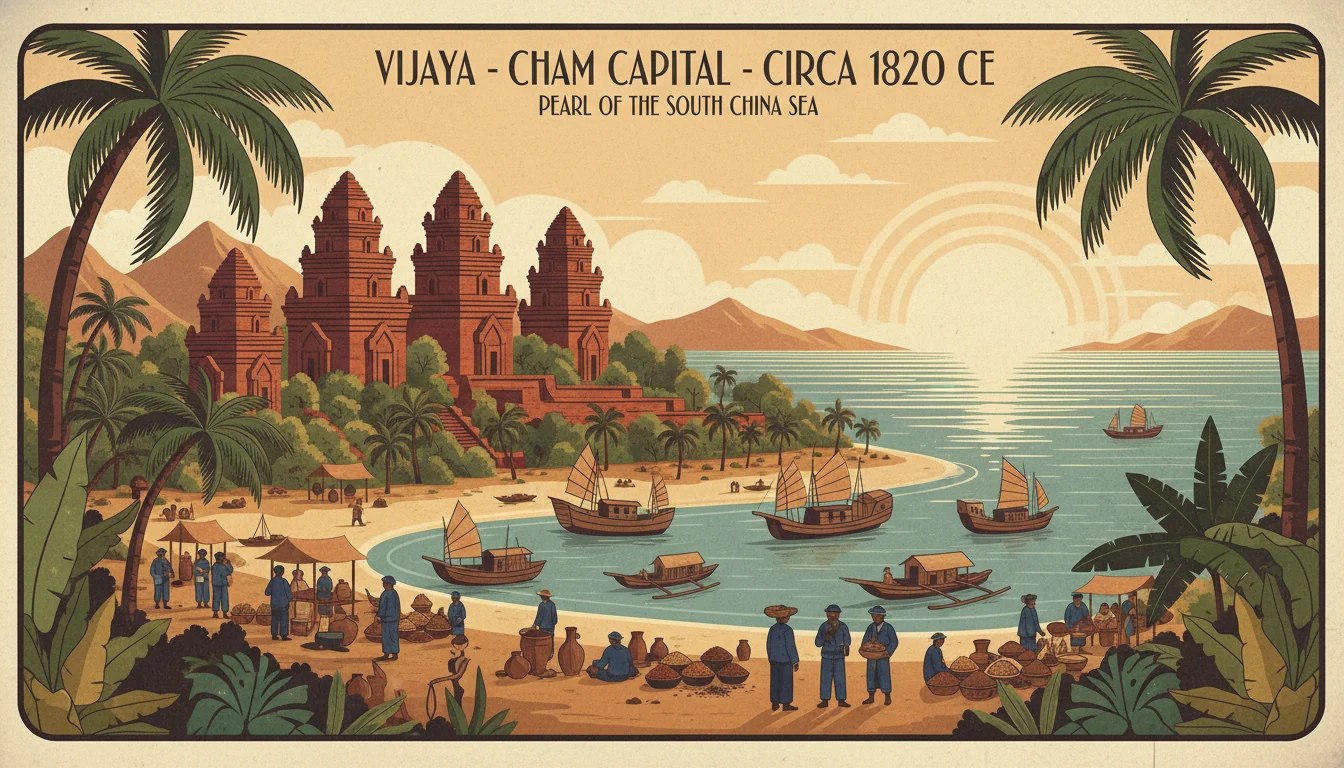
You are standing at the top of a brick staircase on a low hilltop east of the Cham capital, and every direction offers you something extraordinary. To the west, the walled city of Vijaya stretches along the coastal plain, its rooftops and towers rising above teak and palm. To the east, the South China Sea glitters a shade of green that nobody who grew up in Europe would believe was real. Anchored in the river mouth below you are Chinese merchant junks, Javanese sailing vessels with distinctive outriggers, and a Cham war fleet of long-hulled wooden ships painted in red and ochre.
It is around the year 1200, and the Champa kingdom is alive, sophisticated, dangerous to underestimate, and in far more trouble than anyone in this city has yet accepted.
Before you arrive
You need to understand what kind of civilization you are entering, because it will not fit any of your existing categories.
The Cham are not Khmer. They are not Vietnamese. They are an Austronesian people who sailed to mainland Southeast Asia from island origins, settled the coastal strip of what is now central and southern Vietnam, absorbed several thousand years of Indian cultural influence, built a Hindu-Buddhist civilization of genuine architectural achievement, and survived as a distinct kingdom through fifteen centuries of pressure from neighbors on every side.
Their language is related to Malay and Javanese, not to Vietnamese or Khmer. Their script, derived from Brahmi via an Indian intermediary, runs down sandstone and brick in elegant steles. Their priests speak Sanskrit for ritual purposes and Cham for everything else. Their merchants speak whichever trade language their current customer needs.
Your cover story should be that of a Tamil or Javanese merchant. Trade is the framework through which Vijaya understands all strangers. You will not be the most exotic visitor on the waterfront this week.
Getting oriented in Vijaya
The capital in 1200 is a walled urban center surrounded by agricultural plains watered by the Kon and Ha Thanh rivers. The royal palace complex is in the inner city, heavily guarded and not a place for casual visitors. The temple precincts are more accessible. The market is the safest public space of all.
The brick towers you see on hilltops throughout the region are not the city itself; they are the ritual infrastructure of the kingdom, sanctuaries dedicated to Shiva and to the deified ancestors of Cham kings. Each tower, called a kalan, is oriented east, built of fired brick with an interior altar holding a sacred image or lingam. Priests attend them daily. The towers are active religious sites, not monuments, and you should treat them accordingly: remove your sandals, make the appropriate gesture of respect, and do not handle anything on an altar.
The towers in the Binh Dinh region around Vijaya range from modest single towers to the more elaborate multi-tower complexes that suggest the wealth and ambition of Cham rulers at their high point. The largest complex you will see is the Duong Long group, whose central tower, still under construction or recently completed, reaches a height that commands the plain for miles. It is the tallest Cham tower ever built, and it is here that you understand the Cham relationship to brick as both material and metaphor: they build for permanence on a scale that announces confidence in the future.
That confidence is not well-founded in 1200, but nobody has gotten the message yet.
What to wear, carry, and expect
Cotton and silk are the appropriate fabrics. Bright colors, particularly reds and yellows, are favored by those who can afford them. Linen is a marker of coastal trade culture. Wool would mark you as someone from far away, which is fine for a merchant cover but will prompt questions.
Sandals are standard. Bare feet are for temples and formal audiences. Anything resembling armor or weapons will draw immediate attention from royal guards. Carry a brass or bronze object - a small figure, a ring, a handled cup - as currency of introduction with the kinds of people you want to meet.
Expect heat. The coastal plain of Binh Dinh in any season is humid and warm. The wet season brings heavy rain from the northeast monsoon between roughly October and January; the dry season from February through August is less brutal. Arrive in the dry months if you want mobility.
Expect mosquitoes after dark. Expect extraordinary food: freshwater fish from the rivers, saltwater fish from the coast, river crabs, rice in several varieties, vegetables you will not recognize, and spice preparations that the Cham have been refining through centuries of Indian Ocean trade.
Three things to see
The tower complex on the hill
Whatever complex is nearest to you on arrival - and there will be one within walking distance of any part of the Vijaya region - is worth a full morning. The construction technique the Cham use to build their towers has puzzled later scholars precisely because it works so well. The bricks fit with extraordinary tightness, appear to have been assembled using some form of fired-in-place bonding rather than mortar as it is understood elsewhere, and have in many cases survived eight centuries better than medieval European stone construction.
Watch the priests. The ritual is Shaiva - the lingam at the center of the altar represents Shiva as cosmic creator and destroyer - but the ceremony has been translated into a specifically Cham idiom over centuries. The Sanskrit invocations are real Sanskrit. The gestures and offerings carry both Indian inheritance and local innovation. This is what syncretism looks like when it has had time to mature.
The port and the market
The waterfront market at Vijaya is the city's real nervous system. It runs from before dawn - when the fishing boats come in - until late afternoon. What you will find there is a working demonstration of the Indian Ocean trade network at its 12th-century peak.
Ceramics from China are stacked in merchant stalls beside Indian cotton and Javanese spices. Cham textiles, particularly a distinctive woven silk that is beginning to develop the geometric patterns that will later characterize Cham weaving, are sold alongside Vietnamese lacquerware from the north. Camphor, aloe wood, cinnamon, and ivory from the Cham interior highlands are the exports that make this waterfront wealthy.
The traders you will meet represent a dozen languages and several religions. A Tamil Shaiva merchant and a Chinese Buddhist sailor and a Javanese animist captain can all share a meal on the dockside without incident. Commerce is its own religion, and Vijaya is one of its temples.
An evening at a noble household
If your cover story holds and your introductions are good, you may be invited to eat with a lesser noble family. Accept. The food will be extraordinary. The entertainment will likely include music - drums, metallophones, and a double-reed instrument whose sound is unlike anything from East Asia or India proper - and possibly dance.
Cham court dance is a refined tradition that has been developing since at least the 7th or 8th century, as seen in carvings from earlier temple sites. The stylized hand gestures are related to Indian mudra traditions but distinctively Cham in their elaboration. Watching a trained dancer perform by torchlight in a wooden hall in Vijaya in 1200 is one of the more reliable ways to understand what it means for a civilization to have its own aesthetic language.
The trouble on the horizon
If you are paying attention, you will notice tension in the city that the public performances do not acknowledge. The Khmer Empire to the west, under its ruler Jayavarman VII, has been on a campaign of expansion for two decades. Jayavarman VII is a Buddhist monarch of unusual energy who has been building hospitals and rest houses across his empire and simultaneously conquering his neighbors. Champa has not yet fallen to him at this exact moment, but the campaigns have begun and the pressure is real.
The Cham kingdom will not survive the 13th century intact. It will be occupied, pushed southward, and eventually reduced to a fragment of its former territory over the following centuries, squeezed between expanding Vietnamese power from the north and Khmer then other pressures from the west. The towers will outlast the kingdom by centuries. The Cham people will persist, reduced in number and territory, to the present day - a community still present in Vietnam and Cambodia, still practicing a form of Islam layered over the Hindu-Buddhist inheritance, still weaving the geometric cloth.
But in 1200, the towers are still being built and the fleet is still in the river mouth and the market is still running. Whatever is coming has not arrived yet. Eat the fish. Watch the dance. Walk up to the kalan on the hill and leave your sandals at the door.
You are in one of the most interesting cities in the medieval world, and it will not look like this for much longer. The Khmer Empire pressing on Champa's borders from the west is at the height of its own cultural florescence - explored in the guide to visiting Khmer Angkor in 1150. For a very different kind of medieval city thriving at the same historical moment, the guide to visiting Mayan Tikal in 750 covers a civilization that also reached its peak and fell before it was truly understood.
Quick Answers
Common questions about this topic
Where was Vijaya, the Cham capital?
Vijaya, also known as Cha Ban, was the political capital of the Champa kingdom from around the 10th century. It was located near what is now Quy Nhon in Binh Dinh province, in central Vietnam. The surrounding region was dense with brick tower sanctuaries that still survive, including the Banh It and Duong Long tower groups.
What religion did the Cham follow?
The Cham practiced a form of Hinduism centered on Shaiva worship, with Shiva as the supreme deity. Buddhist traditions also had a presence, particularly among merchants and at certain royal courts. Sanskrit was the language of ritual, inscription, and royal prestige, while the Cham language, from the Austronesian family, was used in everyday life and in a parallel written tradition.
What was happening in Champa around 1200?
Around 1200, the Champa kingdom was under significant pressure. The Khmer Empire under Jayavarman VII was at the height of its power and had launched major campaigns against Champa. A Khmer invasion would lead to the occupation of Champa for a period in the early 13th century. For a traveler arriving in 1200, the city of Vijaya exists in a moment of tension, caught between an established culture of remarkable sophistication and an approaching political storm.
What are the Cham towers and why do they survive?
The Cham built brick tower sanctuaries called kalans, typically on hilltops, as temples to Shiva and other deities. They used a distinctive construction technique, possibly involving resin-coated brick and fired-in-place mortar, that has given many towers exceptional durability. Dozens survive across central and southern Vietnam, the best known being the Po Nagar towers near Nha Trang and the Banh It and Duong Long complexes in Binh Dinh province.

Need Advice from Someone Who Lived There?
Get firsthand accounts from people who actually lived through these moments in history.
Create your free account →No card required. Talk to anyone in history with 8 free credits a day. Some features require a paid plan.
Join the HistorIQly Club
Get smarter about the past.
Weekly stories, deep dives, and exclusive content straight to your inbox.