A Time Traveler's Guide to Plantagenet Westminster, 1200
Plantagenet Westminster in 1200: a waterlogged royal seat, a freshly crowned king nobody trusts, and the roots of Magna Carta already taking shape. A guide for careful visitors.
Read Wikipedia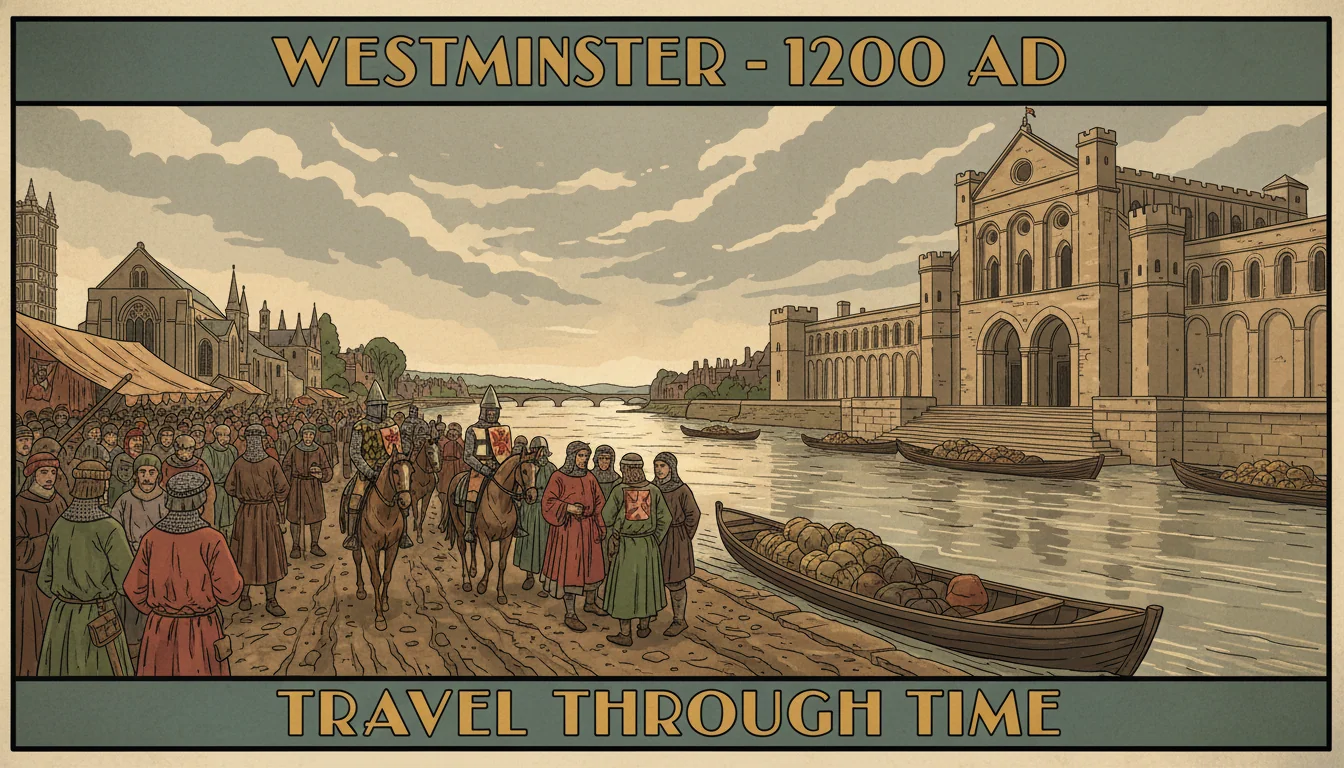
Set your arrival for December. The sky will be a low grey blanket over the Thames, the river will smell powerfully of mud and fish, and the building site that will eventually become one of Europe's great political centers is, right now, a collection of stone halls, a recently reburied abbey, and a deeply uncertain king.
Plantagenet Westminster in 1200 was the nerve center of English royal power - and it is not London. It is something smaller and, in its way, more important. This is where English royal government happens: where the king holds court, where the Exchequer counts its coin, where the great men of the realm come to petition, bribe, argue, and occasionally kneel. If you want to understand how England works at the turn of the 13th century, this is the place to be.
Before you step off whatever you arrived on, here is your practical guide to the year.
Know who is in charge, and be cautious about it
John, the youngest son of Henry II and Eleanor of Aquitaine, became king in May 1199 when his older brother Richard I died of a wound at a siege in the Limousin. Richard had no legitimate children. John, already a problematic political actor, was the heir.
Christmas 1200 is John's second Christmas as king. He has, this past summer, divorced his first wife Isabella of Gloucester and married Isabella of Angouleme, a teenager from a strategically important French county. His new wife is with him. His position in France is beginning to show cracks: his nephew Arthur of Brittany has rival supporters, and the French king Philip II is watching for opportunities.
John is intelligent, suspicious, energetic, and not well liked. His father's former administrators distrust him. His barons are watching him with the particular wariness of men who know what he can do to those he suspects. He has a reputation for arbitrary cruelty. He is also, when he chooses, capable of charm and brilliance.
The political atmosphere at Westminster in December 1200 is not panicked, but it is watchful. Keep your opinions about the succession, the French territories, and the relative merits of King John to yourself and to the privacy of your own head.
Your cover story
The safest identity for a foreign visitor at Plantagenet Westminster is a merchant or minor cleric with business at the court. The court regularly receives foreign merchants, especially from the trading cities of the Low Countries and northern France, and a man or woman who presents as having come from Bruges, Paris, or the cities of the Rhine faces less scrutiny than an unexplained English figure with unfamiliar mannerisms.
If you can manage any passable Anglo-Norman French, use it. It is the language of power and of anyone who wishes to be taken seriously above the level of a common laborer. Latin will serve you well with clergy and in any written communication. Middle English will mark you as a person of lower station, which has its own advantages if you want to move through the town market and the waterfront without being noticed.
Do not claim to be from anywhere in the lands currently contested with the French crown. Do not express sympathy for Arthur of Brittany. Do not mention the Interdict that will fall on England in 1208 - it has not happened yet, and the mention would be inexplicable.
Dress for the season and the occasion
Plantagenet court dress in 1200 is heavy, colorful, and layered. Sumptuary conventions are not yet codified into formal law the way they will be later in the medieval period, but convention does the same work: the wrong fabric in the wrong context marks you immediately.
For men, the basic ensemble includes:
- a long tunic of wool or linen reaching to the mid-thigh or knee, belted at the waist
- a mantle or cloak of heavier wool, fastened at the right shoulder with a pin or brooch
- linen braies beneath the tunic, visible only at the ankle
- wool chausses (leg wrappings or fitted stockings) tied at the knee
- low leather shoes with a pointed toe
For women:
- a long linen chemise next to the skin
- a fitted wool gown called a bliaut over the chemise, with tight sleeves to the wrist
- a mantle over the gown, often in a contrasting color
- a white linen head-covering for married women or those wishing to appear respectable
- leather slippers inside buildings, wooden pattens in the mud
Bright colors - scarlet, blue, green - are expensive and signal wealth. Undyed wool, grey, and brown indicate a working person. If you intend to move through both worlds in a single day, a neutral mid-quality wool mantle over a reasonably cut tunic will serve. Do not wear gold embroidery unless you are prepared to explain yourself.
Getting around
Westminster sits on the north bank of the Thames roughly two miles upstream from the city of London. There is no bridge at Westminster. The only fixed crossing over the Thames in this part of the world is London Bridge, nearly two miles downstream in the heart of the city, a remarkable structure of stone arches built on the ruins of a Roman predecessor.
If you need to cross the Thames from Westminster, you hire a boat. Wherrymen who work the foreshore below the palace steps can take you across for a small coin. The crossing takes a few minutes in calm weather and is dangerous when the tide is running fast or the river floods, which it does in winter.
To reach the city of London from Westminster, you walk or ride east along the Strand, a road that follows the north bank of the river through an increasingly built-up area of noble townhouses and religious foundations. On a dry winter day it takes perhaps half an hour on foot. In the mud and rain that characterizes English December, allow for considerably more.
What to see
Westminster Hall
The great hall built by William II between 1097 and 1099 is one of the largest secular buildings in northern Europe. Its stone walls and timber roof enclose a space that functions simultaneously as a royal reception chamber, a market hall, a law court, and an administrative center. On a busy court day the hall fills with petitioners, officials, merchants, and servants moving in all directions at once.
The hall is formally open to those with legitimate business at court and, less formally, to anyone who can look purposeful and is not obviously out of place. Stand near the south end and watch the administrative machinery of a medieval kingdom in motion. You will see royal clerks copying documents, magnates waiting for an audience with the king's officials, and someone arguing their case before a royal judge.
Westminster Abbey
Edward the Confessor's abbey, consecrated in 1065, sits a short walk west of the hall. What you see now is the Romanesque structure of the Confessor's building - solid Norman arches, a low tower, a nave built for Benedictine monks rather than royal pageantry. Henry III will begin tearing most of it down and rebuilding in Gothic style starting in 1245, creating the abbey recognizable today. In 1200 it is older, plainer, and very much a working monastery.
The Benedictine community here is one of the most powerful and politically connected monastic houses in England. The monks sing the canonical hours, maintain the royal library, and serve as the administrative memory of the English crown. Visitors are permitted in the nave at certain hours. The cloister and monk's quarters are not for you.
The Thames waterfront
Westminster's riverfront below the palace is a working quay. Flat-bottomed boats deliver stone, timber, and provisions for the royal household. Fishermen sell directly from their boats. Merchants arriving from upstream or downstream find anchorage here or at the various religious-foundation wharves along the bank.
Walk the waterfront slowly on a cold morning, buy something hot if you can manage the language - pottage sold from a brazier, small baked goods - and watch the river traffic. The Thames in 1200 is the main artery of English commerce, and Westminster's stretch of it is a working river full of small craft doing the actual work of supplying a royal court.
What to eat and drink
Do not drink the water. This is not a modern concern about municipal infrastructure - it is a current and genuine danger. The Thames is also the city's drainage system, and wells are not reliably clean.
Ale is the default beverage at every level of society except the richest households and the clergy, who drink wine. You will be offered ale everywhere. It is lower in alcohol than modern beer, slightly sour, and not always good, but it is safer than the alternative.
Food for a traveler of middling status means bread, pottage (a thick stew of grain, legumes, and whatever vegetables and scraps of meat are available), salted fish on Fridays and the other many fast days of the church calendar, and fresh meat when you can afford it and the calendar permits. The royal court's kitchens produce roast meat, river fish, spiced pastries, and imported fruit and spices for those at the upper tables. You will not be at the upper tables.
What to avoid
King John's justice is famously arbitrary. Stay away from anything that looks like a legal dispute involving magnates, and do not take sides in any conversation about the king's relationship with his barons or his French territories. People at court have long memories and short tempers about those subjects.
The river floods regularly in winter. If the water levels at the waterfront look unusually high, move uphill immediately and stay there.
December in southern England in 1200 is genuinely cold, damp, and dark. Hypothermia is a real risk if you are wet and cannot find warmth. Keep your wool dry, stay near the fires in the hall during the evenings, and do not attempt the road to London after dark.
Leave before 1202. What happens to Arthur of Brittany that year is not a topic you want to be nearby for.
For related guides to medieval Europe, see A Time Traveler's Guide to Medieval Paris, 1300 and Time Traveler's Guide to Medieval Venice, 1300.
Quick Answers
Common questions about this topic
What was Westminster like in 1200?
Westminster in 1200 was the seat of English royal government - a cluster of stone buildings around the great hall built by William II in 1099, a nearby Benedictine abbey, and a muddy waterfront on the Thames. It was not yet a city in its own right but a royal administrative center about two miles upstream from the commercial city of London.
Who was king of England in 1200?
John, the youngest son of Henry II and Eleanor of Aquitaine, had been king since May 1199, when his brother Richard I died of a crossbow wound in France. Christmas 1200 was John's second Christmas as king. He was already maneuvering politically and had just contracted a second marriage to Isabella of Angouleme that summer.
What language did people speak in Westminster in 1200?
The court and aristocracy spoke Anglo-Norman French, a dialect of Old French brought to England by the Normans in 1066. The common people spoke Middle English, which would be barely comprehensible to a modern speaker. Latin was used for church services, royal documents, and most written administration.
Was Westminster the same as London in 1200?
No. Westminster and London were separate settlements in 1200. London was the older commercial city enclosed by its ancient Roman walls, about two miles downstream on the Thames. Westminster was the royal and ecclesiastical center upstream. The two would not effectively merge until centuries later.

Need Advice from Someone Who Lived There?
Get firsthand accounts from people who actually lived through these moments in history.
Create your free account →No card required. Some figures and features require a paid plan.
Join the HistorIQly Club
Get smarter about the past.
Weekly stories, deep dives, and exclusive content straight to your inbox.