A Time Traveler's Guide to Chimu Chan Chan, 1300
In 1300 CE, Chan Chan and Chimu power dominated Peru's coast. This guide covers how to navigate the largest adobe city on Earth before midday.
Read Wikipedia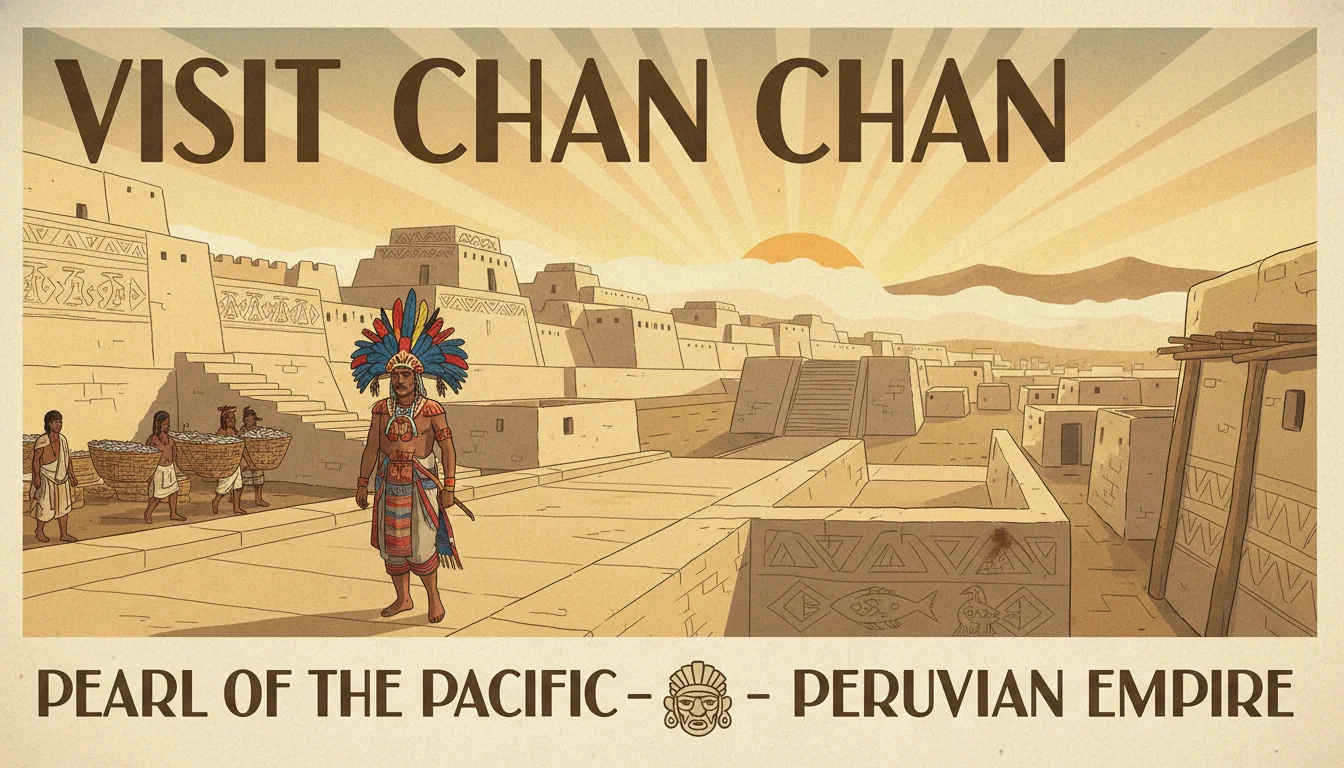
The Pacific fog sits low over the Moche Valley in the early morning, thick enough to taste salt in it. Beyond the city walls, the desert runs to the horizon in every direction - the Atacama is not far, and the land here is one of the driest places on Earth. Inside those walls, however, a city of tens of thousands has built something extraordinary: a civilization of gold, fish, and adobe brick, stacked into compounds so large that walking from one end to the other takes most of a day.
You are in Chan Chan, capital of the Chimu Kingdom, in the year 1300. You have arrived at the height of the city's power, a generation before the late construction campaigns and well before the Inca arrive to dismantle what was built here. This is the largest city on the continent. You should plan your visit accordingly.
What kind of place this is
The Chimu are the inheritors of the Moche culture, whose distinctive ceramics and irrigation systems preceded them by several centuries. The guide to the Moche at their peak covers the civilization that laid the groundwork for what you are about to see. Chan Chan sits in the Moche River valley, a narrow band of irrigated green flanked immediately by coastal desert to the south and dry hills to the east. The ocean is close - you can hear it from the highest platform in the ciudadelas on a quiet morning.
Chan Chan's wealth is built on two things: fish and water. The sea off this coast is among the most productive fishing grounds on Earth, enriched by the Humboldt Current. Dried anchovies, sardines, and shellfish move inland from the coast in exchange for highland goods. The city's agriculture depends entirely on an elaborate canal system fed by the Moche and Chicama rivers - without the canals, the city cannot eat, and the Chimu know this. Maintaining the irrigation network is a state function as central as maintaining the army.
The city itself is not a unified space. Think of it as a collection of massive walled compounds, the ciudadelas, each the palace and eventual mausoleum of a royal dynasty, surrounded by barrios of artisans, merchants, and fishing families. The outer precincts are dense, low, and loud. The inner precincts are controlled space, governed by protocol, and accessible only if you have a reason to be there.
What to wear
Do not arrive in modern clothing. The Chimu aesthetic is specific and status-conscious.
Common people in Chan Chan wear cotton tunics, undyed or in simple earth tones. Cotton is cultivated in the valley, and weaving is a significant industry. Your safest cover is as a traveling trader from a coastal community to the north or south - the Chimu trade extensively along the Peruvian coast by balsa log raft, and strangers from distant communities are not uncommon in the port barrios.
Wear a plain cotton tunic reaching to mid-thigh or knee, fiber sandals, and a simple woven headband or plain cap. Avoid any gold or silver ornamentation. In Chan Chan, precious metal signals rank, and wearing it without the rank to match invites swift and uncomfortable attention from the city's officials. The elite wear elaborate headdresses, gold ear ornaments, and pectorals of hammered copper and silver that can weigh several kilograms. You are not the elite.
Navigating the city
Chan Chan is not difficult to navigate once you understand its organization. The ciudadelas are the landmarks - enormous rectangular enclosures surrounded by walls that reach nine meters in height, decorated with friezes of fish, birds, and geometric patterns in relief. Each ciudadela faces the ocean or the prevailing wind, with its main entrance oriented toward the north.
You will not enter a ciudadela uninvited. They are restricted space, governed by a class of administrators and ritual specialists who control access to the royal person and to the burial platforms of the royal ancestors. Approach the entrance, observe the guards, and go no further.
The outer city, however, is open. The market barrios near the western edge of the city concentrate the fishing trade and coastal merchants. Dried fish is sold by weight. Dried chili and maize arrive from highland traders. Shells for ornament come from as far north as Ecuador. The chicha stalls - sellers of fermented maize beer - are easy to find by smell.
What to eat
The safest meal in Chan Chan is what the city eats daily: boiled or roasted fish, dried chili, and a grain paste made from maize. Chicha, fermented corn beer, is consumed with every meal at all social levels. If you are offered chicha, accept it. Refusing without a specific ritual justification is rude.
The fish here are excellent. Anchovies are the staple, but you will also find sea bass, mullet, and on good days crab and large shrimp from the reed beds near the river mouth. Eat the fish. Avoid any land meat that has been sitting in the midday heat. The preservation methods used here for fish are effective; for other meats, less so.
Do not drink standing water. The city's canal system is well-maintained, but the lower barrios near the southern edge draw from channels that also receive waste. Chicha, made from boiled liquid, is safer than anything unboiled.
Three things you must see
The Chan Chan friezes. Even from outside the ciudadela walls, you can see the relief decoration on the exterior surfaces - geometric nets, stylized pelicans and sea otters, repeating wave patterns that encode the ocean's importance to everything here. Take time with these. Later generations will not preserve them well, and the rains that El Nino years bring are already softening the exposed surfaces.
The fishing quarter. The barrio near the ocean side of the city is a working port community with a directness of purpose that the royal precincts lack. Men sit repairing balsa log rafts and knotting nets from agave fiber. Women sort dried fish and argue over weights. Children run along the low walls. This is the engine of Chan Chan, and it smells exactly as productive as it is.
The metalworking district. Chan Chan's goldwork and silverwork will eventually reach a level of technical sophistication that astonishes Spanish observers a century and a half from now. You can observe the workshops from outside. Hammering and lost-wax casting are both in use. Do not attempt to acquire metalwork. Its ownership is tightly regulated, and your cover as a visiting coastal trader does not include arriving with Chimu goldwork in your bag.
Health and practical dangers
The practical dangers of Chan Chan in 1300 are not dramatic but they are consistent.
Altitude is not a concern - the city sits at sea level. Heat and sun are. The Peruvian coastal desert generates powerful ultraviolet radiation even through the morning fog, and the midday hours on exposed streets are harsh. Move in shade when you can. Keep your head covered.
Waterborne illness is the primary health risk. Stick to chicha. Cuts and abrasions heal slowly in salt air and should be kept clean. The city's healers use plant-based remedies and ritual intervention; if you need actual medical treatment, you are largely on your own.
Do not get into disputes over property or precedence. The Chimu legal system resolves these disputes in favor of the party with higher rank, and your rank as an unsponsored foreign traveler defaults to low.
What not to do
Do not touch or interfere with any item associated with the royal household or the ciudadelas. The Chimu conception of sacred objects extends well beyond what you might recognize as explicitly religious items.
Do not enter the burial platforms within a ciudadela. Even surviving relatives of deceased rulers approach these spaces with careful protocol.
Do not comment on the succession, the relative merits of current and previous rulers, or the management of the irrigation canals. You do not know the internal politics well enough to survive getting them wrong.
Do not arrive after dark without a specific destination and a credible explanation for why you are there. The outer city at night is not hostile to strangers, but unaccompanied foreigners moving through barrios after dark attract the kind of attention that will complicate your departure.
The thing to carry with you
You will leave Chan Chan with the impression of a city that has solved a very difficult problem: how to build a large, complex, hierarchical society in one of the driest places on Earth, using nothing but labor, water management, and the extraordinary productivity of a cold ocean current. The adobe walls will not last forever - the rains that come every decade or so are already softening their bases. But in 1300 they stand, massive and cream-colored in the morning fog, as a demonstration of what organized human effort produces when aimed at the right problems.
Stand on the outer city wall at sunrise and watch the fishing rafts go out past the breaking surf. The Pacific is cold, silver-green, and full of food. The people launching those rafts have built an empire on that fact, and they are not surprised by it. For the Andean empire that eventually absorbed Chan Chan, see the guide to Inca Cusco in 1450.
Quick Answers
Common questions about this topic
What was Chan Chan?
Chan Chan was the capital of the Chimu Kingdom (Kingdom of Chimor) on the northern coast of present-day Peru. Founded around 850 CE and reaching its peak between roughly 1200 and 1400, it was the largest pre-Columbian city in South America and the largest adobe city in the world, eventually covering more than 20 square kilometers.
What happened to Chan Chan?
The Chimu were conquered by the expanding Inca Empire around 1470 CE during the reign of Tupac Inca Yupanqui. The Inca deported the Chimu king and many skilled metalworkers to Cusco. Chan Chan was gradually abandoned. The ruins still stand near modern Trujillo, Peru, and are a UNESCO World Heritage Site.
What language did the Chimu speak?
The Chimu spoke Mochica, also called Yunga or Muchik, a language isolate with no established relatives. It survived as a spoken language until the 19th century in some coastal communities. Spanish replaced it following the conquest of the Inca Empire in the 1530s.
What were the royal ciudadelas of Chan Chan?
The ciudadelas were massive walled royal compounds within Chan Chan, each built by a new Chimu ruler as his administrative and ceremonial palace. When a ruler died, his compound became his mausoleum, maintained by his descendants, while a new ruler built a fresh compound. Nine such ciudadelas have been identified, representing successive Chimu dynasties.

Need Advice from Someone Who Lived There?
Get firsthand accounts from people who actually lived through these moments in history.
Create your free account →No card required. Talk to anyone in history with 8 free credits a day. Some features require a paid plan.
Join the HistorIQly Club
Get smarter about the past.
Weekly stories, deep dives, and exclusive content straight to your inbox.