A Time Traveler's Guide to Hanseatic Lübeck, 1300
The Hanseatic League's Lübeck in 1300: how to navigate Europe's most powerful trading city, from the herring quay to the merchant guilds and Gothic churches.
Read Wikipedia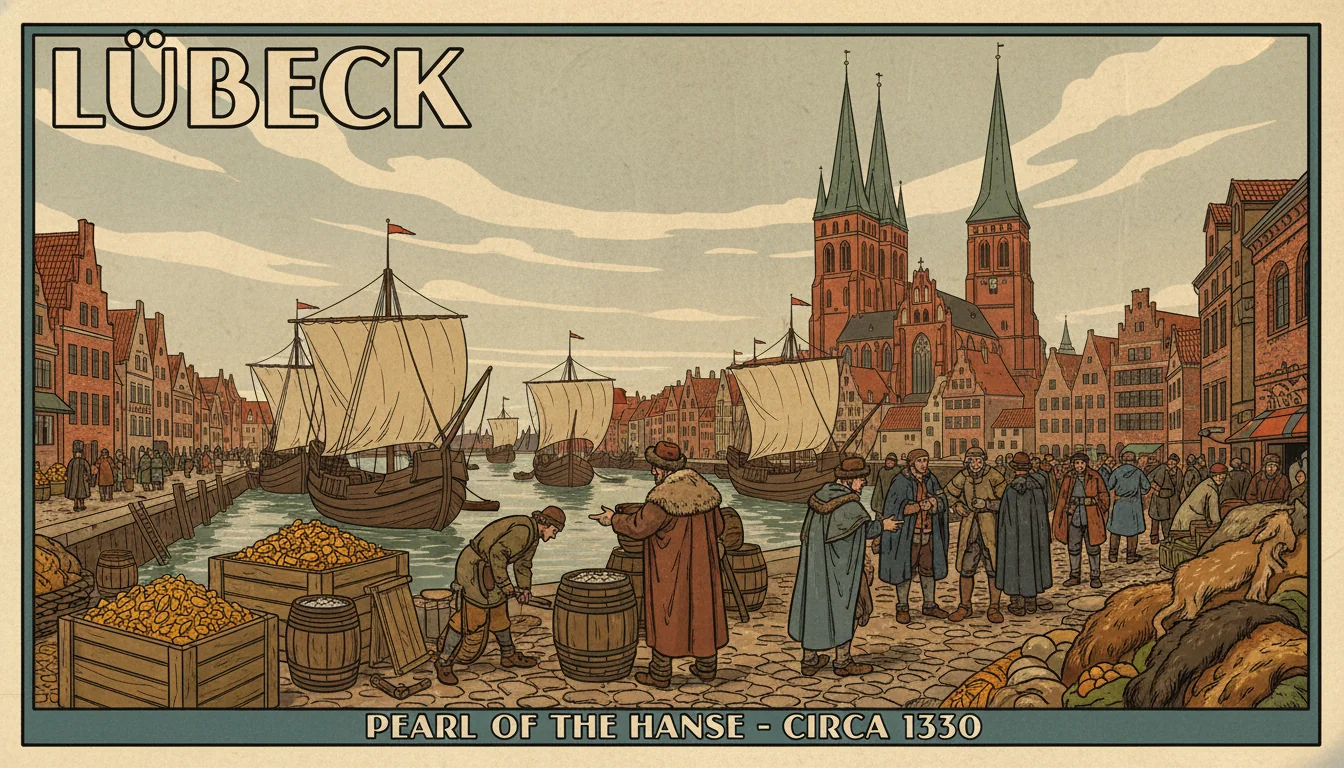
Hanseatic League Lübeck in 1300 does not welcome you with charm. It charges you a toll at the city gate, inspects your goods at the customs house, records your name and origin in a ledger, and then, having confirmed you are carrying nothing that undercuts a local monopoly, waves you through with the indifferent efficiency of a city that has been processing strangers for 150 years and intends to do so for another century.
You have arrived in the commercial capital of the northern world. Try not to look like you do not know what you are doing.
What kind of place you are entering
Lübeck was founded in 1143 on a river peninsula where the Trave and the Wakenitz meet, giving the city water on three sides and a defensible neck to the south. By 1300 it has a population of perhaps 20,000 to 25,000 people - very large for Northern Europe in this era - crowded into a dense network of streets on a limestone ridge above the river.
The skyline is defined by brick. Lübeck sits far north of the great limestone deposits that gave medieval France and southern England their cathedral stone. The local solution was to fire clay into the reddish-brown brick called Backstein, and to build with it in a Gothic style that becomes unmistakably northern: sharp gables, stepped facades, enormous windows of plain or lightly colored glass, and an angular seriousness quite unlike the warm honey stone of the Mediterranean world.
Five parish churches are under construction or recently completed, including the Marienkirche, which will become one of the largest brick Gothic churches in the world. The cathedral on the southern tip of the island dates to the 12th century and looks it.
The city is wealthy, visibly and confidently so. The merchant families who run Lübeck have been accumulating capital across two generations of Baltic trade. They build houses four or five stories high, with large warehouse cellars at ground level and residential quarters above. The ground floor of almost every significant house is also a shop or a storage space. Commerce does not stop at the front door.
Arriving and presenting yourself
You will enter the city through one of the main gates on the southern landward approach. The gate has guards, and they will want to know your trade and origin. Traveling as a foreign merchant is your safest cover - Lübeck has been dealing with foreign traders since its founding and has a reasonably sophisticated system for accommodating them.
If you claim to be from Flanders or Westphalia, you will be treated as a known quantity. If you say you are from England, the merchant contacts known as the Lübeck Englishmen's group will have a general framework for your presence. Avoid claiming to be from cities with whom Lübeck is in a commercial dispute.
You will need the local currency. The Lübeck mark was divided into 16 shillings and used as the accounting unit across much of the Baltic world. It is a silver standard. Do not try to use foreign coins directly in shops - you will be sent to a money changer, who will extract a fee, and look at you with the specific contempt reserved for people who should have known better.
Navigating the streets
The street plan is straightforward by medieval standards. The main north-south thoroughfare, the Breite Strasse, runs the spine of the ridge from the Holstentor end to the market and beyond. Cross streets connect to the harbor quays on the Trave to the west, where the real commerce happens.
The streets are not paved in 1300 in the modern sense, though some of the main streets have stone sets. Most are packed earth, gravel, and what you prefer not to think about. It rains frequently in Lübeck. The combination of horse traffic, market stalls, and the constant movement of barrels, bales, and crates from the harbor means the central streets are perpetually churned.
Keep to the side of the main thoroughfares. Carters with loads from the quay have right of way by custom and will not stop for a pedestrian who wanders into the route. The canal that runs parallel to the Trave quayside serves both as a drainage channel and as a transport route for small craft, and it smells accordingly.
The market and the quay
The Marktplatz at the center of the city is your primary destination for almost everything. The weekly market, held on specified days, brings in regional produce, crafts, and the kind of face-to-face trading that happens before or after the big contracts. Here you can buy bread, dried fish, leather goods, pottery, and small metal tools. The permanent shops on the surrounding streets handle the more expensive trades - cloth merchants, goldsmiths, spice dealers.
For the serious business, go to the harbor quay. The cog ships, the flat-bottomed vessels with high freeboard and a single square sail that the Hanseatic world invented and perfected, are being loaded and unloaded at continuous speed. The smell at the quay is dominated by salt and fish - salted herring by the barrel, packed tight, bound for destinations in every direction. During the Skane herring season, which runs through the late summer and autumn, the quayside operates near around the clock.
If you want to understand what makes this city run, watch a single barrel of herring. It was caught off the Swedish coast near Falsterbo, gutted and salted there using Luneburg salt carried by Lübeck ships, loaded onto a cog, transported to Lübeck, and transferred here to a warehouse where it will wait for onward distribution to Westphalia, Rhineland, England, or the Italian cities via Alpine passes. Each stage involves a Lübeck merchant taking a margin. The city does not produce the herring. It does not mine the salt. It controls the network through which both things move.
Food and drink
Your day begins with bread. Rye bread, dark and dense, is the standard fuel for everyone below the merchant class, and often for them as well in the morning. The bakers' guild operates under city regulation, which means loaf weights are standardized and short-weighing is a criminal matter. You can buy a loaf for very little.
The city's brewers produce a weak ale that serves as the primary daily beverage for most of the population. The water supply in medieval cities is unreliable, and Lübeck's water, drawn from shallow wells and the river, is no exception. The ale is weak enough that you can drink it throughout the day without becoming visibly impaired, which is the point.
For a meal, the cook-shops near the market offer hot food - pottage (a thick stew of grains and whatever else is available), grilled fish, roasted meats on market days. The taverns serve more substantial fare to travelers and merchants who are not eating in private houses. Expect salted herring in some form at almost every table.
Staying safe and visible
The city maintains a night watch, and the merchant oligarchy that governs Lübeck has strong incentives to keep the streets orderly - a reputation for safety was a commercial asset in the medieval world, and Lübeck's council took it seriously. The major risk is fire, not crime. The brick buildings resist burning better than the timber-framed construction of many contemporary cities, but fires do occur and spread rapidly in the dense urban fabric.
Do not be on the streets after curfew without a lantern and a plausible explanation. The night watch will question you, and an unsatisfactory answer will end your evening in a lockup. Stay near the main commercial streets during the day, keep your goods secured, and do not display silver or valuables openly at the market.
The greatest danger in Lübeck is the same as everywhere in 1300: disease. The city is dense and its sanitation is medieval. Plague had not yet visited Lübeck in its most catastrophic form - the Black Death would arrive in 1350 - but dysentery, typhoid, and the ordinary roster of medieval respiratory infections were constant background threats.
When to visit
The city is most alive from June through October, when the Baltic sailing season is open and the Skane herring markets are running. Ships arrive from Bruges, from Riga, from Visby on Gotland, from the English east-coast ports, and the quay is one of the most cosmopolitan places in the northern world.
If you arrive in winter, the city is quieter but not empty. Warehousing, accounts, and contract negotiation fill the cold months. The Marienkirche interior is worth seeing in any season - the vaulting is extraordinary and the candles against the winter light produce an effect that no photograph of a later era adequately captures.
Do not leave without eating a proper meal of Labskaus - a salted-meat and potato dish - except that in 1300 the potato has not yet arrived from the Americas. You will be eating salted herring and rye bread. It is exactly what everything around you was built on.
Leave by the same gate you entered, pay the exit toll without comment, and do not try to carry Baltic amber out without the correct documentation. The customs officers have seen every trick, and they have been practicing since 1143.
For more medieval trading city time-travel, see our guides to Krakow in 1400 and Ottoman Istanbul in 1555.
Quick Answers
Common questions about this topic
What was Lübeck's role in the Hanseatic League?
Lübeck was the dominant city of the Hanseatic League, the trading confederation of northern German and Baltic cities. It held the primary position in negotiations, hosted the major Hansetage (league diets), and controlled the crucial transit point between the North Sea and the Baltic. The city's merchants set the standards for weights, currency, and contracts across the entire network.
What did people eat in medieval Lübeck?
The staple foods were salted herring (the city's primary trade commodity), dark rye bread, weak ale, eels, pork and game when available, cabbage, turnips, and dried legumes. Fresh fruit and vegetables were seasonal. The wealthy merchant class ate substantially better than craftsmen or day laborers, and kept impressive cellars of imported wine from the Rhine and France.
What did Lübeck trade in 1300?
Lübeck's trade centered on the Schonenfisch - salted herring from the Scanian markets at Falsterbo and Skanor. It also moved Luneburg salt (used to cure the fish), Baltic amber, furs from Russia and Lithuania, timber, grain, and wax. Finished Flemish cloth traveled eastward; raw goods traveled west. Lübeck took a percentage of nearly everything.
Was Lübeck dangerous to visit in 1300?
The city itself was well-governed and safer than most medieval towns. The major risks were disease (plague was a constant background threat), fire (the close-packed timber and brick buildings burned periodically), and the hazards of Baltic Sea travel to reach the city. Street crime existed but the merchant oligarchy kept order firmly.

Need Advice from Someone Who Lived There?
Get firsthand accounts from people who actually lived through these moments in history.
Create your free account →No card required. Some figures and features require a paid plan.
Join the HistorIQly Club
Get smarter about the past.
Weekly stories, deep dives, and exclusive content straight to your inbox.