A Time Traveler's Guide to Moche Peru, 500
The Moche civilization of coastal Peru in 500 CE built pyramids from 143 million adobe bricks. Here is what you need to know before you visit this overlooked ancient world.
Read Wikipedia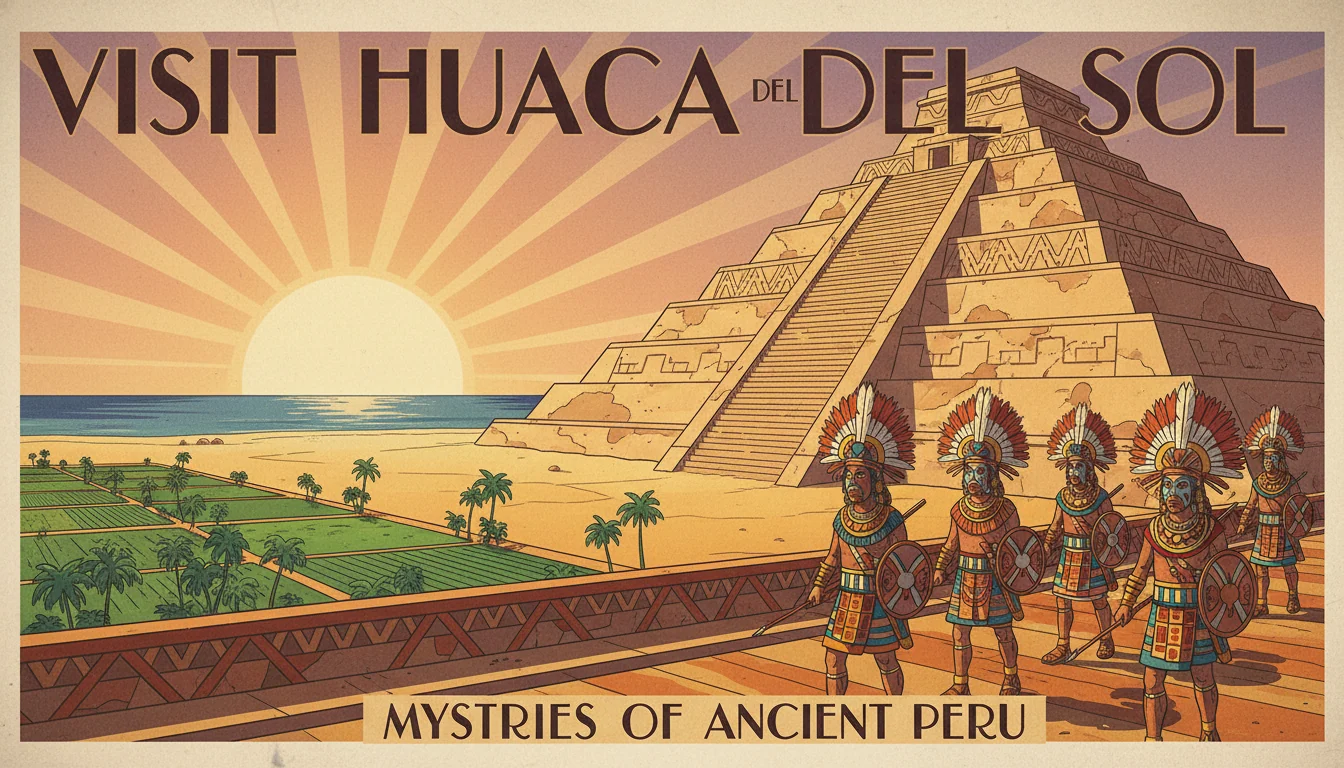
The north coast of Peru in the year 500 CE is not a civilization that shows up in most people's mental map of the ancient world. It sits outside the grand narrative of Rome and China. It predates the Inca by nearly a thousand years. It has no famous name in the English-speaking world beyond the narrow channel of specialist archaeology. This is a mistake. The Moche state at its height is one of the strangest, richest, and most visually overwhelming societies that human beings have ever built, and by 500 CE it is at or very near its peak.
Before you go, understand what you are walking into.
First, know where you are
The Moche world occupies a series of river valleys cutting west through the Andes to the Pacific coast of what is now northern Peru. The climate is extreme. The coast is desert - genuinely, relentlessly desert, one of the driest places on earth, kept alive only by the rivers draining from the mountains. The Moche have mastered this environment with an irrigation system of canals and aqueducts that coaxes green agriculture from the sand. Outside the irrigated zones, the landscape is barren and hot, relieved only by the cold Humboldt Current that keeps coastal temperatures lower than the latitude would suggest.
The political center in 500 CE is the Moche River valley near modern-day Trujillo. Two pyramid complexes dominate the floodplain like nothing you have ever seen outside Egypt: the Huaca del Sol and the Huaca de la Luna. They are built entirely from adobe bricks, tens of millions of them, stacked into stepped platforms that rise 40 to 50 meters above the desert floor. Do not mistake them for hills. They are monuments.
Your cover story is simplest if you arrive from the north, moving along the coastal road between valleys. Long-distance travel exists along the desert coast, and traders from other valleys would be unremarkable. Dress appropriately.
What to wear
The Moche are not a toga-and-sandals civilization. They are a dressed, tattooed, ornamented society with specific visual codes that mark rank, warrior status, and ritual role.
For a low-profile visit, you want simple cotton cloth. The Moche weave excellent cotton from fields irrigated in the valley lowlands. A plain wrapped tunic, knee-length, in undyed or simply dyed cloth is the baseline. You need sandals made from vegetable fiber or leather. A simple headcloth is appropriate; elaborate headdresses are the mark of warriors, priests, and rulers, and appearing in one without the status to back it up will cause problems.
Do not arrive bare-headed in the sun. The coastal desert is brutal even in the morning hours, and Moche of all ranks cover their heads. A plain cotton wrap is fine. A woven reed hat also exists.
Leave modern materials behind entirely. No plastic, no metal except copper ornaments if you can acquire them, no nylon, no dyed cotton in colors the Moche do not use. Stick to cream, brown, tan, and the ochres and reds that appear in surviving textiles. Turquoise and copper-green are acceptable for small ornaments if you have the right cover identity.
Getting into the city
The area around the Huaca del Sol is not exactly a city in the Roman sense, but it functions like one. A dense residential zone stretches between the two pyramids, housing artisans, administrators, priests, and the families of warriors. Potters work in large workshops, producing the famous Moche stirrup-spout vessels - realistic portrait jars, erotic scenes, animals, vegetables, and supernatural figures - in quantities that suggest something approaching mass production.
You can move through the residential areas with caution. The population is busy with craft production, canal maintenance, food processing, and the logistics of feeding a large ceremonial state. A stranger is noticeable but not impossible, especially if you can communicate basic intent through gesture. The Moche language is unrelated to Quechua, the later Inca language, and to anything you are likely to know.
Stay away from the pyramid precincts when ritual activity is visibly underway. This is not a suggestion.
The ritual danger
The Moche conduct large-scale human sacrifice. This is documented with considerable precision by archaeologists who have excavated the Huaca de la Luna complex and found mass burial sites with dozens and sometimes hundreds of sacrificed individuals, primarily young adult men showing evidence of violent processing.
The victims are captured warriors from other valleys and polities. The Moche practice a distinctive form of elite combat designed to capture rather than kill, with the goal of producing sacrificial prisoners. Great ceramic murals on the interior walls of the moon pyramid depict the sequence: combat, capture, procession, ritual bloodletting, and the body offered to supernatural figures.
If there is a major El Nino event during your visit, which there may be - the Moche state is climatically stressed throughout its later period - you should leave the ceremonial zone immediately. The sacrifice events appear to cluster around climate crises, and the processions toward the pyramid are not something you want to observe from close range.
In normal conditions, the public face of Moche ritual is spectacular rather than immediately threatening. Elaborately costumed figures in massive headdresses move through the city in procession. Drums and ceramic trumpets produce sound unlike anything from the Western tradition. The platforms of the pyramids are painted in geometric polychrome designs that cover every exterior surface. From a safe distance, during a peaceful period, this is among the most extraordinary visual experiences available in the ancient world.
What to eat
Moche agriculture produces maize, beans, squash, chili peppers, and sweet potatoes from the irrigated fields. The coast provides shellfish, fish, and sea mammals taken by net and by balsa-wood raft. Camelids - llamas and alpacas - are present as both pack animals and food sources, though the Moche culture of this period does not have the Andean highland emphasis on llama herding that later civilizations develop.
Chicha, fermented maize beer, is the standard beverage at communal gatherings. It is nutritious, mildly alcoholic, and safer than the irrigation canal water. Drink it.
The Moche do not appear to use coca leaf in the intensive way that later highland cultures do, though limited use may exist. Do not mistake this for temperance - chicha flows freely at feasts and ritual events.
Do not eat shellfish from an unfamiliar source without establishing that the source is trustworthy. Red tide events on the Peruvian coast produce paralytic shellfish poisoning severe enough to kill. It was dangerous then and it was dangerous long before then.
What not to miss
Go to the ceramics workshops. The Moche produce portrait vessels of such specificity and realism - individual faces rendered with what appears to be genuine portraiture, specific individuals identifiable across multiple jars - that archaeologists have spent decades debating whether they were made from life casts. Whether or not that is true, the production process itself is worth observing. Potters work in organized groups, producing specialized forms at volume.
Walk the main canal. The Moche irrigation network in the Moche Valley is a feat of engineering: canals cut through desert hillsides, directed with wooden sluice gates to maximize the area of arable land. The line where irrigated green farmland meets the bare desert is one of the starkest boundaries in any ancient landscape.
Look at the metalwork if you get the opportunity. Moche gold and gilded copper metalworking in 500 CE is among the most sophisticated in the ancient world. The burial objects from high-status Moche graves, discovered by archaeologists in the 20th century, include assemblages of gilded copper, silver, and gold with technical complexity that still impresses modern metallurgists.
Getting out
The best exit is along the coastal road northward or southward, into adjacent valleys. There is movement between valleys for trade, tribute, and marriage alliance. A person on the road with plausible goods to trade is more or less unremarkable.
Do not be in the area when the political situation between valleys deteriorates into active raiding. Moche warrior culture is real and purposeful. Capture is the military goal, and captives have a specific and unpleasant destination.
The civilization you are visiting has another century or two of political coherence ahead of it before El Nino flooding of catastrophic severity disrupts the irrigation system and the pyramid centers are abandoned. In 500 CE you are catching it before the decline. The pyramids are maintained. The pottery workshops are running. The political structure is intact. The danger is real. The spectacle is unrepeatable. Come for the ceramics and the engineering. Leave before the processions form. For other pre-Columbian civilizations at their peak, see our guides to the Inca at Cusco in 1450 and Zapotec Monte Alban in 300 CE.
Quick Answers
Common questions about this topic
Who were the Moche people?
The Moche were a pre-Inca civilization who flourished on the north coast of modern Peru from roughly 100 to 800 CE. They built massive adobe pyramid complexes, developed sophisticated metalworking in gold, silver, and copper, created some of the most detailed ceramic portrait vessels in the ancient world, and maintained an elaborate ritual life centered on warrior sacrifice.
What were the Moche pyramids?
The Moche built two enormous adobe pyramid platforms near modern Trujillo, Peru. The Huaca del Sol (Pyramid of the Sun) was one of the largest pre-Columbian structures in the Americas, built from an estimated 143 million adobe bricks. The nearby Huaca de la Luna (Pyramid of the Moon) served primarily as a ceremonial and sacrificial center and is better preserved today.
What did the Moche sacrifice in their rituals?
Archaeological excavations at the Huaca de la Luna have confirmed that the Moche conducted large-scale human sacrifice, primarily of captured warriors. Bodies show evidence of throat-cutting and ritual processing. The sacrifices appear tied to El Nino events and agricultural crises - the Moche seem to have killed captives in enormous ceremonies intended to appease the mountain gods controlling rainfall.
Why did the Moche civilization collapse?
Archaeologists believe a combination of severe El Nino flooding events, prolonged drought, and possibly internal political fragmentation caused the collapse of the main Moche state around 600-700 CE. The Huaca del Sol center was eventually abandoned. Some Moche communities survived in transformed regional forms until the Wari expansion and ultimately the rise of the Chimu around 900 CE.

Need Advice from Someone Who Lived There?
Get firsthand accounts from people who actually lived through these moments in history.
Create your free account →No card required. Some figures and features require a paid plan.
Join the HistorIQly Club
Get smarter about the past.
Weekly stories, deep dives, and exclusive content straight to your inbox.