A Time Traveler's Guide to Sukhothai, 1300
Sukhothai in 1300, golden age of the first Thai kingdom: navigating the lotus-bud temples, open markets, and elephant-crossed streets of Ram Khamhaeng's world.
Read Wikipedia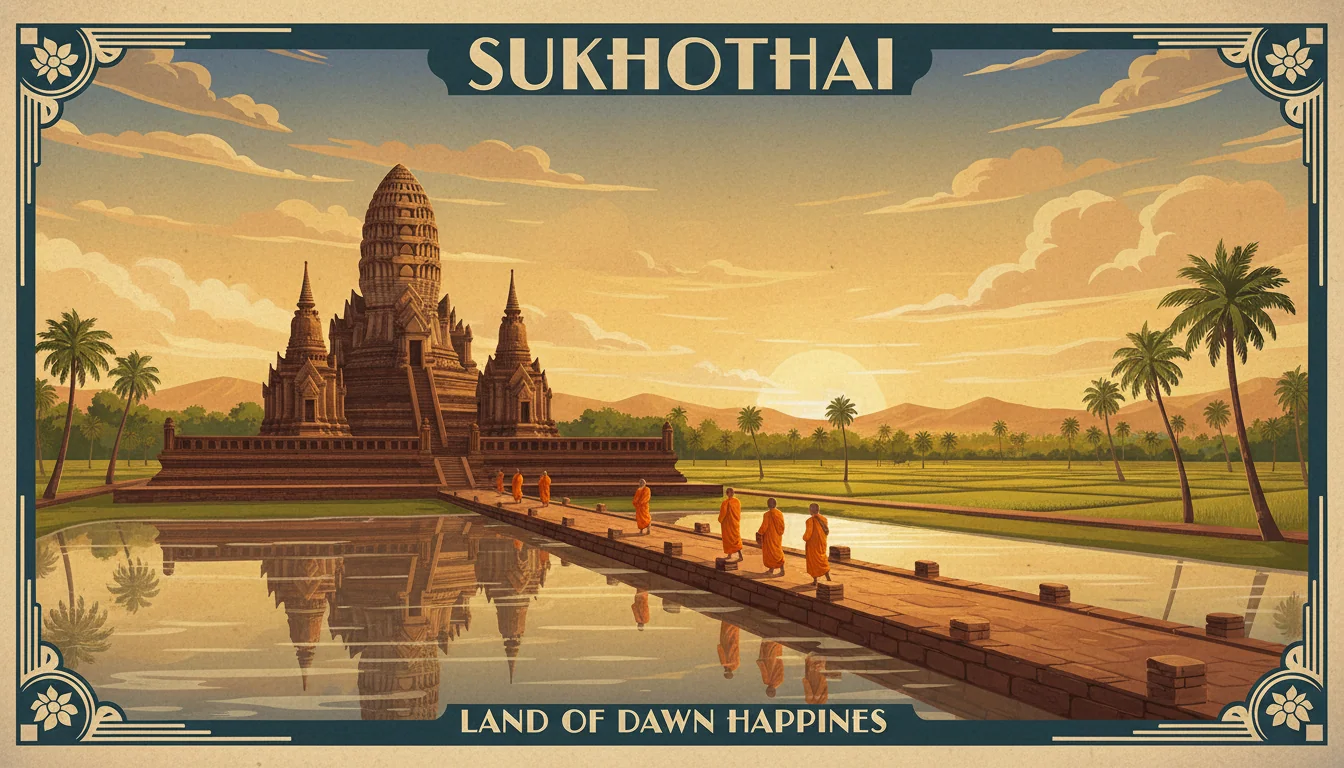
Ram Khamhaeng died two years ago. His son Lo Thai sits on the throne, a quieter figure than his father, and the kingdom feels it. Sukhothai in 1300 is not quite the magnetic center it was when Ram Khamhaeng's famous stone inscription described a land of abundant fish and rice, where merchants passed freely through the gates without paying tolls, and where the king himself sat outside the palace to hear grievances from ordinary people.
But it is still a remarkable city. The temples are intact and busy with monks. The markets hum with Sangkhalok ceramics, silk, and dried goods from the surrounding lowlands. Elephants pass through the main avenues several times a day. The air smells of incense, woodsmoke, and the flat rice fields that extend to every horizon. If you are careful about your cover story, your dress, and what you eat, this is one of the most peaceful stops in Southeast Asian history.
First, know where you are landing
Sukhothai sits in a broad river valley in what is now north-central Thailand, surrounded by mountains to the north and west and flat rice plains to the south and east. The city proper is defined by three concentric moats and earthen walls, enclosing a space of roughly three kilometers by four. The outer moats are mostly dry in the dry season and full during the monsoon months. The inner walls are lined with trees and crossed by four main gates oriented to the cardinal directions.
The city was laid out with the royal palace and main temple at the center. Wat Mahathat, the royal temple, is the dominant structure: a large complex with a central prang tower in the older Khmer style and a cluster of smaller chedis in the lotus-bud form that Sukhothai's architects were beginning to develop as their own distinctive idiom. The tower is visible from most of the city. Orient yourself by it.
Your cover story should be merchant. Sukhothai in 1300 receives traders from China, Champa, Kedah, and neighboring Tai polities. A foreigner arriving with trade goods or a letter of introduction from a Chinese port raises no eyebrows. If you speak no Thai, a few words of Malay and confident pantomime will carry you further than you might expect - the city has enough cosmopolitan trade traffic to handle communication by improvisation.
Dress correctly before you arrive
A merchant arriving from the Gulf of Thailand or the South China Sea would wear a length of undyed or lightly dyed cotton wrapped at the waist, a loose cotton upper garment, and sandals. Nothing tight, nothing that ignores tropical logic. A wide-brimmed hat woven from palm leaves is both appropriate and essential: the sun in the central Thai plains is serious at any hour between mid-morning and late afternoon.
Do not arrive in anything resembling modern synthetic fabric. Do not arrive with a backpack, wheeled luggage, or anything with visible metal closures. Carry a woven basket or cloth bundle. Jewelry is acceptable - brass and copper are more appropriate than gold unless you want to attract sustained attention.
For women: a length of cotton wrapped at the chest and extending to the ankle, with a lighter cloth over the shoulders when in religious spaces. Cover your head when entering any temple compound. You will be expected to, and the expectation is not negotiable.
Getting around the city
Sukhothai's street grid is loose, organized around the canal system and the main roads running between the gates. Most of the population lives outside the inner walls in villages that have grown up along the canals. The inner city is largely religious and administrative space.
Walk. Ox-carts move between the villages and the markets. Elephants carry logs and occasionally passengers on formal occasions. The king's procession uses the main north-south road through the central precinct, and you should step back and lower your head when it passes.
The markets are outside the main eastern gate. The morning market runs from dawn to mid-morning. The most interesting goods available are Sangkhalok ceramics from the kilns north of the city: a distinctive blue-green glaze on wide-rimmed plates and covered jars that will, three hundred years from now, be dug up in Java and Borneo as prized antiques. If you are carrying coins from later periods, Chinese copper cash circulates freely and most merchants can identify and accept it.
Three things you should not miss
Wat Mahathat. The main temple complex in the center of the city is active and accessible to laypeople. The monks will not object to a foreign merchant walking the paths between the smaller chedis. The large central lotus-bud stupa is undergoing refinement by Lo Thai's court artisans and looks slightly raw in 1300, its plasterwork newer than the surrounding structures. The seated Buddha images in the Sukhothai style - serene, elongated, with a flame-shaped protrusion at the crown - are being produced now in large numbers for placement in temple niches across the kingdom.
The Sangkhalok kilns north of the city. A half-day walk north of the inner walls brings you to the Si Satchanalai kiln complex where the famous ware is produced. The scale is impressive: dozens of kilns, a constant thread of smoke, workers treading clay and shaping vessels in open sheds. The finished goods are extraordinary, and if you can negotiate with a kiln master directly rather than through market middlemen, prices are substantially lower.
The evening water procession. On significant Buddhist calendar dates, which fall on the phases of the moon, monks process in small boats along the inner canal by torchlight. The ritual is quiet and beautiful. Watch from the canal bank. Do not wade into the canal for a better view - it is deeper than it looks and the banks are slippery in the hours after dusk.
Food and water
Eat rice with everything. This is not a stylistic option; it is what the economy produces and what the population eats. Steamed rice with grilled or dried fish, fermented shrimp paste, fresh green herbs, and fermented vegetables is the daily diet of most residents. It is nutritionally solid and safer than almost anything else you will encounter.
Drink coconut water when you can find it, or water that has been boiled and stored in sealed ceramic vessels. Do not drink directly from the canals. Do not eat shellfish from standing water. Tropical gut infections in this climate are serious, and you do not want to spend three days of a limited visit unable to move.
An early form of fermented fish sauce is already in widespread use here. Everything will taste of it. You will either adapt quickly or you won't adapt at all.
What not to do
A short list of mistakes that will end your visit badly.
Do not enter any temple compound with footwear. This is non-negotiable, and violating it marks you either as ignorant or as disrespectful - the second category can get you arrested and brought before the city magistrate.
Do not touch any monk. Not incidentally, not accidentally, not in passing. The prohibition on physical contact between monks and laypeople is strictly observed, and the prohibition applies regardless of whether you understand it.
Do not discuss the succession. Lo Thai is newly on the throne after his father's death, and the political situation around that transition is not fully settled. Raised with a court full of ambitious half-brothers and uncles, Lo Thai's officials are watchful. This is not a conversation you want to have with strangers in a market.
Do not walk alone outside the city walls after dark. The outskirts have fewer people, no reliable lighting, and no immediate recourse if something goes wrong. Sukhothai is peaceful by the standards of the region, but peaceful and safe at two in the morning are different things.
Do not assume the working elephants near the markets are approachable. They are trained animals with dedicated handlers who are not interested in visitors attempting to interact with their charges.
What you will take away
The abiding impression of Sukhothai in 1300 is of a civilization that has not yet decided to be defensive. The stone inscription that Ram Khamhaeng left behind describes a world of open gates, free fishing in the rivers, and a king who judged fairly. The city in 1300, two years after that king's death, still carries that atmosphere. It is not naive - the markets are commercial, the court is calculating, and the surrounding region has competing polities with their own ambitions. But there is an ease to the streets, a sense that the city's purpose is to let its residents live and work and worship, that is not universal in the medieval world.
The lotus-bud chedis rising in the morning heat, the smell of incense drifting from the temple courtyards, the clatter of a potter's wheel at the market, the distant bellow of a working elephant on the north road - these are small things. In 1300 they add up to something worth the journey.
Pack light. Dress appropriately. Bring your own water for the first day. And do not be late to the evening procession. The torchlight on the canal is a sight that the word beautiful keeps trying to describe and never quite managing.
For neighboring Southeast Asian civilizations worth a time-travel visit, see our guides to Khmer Angkor in 1150 and Heian Kyoto in 1000.
Quick Answers
Common questions about this topic
What was Sukhothai?
Sukhothai was the capital of the first major Thai kingdom, established in the mid-13th century after Thai-speaking peoples broke free of Khmer domination. At its peak under King Ram Khamhaeng, who ruled roughly from 1279 to 1298, Sukhothai controlled a substantial territory in what is now central and northern Thailand and was known for its Buddhist temples, distinctive artistic style, and a newly invented Thai script.
What language did people speak in Sukhothai?
The population spoke an early form of the Tai language family, written from around 1283 in an alphabet attributed to Ram Khamhaeng himself. The script, inscribed on a famous stone stele now in the Bangkok National Museum, was derived from earlier Khmer and Mon writing systems but adapted for Tai phonology. Khmer remained in use for administrative and religious contexts.
What religion was practiced in Sukhothai?
Theravada Buddhism from Sri Lanka was the dominant religion and the ideological foundation of the Sukhothai state. The king was understood as a patron of the Sangha, the monastic community, and the cityscape was defined by temple complexes. Brahmanical ritual practices inherited from the earlier Khmer period persisted alongside Buddhism in court ceremony.
Is the city of Sukhothai preserved today?
The ruins of the old city survive as Sukhothai Historical Park, a UNESCO World Heritage Site in Sukhothai Province, Thailand. The park contains more than 190 temple ruins across roughly 70 square kilometers. The most famous monument is Wat Mahathat, the royal temple at the city's center.

Need Advice from Someone Who Lived There?
Get firsthand accounts from people who actually lived through these moments in history.
Create your free account →No card required. Some figures and features require a paid plan.
Join the HistorIQly Club
Get smarter about the past.
Weekly stories, deep dives, and exclusive content straight to your inbox.