A Time Traveler's Guide to Kievan Rus, 980 CE
Your guide to Kievan Rus 980 CE: Kyiv at its Norse-Slavic peak, Vladimir's pagan court, and the amber trade routes that run from Scandinavia to Byzantium.
Read Wikipedia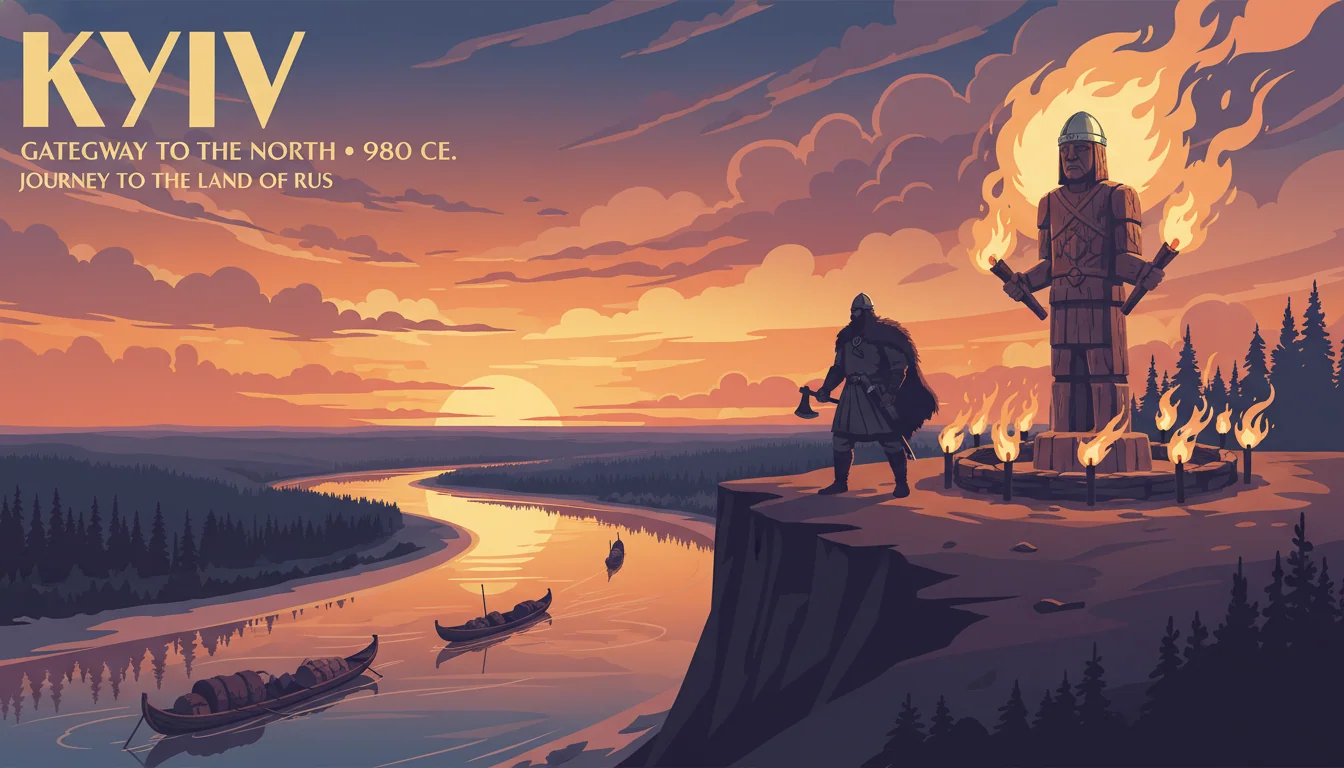
The timing of your arrival matters. Come to Kyiv in the year 980 and you step into a world in mid-transformation - a city that is neither fully Norse nor fully Slavic, neither fully pagan nor anything else yet, straddling a river trade route that connects Scandinavia to Byzantium and feeds one of the wealthiest courts in the early medieval world. Vladimir I has just consolidated power. The pagan temples are up. The Christian missionaries are circulating cautiously. The mead is flowing, the Pechenegs are somewhere out on the steppe, and the city smells of pine smoke, fish, and furs.
Here is what you need to know before you arrive.
What kind of place you are entering
Kyiv in 980 is a city of perhaps 30,000 to 50,000 people, which makes it large by the standards of the early medieval world and enormous by the standards of northern Europe. It sits on the steep right bank of the Dnieper River, arranged in two distinct zones: the kremlin-like citadel (the Detinets) on the high bluff, where the prince's hall and the new pagan temple complex stand, and the Podil below, the sprawling lower-town market district that backs directly onto the river.
The Varangian Route, the river road from the Baltic south to Byzantium, passes directly through Kyiv. Trading boats loaded with furs, amber, beeswax, and slaves travel south toward Constantinople; they return loaded with Byzantine silk, glassware, wine, and silver. The city exists because this trade exists.
The ruling class is a hybrid: Norse-descended Varangians who have been in the Dnieper basin for several generations and have mostly adopted Slavic names and Old East Slavic as their daily language, sitting alongside Slavic boyars (noble landowners) whose families have been here far longer. The common people are Slavic farmers, craftsmen, and traders. The language you need is Old East Slavic, which in 980 is intelligible across most of the Rus territories. Norse helps you at court. Latin gets you nowhere except with the Byzantine monks.
Vladimir himself is the son of Sviatoslav I and a slave woman named Malusha. He is energetic, politically ruthless, and genuinely invested in the pagan traditions he is currently promoting. He has just had his half-brother Yaropolk killed, which is the reason you should be careful about expressing any particular loyalty or nostalgia for recent political arrangements.
How to dress and who to be
Arriving as a foreign trader is your best cover. The Varangian Route brings people from Sweden, Norway, Gotland, the Frankish lands, Byzantium, Khazaria, and the Caspian world through Kyiv constantly. A foreigner who speaks some Slavic and claims to be moving furs or amber south will arouse no special interest.
For men, the basic dress is a knee-length wool tunic belted at the waist, linen trousers tucked into leather boots, and a fur-trimmed cloak in colder months. Better-class travelers carry a penannular brooch to fasten the cloak. You will want wool. The October temperatures in Kyiv drop sharply after dark.
For women, a long linen dress under a wool overgown, with a headscarf. Women of the merchant and craftsman class move through the Podil market without much restriction.
Do not arrive in anything that looks Byzantine unless you are prepared to explain yourself in considerable detail.
The Podil
The lower town is where you want to spend most of your time. The Podil is the commercial district, packed along the riverbank with boatbuilders, smiths, potters, tanners, and traders of every description. The market stalls sell Byzantine wine, imported cloth, local honey, dried fish, and silver jewelry of considerable craftsmanship. The Rus artisans of 980 are skilled metalworkers, and the silver craftwork coming out of Kyiv is already finding its way into Scandinavian graves.
The river here is wide and steady. Trading vessels are tied up at the bank for much of the spring and summer sailing season. The boatmen are Varangian and Slavic in roughly equal proportion, and they speak a fluid trade argot that will serve you for basic commerce even if your Slavic is limited.
What you want to avoid in the Podil: the slave pens. They exist, and they are visible. The slave trade in Kievan Rus is substantial - raids on neighboring populations produce captives who are sold at Kyiv and moved south to Byzantine markets. Do not look too foreign and too unprotected at the same time. Travelers moving without companions have occasionally failed to remain travelers.
Three things worth seeing
The pagan temple complex on the Kyiv hill
Vladimir has recently erected carved statues of his six principal deities on the hill above the city. Perun, the thunder god, is the senior figure - his wooden idol reportedly has a silver head and a golden moustache. Veles, god of the underworld and of cattle and wealth, is associated with the lower town rather than the hilltop. The others include Khors, Dazhbog, Stribog, and Mokosh.
Ritual ceremonies at the hilltop complex involve animal sacrifice and communal feasting. Attendance at the public festivals is expected of residents. As a foreign trader you have some latitude to be respectfully present without full participation. Do not visibly express scepticism. Vladimir is currently very interested in religious legitimacy, and the atmosphere around the pagan shrines is not one where theological debate is welcome.
The druzhina feast at the prince's hall
If you can arrange an introduction, the evening feasts at Vladimir's princely hall are one of the great spectacles of the early medieval world. The druzhina - the warrior retinue - eats together with the prince in the hall, a custom with deep roots in Norse and Slavic tradition. The mead flows in quantities that are difficult to imagine and easy to underestimate. The food is roasted game, boiled meats, bread, and river fish. There is music.
The atmosphere is genuinely dangerous. Men who have recently been on opposite sides of a dynastic war are sitting in the same hall, which creates a particular electric tension underneath the celebration. Stay sober, stay near the door, and do not claim any specific loyalties if asked.
Trading boats on the Dnieper
For a slower and safer experience, watch the boat traffic on the Dnieper from the Podil bank in the late morning. The trading vessels going south are loaded for months-long journeys: they will travel down the Dnieper rapids (where the Pechenegs are most dangerous), across the Black Sea to Byzantium, and return in the autumn. Some of the men loading cargo are Swedes who have been in Rus territory for years and speak better Slavic than Norse. The boats themselves are the famous drakar-derived vessels, adapted for river travel, and they are worth examining closely.
Food, drink, and staying well
The diet in Kyiv in 980 is based on millet porridge, rye bread, river fish, game, and preserved vegetables. Apples and other orchard fruits are available in season. Honey is abundant and used for both food and the fermentation of mead, which is the primary drink of the upper classes. Beer is also made and widely consumed.
Do not drink from the river. Do not eat raw shellfish or river fish. The city's water supply comes from wells and does not generally flow through residential areas in ways that prevent contamination. Cooked food from established market stalls is your safest option.
The mead served at the princely hall is genuine and strong. Rus mead of this period is not the thin honey-water of popular imagination. It is a serious fermented drink, and the volumes consumed at a druzhina feast are designed for men who have been fighting and riding all day.
Dangers you need to know about
The Pecheneg confederacy is the primary external threat. These Turkic nomads killed Vladimir's father Sviatoslav I in an ambush at the Dnieper Rapids in 972, and they remain a constant presence along the steppe routes south of Kyiv. Outside the city walls, you do not travel without an armed group. The farmland within reasonable distance of the city is reasonably safe. The open steppe is not.
Political violence inside the city is a lower but real background risk. Vladimir has very recently consolidated power, and Kyiv contains men who were on the other side of his succession struggle. Strangers who ask too many questions about recent political arrangements will attract the wrong kind of attention. The rule is simple: express no opinion about the previous ruler, admire the current one's obvious qualities, and change the subject to trade.
One moment you should not miss
If you arrive in the late spring or early summer, make your way to the riverside at dawn on the first clear morning. The Dnieper at Kyiv in 980 runs wide and cold. Mist rises from the water in the early hours. The trading vessels are already loading at the Podil, their crews speaking half a dozen languages, moving furs and silver and wax toward the greatest city in the world, three weeks' travel to the south.
The city behind you is wooden and smoky and occasionally violent, but it is also genuinely extraordinary: one of the largest functioning urban centres in the early medieval world, sitting at the intersection of cultures and trade routes that will shape eastern European history for the next thousand years. Eight years from now, Vladimir will convert this entire civilization to Orthodox Christianity in one of the most consequential decisions in European religious history.
None of that is visible yet in 980. What is visible is a city that knows it matters, trading in everything that the world values, presided over by a prince who has just secured his power and is moving very quickly to define what his realm is for.
Pack wool, carry silver, and be polite about the local deities. Kievan Rus is not an easy destination, but it is one of the great crossroads of the early medieval world, and there is nothing quite like watching it from the riverside at first light. The Byzantine city those trading boats were heading to is described in Constantinople at 540 CE. For the Russian city this becomes nine centuries later, St. Petersburg in 1900 shows what the same civilization looked like at its peak.
Quick Answers
Common questions about this topic
What was Kievan Rus in 980 CE?
Kievan Rus was a confederation of East Slavic and Norse-descended principalities centred on the city of Kyiv, on the high bank of the Dnieper River. In 980, it was ruled by Vladimir I (Vladimir the Great), who had just consolidated power by defeating his half-brother Yaropolk. The state controlled the major river trade routes connecting the Baltic to the Byzantine Empire.
What religion did people follow in Kievan Rus in 980?
In 980, Kievan Rus was pagan. Vladimir I maintained a pantheon of six principal deities, including Perun (thunder) and Veles (underworld and cattle), whose carved statues he erected on the hill above Kyiv. He would convert the realm to Orthodox Christianity in 988, after his baptism at the Byzantine city of Chersonesus in Crimea.
Who were the Varangians in Kievan Rus?
The Varangians were Norse warriors and traders who formed the core of the Rus ruling elite and the prince's druzhina (war band). They controlled the major river trade routes and gave the Rus state its name. By 980, many had adopted Slavic customs and language, but Norse identity remained strong in the upper echelons of the court and military.
What were the main dangers in Kievan Rus in 980?
The primary external danger was the Pecheneg confederacy, Turkic nomads who controlled the open steppe south and east of Rus territory and who had killed Vladimir's father Sviatoslav I in an ambush at the Dnieper Rapids in 972. Inside the city, political violence was a constant background risk - Vladimir had just killed one half-brother to take power, and the court was full of men who had recently been on the wrong side.

Need Advice from Someone Who Lived There?
Get firsthand accounts from people who actually lived through these moments in history.
Create your free account →No card required. Talk to anyone in history with 8 free credits a day. Some features require a paid plan.
Join the HistorIQly Club
Get smarter about the past.
Weekly stories, deep dives, and exclusive content straight to your inbox.