A Time Traveler's Gupta Empire Travel Guide: Pataliputra, 400 AD
A Gupta empire travel guide to Pataliputra in 400 AD, Chandragupta II's golden capital on the Ganges, where Kalidasa writes and a Chinese pilgrim files meticulous notes.
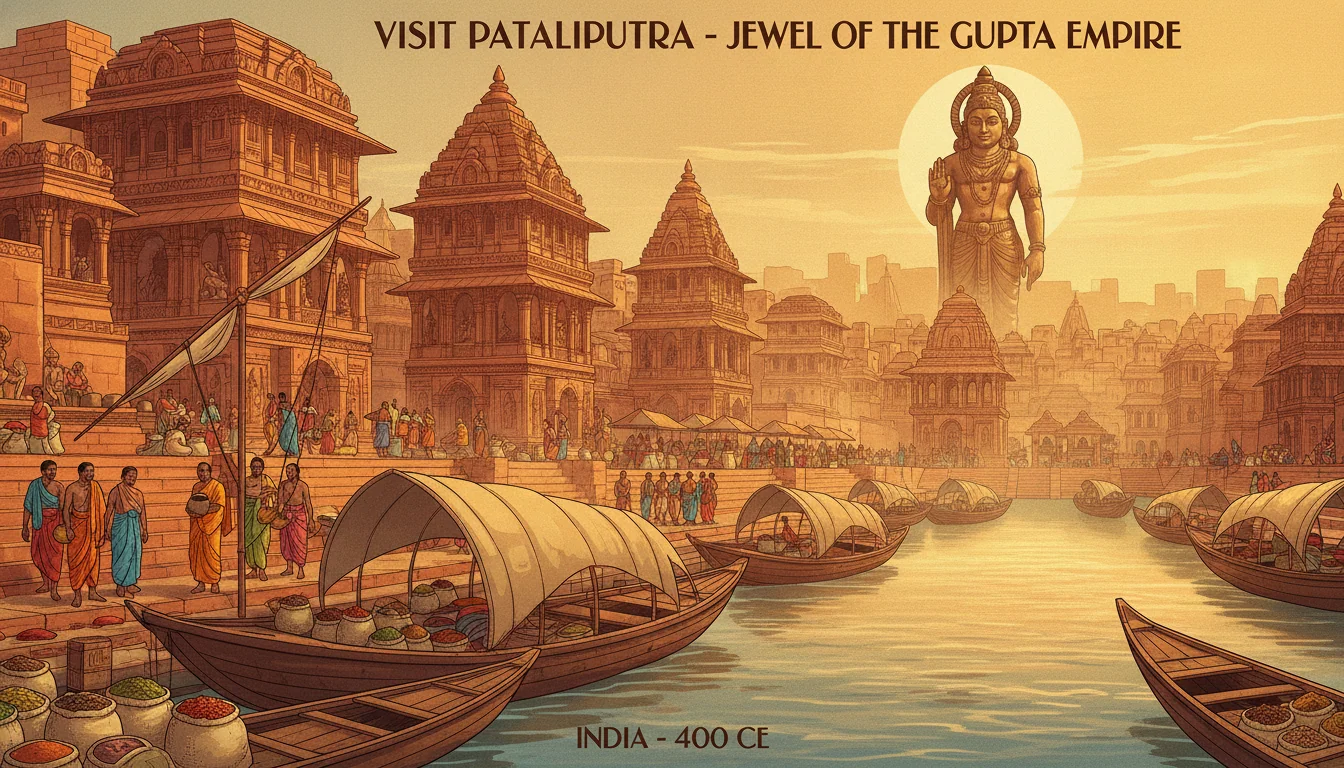
This Gupta empire travel guide starts with the most useful travel document for your visit to Pataliputra in 400 AD, one written by someone who actually made the trip. Faxian, a Chinese Buddhist scholar from Chang'an, spent roughly fifteen years traveling overland to India, studying at its monasteries, and writing down what he found. He arrived in the Gupta heartland around 399 CE and spent several years there before sailing home via Sri Lanka and the Java Sea.
His account of Pataliputra reads like what would later be called a travel memoir. The city is large and prosperous. The people do not kill animals or drink alcohol in public, at least not the Buddhist laity he spent time among. The streets are generally safe. The king governs without regular resort to execution. There are charitable hospitals. The monasteries are well-maintained and their libraries impressive.
If Faxian's description sounds unusually positive for an ancient capital, that is partly because the Gupta period really was, by the standards of the ancient world, unusually organized. It is also partly because he was a devout Buddhist writing about a kingdom that patronized Buddhism and had reason to describe his hosts generously.
Both things can be true. Pataliputra in 400 CE is one of the few stops on the time-travel itinerary where the contemporary reviews are actually reliable.
Who you are and what your cover story is
You are a merchant from the western trading networks, arriving either via the sea route through the Arabian peninsula to the port of Barygaza (modern Bharuch on the Gujarat coast), or overland through the Kushana territories and the northwestern passes. The Gupta world has regular contact with traders from Persia, Central Asia, and distant Rome, whose gold and silver coins have been found at Gupta-period excavation sites.
The city is accustomed to foreigners. You will be treated as a curiosity but not as a threat, provided you avoid immediately violating caste conventions you do not yet understand. A prosperous-looking merchant with clean clothing and respectful manners can navigate most of the city's commercial and public zones without difficulty.
Do not claim to be a Brahmin. Do not claim to know Sanskrit unless you genuinely do. The Gupta court produced some of the finest Sanskrit literature ever composed, and the learned people you encounter will establish the fact of your ignorance within a sentence.
What you arrive into
Pataliputra sits at the confluence of the Ganges and Son rivers in the Gangetic plain. It is not a young city: it was the Mauryan capital under Ashoka more than six centuries before your visit, and its administrative traditions are deep. The current emperor, Chandragupta II, has ruled for perhaps a quarter-century, has pushed the empire's territory westward against the Saka satraps, and presides over a court famous for its literary patronage.
The city extends along the riverbank. The main streets are broad and carry drains. Markets are organized by trade: cloth merchants near the river gates, metalworkers in their own quarter, spice dealers clustered near the storage warehouses. The smells of sesame oil, burning ghee, and the river itself are more or less constant.
The architecture mixes timber and fired brick. Unlike the stone-dominant construction of Rome or the later medieval Islamic world, Gupta buildings are often tall, elaborately carved structures in wood - which explains why so little of Pataliputra's physical fabric survived for later archaeologists. What did survive in stone and bronze suggests a visual culture of remarkable sophistication.
The intellectual atmosphere
This is, without exaggeration, one of the most intellectually productive cities on the planet in 400 CE. It is worth understanding what is actually being worked out here.
The numeral system that the world will eventually call Arabic numerals is being developed in Indian scholarly centers during this period. The concept of a placeholder zero - essential to positional notation and to everything that follows from it - is being formalized in astronomical calculation texts. Greek scholars calculated with alphabetic numerals; Roman administrators used unwieldy symbols that could not handle large calculations efficiently. Indian mathematicians of the Gupta period are working toward the system that every human being on earth now uses to count, measure, and calculate.
Kalidasa, generally considered the greatest classical Sanskrit poet and playwright, is working during this period. If you have any access to the court's literary circles, the performance of his plays represents Sanskrit literature at its absolute peak. His Abhijnanasakuntalam - the Recognition of Shakuntala, a play drawing on a story from the Mahabharata - will be read and translated twenty centuries from now with near-universal admiration. The Meghaduta, a poem sent as a message through a cloud, is already being discussed.
Astronomical observation is serious and organized. The scholars you encounter are working out the length of the solar year, the periods of planetary motion, and the mathematics of eclipses with an accuracy that will not be matched in Europe for another several centuries.
Do not try to explain any of this to them. They are ahead of you.
What to eat, what to drink
Faxian noted that the city's prosperous classes ate moderately and kept good tables. The staple diet is rice, lentils, and vegetables cooked with ghee, turmeric, and mustard. Fruit is abundant along the Ganges - mangoes in season, tamarind, citrus varieties. If you can reach the household of a merchant family, the cooking is more varied: river fish prepared with spices, sesame preparations, flatbreads.
The prosperous classes drink sugarcane preparations and various infusions. The Buddhist population, which is substantial in this city, avoids meat and alcohol. You can eat well as a vegetarian in Pataliputra without making any special arrangement.
Avoid water from the interior channels if you can. Drink from the river upstream of the city or from wells on the city's northern edge. In this period, no one has articulated germ theory, but scholars have noticed that some water sources cause illness and others do not. Trust local advice on which sources are safe, and trust it without asking for justification.
The social architecture
Varna and jati - the caste system in its Gupta-period form - is the organizing principle of social life. As a foreign merchant, you occupy an ambiguous position. The city's trading communities deal with foreigners regularly enough that your presence at the market will not cause immediate scandal. You will not be permitted in certain temple precincts. You will not be served at certain establishments.
The correct approach is to follow rather than lead. Observe what people do before doing it yourself. Do not touch objects in a Brahmin household unless specifically invited. Remove footwear when entering sacred spaces. Accept the position of respectful outsider rather than attempting to claim equivalence with any local social category.
Faxian spent years in the Gupta world as an obvious foreigner and navigated it successfully. His key advantage was that he had arrived specifically to study Buddhism, which had institutional homes - monasteries and educational centers - that could absorb him as a student. If you can identify a similar institutional anchor, your visit will go considerably more smoothly.
Three places to prioritize
The monasteries deserve a full day. Faxian describes the Gupta-era Buddhist establishment as the finest he encountered anywhere in his travels, with hundreds of monks, well-organized manuscript collections, and the kind of scholarly activity that draws pilgrims from across Asia. The monastery complexes are the intellectual infrastructure of the Gupta world, and they are, in 400 CE, at the height of their institutional vitality.
The river itself is worth a morning. Pataliputra's position at the Ganges-Son confluence gave it commercial reach eastward toward Bengal and the sea, westward into the heartland, and south via the Son. The river traffic on a clear day - flat-bottomed boats carrying cotton cloth, copper, and spices - is the Gupta trade network in physical motion.
The markets, particularly the section organized around imported goods, give you a sense of where this civilization sits in the ancient world. You will find Chinese silk carried down trade routes from as far as Han-dynasty Chang'an, pepper from the south, lapis lazuli from the northwest, Roman glass. Pataliputra is not a provincial city. It knows exactly where it sits.
What not to do
Do not travel northwest of the heartland without a specific local contact and an escort. The Kidarites are pushing on the empire's northwestern frontiers in this period, and the roads beyond the well-administered Gangetic core can be unpredictable for travelers without local connections. The Gangetic plain is safe. The passes are not.
Do not position yourself as a philosophical equal with Brahmin scholars. The educational tradition in this city is real and ancient, and its practitioners have spent their lives inside it. Respectful curiosity is welcome and actively encouraged. Bluffed expertise is identified quickly and not forgiven.
Do not miss the chance to hear Sanskrit performed by a scholar who was raised with it. Whatever language you arrive in, classical Sanskrit in the context of a Gupta literary circle - precisely metered, richly ornamented, performing texts that have been refined over centuries - is one of the experiences that makes the journey worthwhile regardless of everything else.
The experience you should not miss
If you can manage one moment in Pataliputra, take it on the city's riverside steps at dusk, when the trading boats are coming in and the evening prayers are starting at the riverbank shrines. The priests are chanting in Sanskrit. The river is wide and carrying red light. A scholar in white cotton is walking fast in the direction of a library that is producing work nobody outside this city has yet read.
You are watching the Gupta golden age from the inside. It does not know it is a golden age - no city ever does - and that is part of what makes it worth the visit. It is simply a great city doing what great cities do, which is produce things the world will not stop using.
Pack lightly, dress respectfully, and tip the boatmen in silver. If your travels continue east, our guide to Ashoka's Pataliputra covers the same city seven centuries earlier, at the height of the Mauryan Empire.
Quick Answers
Common questions about this topic
What was Pataliputra in 400 AD?
Pataliputra (modern Patna, Bihar) was the imperial capital of the Gupta Empire and one of the largest and most prosperous cities in the ancient world. Under Chandragupta II, who reigned until around 415 CE, it was a center of Sanskrit literature, astronomy, mathematics, and long-distance trade. The Chinese Buddhist pilgrim Faxian visited around 399-414 CE and described it as peaceful and well-governed.
Was the Golden Age of India real?
Yes, though historians debate the edges of the label. The Gupta period (roughly 320-550 CE) produced major advances in mathematics, astronomy, literature, and the visual arts. Kalidasa wrote his classical Sanskrit plays and poems during this period. The place-value numeral system, including a formal zero, was being developed in Indian scholarly centers.
Who was Chandragupta II?
Chandragupta II, also known by the title Vikramaditya, was the Gupta emperor whose reign (c. 375-415 CE) is considered the high point of the empire. He expanded Gupta authority westward and maintained a court famous throughout the ancient world for its literary and philosophical patronage. Faxian reached India during his reign and found a well-ordered society by his account.
Was it safe to travel to Gupta India?
According to Faxian, who traveled from China overland and returned by sea, the Gupta heartland was unusually safe by ancient standards. He described a society where property was secure, executions were rare, and the population was generally prosperous. The northwestern frontiers were under some pressure from the Kidarites in this period, but the Gangetic plain was stable during Chandragupta II's reign.

Need Advice from Someone Who Lived There?
Get firsthand accounts from people who actually lived through these moments in history.
Ask Them YourselfJoin the HistorIQly Club
Get smarter about the past.
Weekly stories, deep dives, and exclusive content straight to your inbox.