A Time Traveler's Guide to the Ashanti Empire, 1800
Your Ashanti Empire 1800 travel guide to Kumasi, where the Golden Stool ruled a gold-rich West African power at the height of its influence.
Read Wikipedia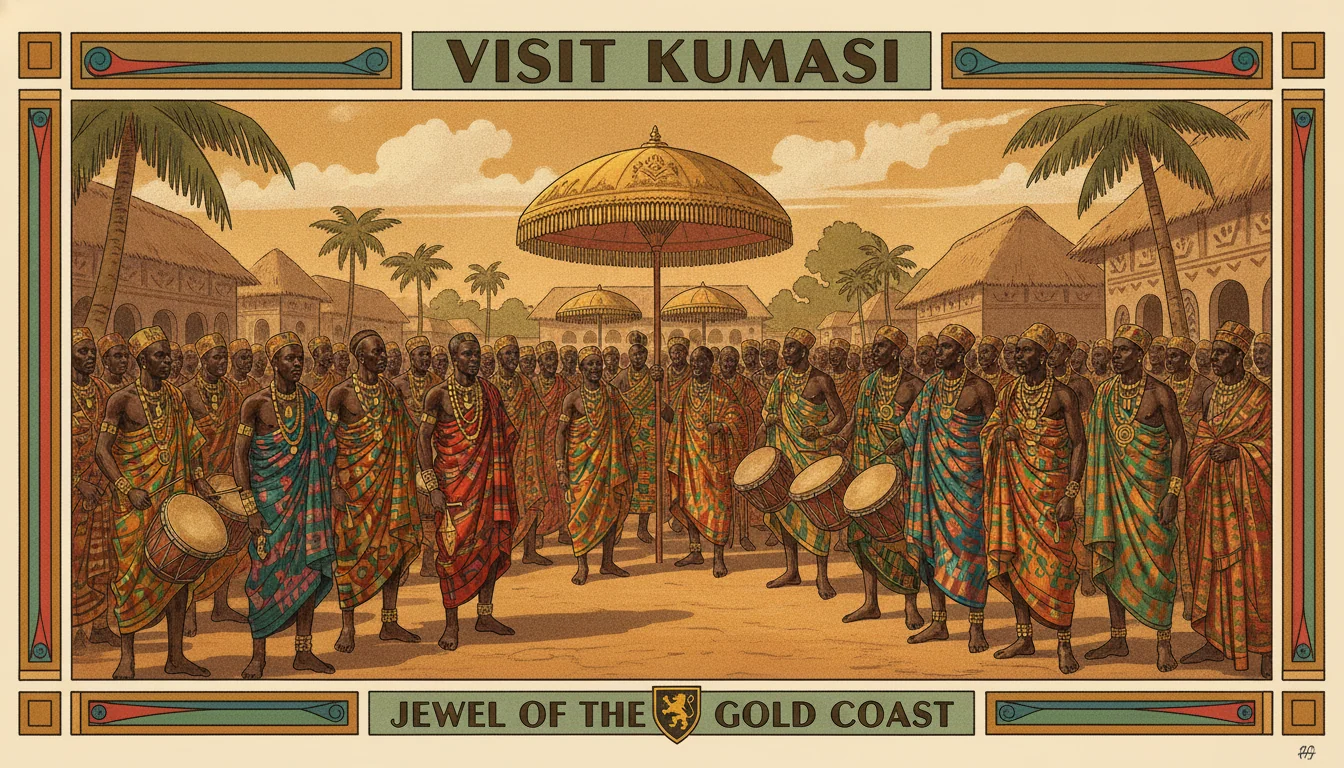
Set your time machine for Kumasi, capital of the Ashanti Empire in 1800. This is West Africa at its most confident: a gold-rich, militarily dominant kingdom whose wealth rivals any court in Europe, ruled from a city of broad avenues, royal courtyards, and a treasury that European visitors struggled to describe without sounding like they were exaggerating. Few destinations on the time-travel circuit combine this much material splendor with this little modern name recognition. That gap between the empire's actual scale and how rarely it gets discussed is exactly why this trip is worth taking.
First, know what kind of place you're entering
Kumasi in 1800 is the political and spiritual heart of a confederation that has been consolidating power for roughly a century, since Osei Tutu and his priest-advisor Okomfo Anokye united the Akan states of the interior forest zone under a single crown around 1701. The city sits inland from the Gulf of Guinea coast, in dense tropical forest that has historically made large-scale European military intervention difficult, a geographic advantage the Ashanti have used deliberately.
The empire you are visiting controls territory stretching from the coast, where it deals with European trading forts, deep into the northern savanna, where it trades with Muslim merchants connected to trans-Saharan caravan routes. This dual orientation, coastal and interior, Atlantic and Saharan, gives Ashanti a diplomatic and commercial flexibility that few African states of the period can match.
Your safest cover story is a merchant or scribe attached to one of the coastal European trading companies, likely Dutch or British, traveling inland with a caravan under official Ashanti protection. Independent travel without such sponsorship is dangerous and will mark you as suspicious. Trade caravans moving between Kumasi and the coast are common, well-organized, and generally safe for travelers who observe the correct protocols.
Dress and bearing
Cloth is not decoration in Ashanti society. It is a language, and getting it wrong announces your ignorance immediately.
For men, appropriate dress includes:
- a large rectangular cloth, woven or plain cotton depending on status, wrapped around the body and draped over one shoulder in the toga-like style
- sandals of leather or woven fiber
- gold ornaments if your rank permits them, though wearing gold above your actual station invites serious suspicion
- a simple cap or bare head depending on the occasion
For women:
- a wrapped cloth skirt paired with a separate cloth covering the upper body
- beaded jewelry appropriate to age and marital status
- elaborate hairstyling, often incorporating threads or beads, that signals social position
The most famous Ashanti textile, kente, is not yet the globally recognized fabric it will become. In 1800 it is a prestige cloth, hand-woven on narrow-strip looms into complex geometric patterns, reserved largely for royalty, nobility, and special occasions. As a visitor, do not wear kente casually. It functions similarly to how a crest or coat of arms functions in European nobility: specific patterns belong to specific lineages and occasions, and wearing the wrong one is a serious social error, not a fashion choice.
Gold: the empire's actual currency
Gold dust, not coin, is the functional currency of daily transactions throughout Ashanti territory. Traders carry small brass weights, cast in an enormous variety of geometric and figurative shapes, each representing a specific unit of gold dust weight, along with a small scale and spoon for measuring transactions on the spot.
Learning the weight system, even approximately, will save you from being cheated or, worse, from insulting a merchant by questioning an honest measurement. The weights themselves are miniature works of art, and collecting or admiring them is a completely normal pastime for visitors, though buying them outright from anyone but a licensed trader is not advisable.
The scale of Ashanti gold wealth genuinely startled European visitors of the period. Royal regalia, ceremonial swords, stools, and even furniture are cast or covered in gold, and the royal treasury's holdings are the subject of considerable, largely accurate, rumor across the region.
The Golden Stool: look, do not touch
If you see nothing else in Kumasi, you may glimpse, from an appropriately respectful distance, ceremonies involving the Sika Dwa Kofi, the Golden Stool. According to Ashanti tradition, the stool descended from the sky in a cloud of white dust and settled onto the lap of Osei Tutu, brought down through the ritual power of the priest Okomfo Anokye. It is understood to contain the sunsum, the spirit, of the entire Ashanti nation, and it is never sat upon by anyone, including the Asantehene himself, who sits beside it on ceremonial occasions rather than on it.
Do not ask to touch it. Do not photograph it, obviously, since you have no camera, but do not sketch it either without explicit permission. Foreigners who have treated the stool as a curiosity rather than a sacred object have created serious diplomatic incidents in this era, and you do not want to be the visitor remembered for the offense.
The court and the Asantehene
Around 1800, the throne is held first by Opoku Fofie and then, from roughly 1801, by Osei Bonsu, remembered as one of the empire's shrewdest rulers. The royal court at Kumasi operates with an elaborate hierarchy of officeholders, from military commanders to treasury officials to specialized craft guild heads, all owing personal loyalty to the Asantehene while also representing their own lineages and constituencies.
Court ceremonies, particularly the periodic Odwira festival, a purification and thanksgiving rite tied to the yam harvest, involve elaborate public processions, drumming, and displays of royal regalia. If your visit coincides with such an occasion, observe from the edges of the crowd. These events combine religious observance with a genuine display of state power, and outsiders are tolerated as spectators but should not attempt to participate in ritual elements they do not understand.
Trade and the coastal connection
Kumasi's relationship with European trading forts on the coast, run by the Dutch, British, and Danish among others, is transactional and carefully managed. Gold, kola nuts, and increasingly enslaved captives taken in regional conflicts move toward the coast in exchange for firearms, cloth, alcohol, and other manufactured goods. This is one of the darker realities of the period: the transatlantic slave trade is deeply entangled with regional warfare and political economy throughout coastal West Africa, and Ashanti's military expansion during this era is connected to this trade in ways that complicate any romanticized view of the empire's wealth and power.
Be aware of this reality as you observe court life and commerce. The gold and splendor you see exist within a regional and Atlantic economic system with a brutal human cost that was already, by 1800, generating moral debate among reformers in Europe, even as it continued.
Language and etiquette
Twi, the Akan language spoken across Ashanti territory, uses an elaborate system of indirect speech and proverb for anything touching on politics, status, or sensitive topics. Direct statements about rank, wealth, or royal matters are considered crude. Learn a handful of common proverbs if you can manage it; even an imperfect attempt signals cultural respect that will smooth your interactions considerably.
Basic etiquette:
- greet elders and officeholders before addressing anyone else in a group
- never point with your left hand, considered unclean for such gestures
- remove sandals before entering certain shrine spaces or the homes of senior officials, following the lead of your hosts
- accept offered food or drink with your right hand
What to eat
Ashanti cuisine in this period centers on starchy staples, fufu pounded from yam or plantain, served with richly spiced soups and stews built around palm oil, groundnuts, and fish or game meat. Kola nuts, bitter and stimulating, are both a trade commodity and a social ritual, offered as a gesture of hospitality and respect that you should accept graciously even if the taste surprises you.
Palm wine, tapped fresh from palm trees and mildly fermented, is the common social drink. It spoils quickly, so freshness matters; drink it soon after it is offered rather than letting it sit.
The experience you should not miss
If you have one moment in Kumasi in 1800, spend it at the edge of a state procession during the Odwira festival, watching the Asantehene pass beneath an enormous ceremonial umbrella, surrounded by drummers, gold-adorned officeholders, and the accumulated visual weight of a century of imperial consolidation. It is a display of wealth and organized state power that few contemporary visitors from anywhere in the world would have expected from this part of the continent, which is precisely the point. Ashanti in 1800 does not need European validation to know exactly how powerful it is.
Bring your best manners, your patience for indirect speech, and an appetite for kola nut. Kumasi in 1800 rewards a visitor who understands that gold, cloth, and ceremony are, here, three dialects of the same language of power.
For another West African destination built on gold, trade, and courtly splendor, see our guide to the Kingdom of Kongo in 1600, and for the Sahel trading empires that fed gold north into the trans-Saharan network, see our guide to Songhai's Gao in 1500.
Quick Answers
Common questions about this topic
How powerful was the Ashanti Empire in 1800?
By 1800 the Ashanti Empire, centered on the city of Kumasi in present-day Ghana, controlled a territory stretching from the Atlantic coast deep into the West African interior. It was one of the wealthiest and most militarily formidable states in Africa, built on gold mining, kola nut trade, and control of trade routes to both the Atlantic coast and the trans-Saharan network to the north.
What was the Golden Stool?
The Sika Dwa Kofi, or Golden Stool, was and remains the sacred symbol of the Ashanti nation, believed by tradition to have descended from the sky and landed in the lap of the first Asantehene, Osei Tutu, around 1701. It was never meant to be sat upon even by the king himself, and it symbolized the unified soul of the Ashanti people rather than mere royal authority.
Who ruled the Ashanti Empire in 1800?
Osei Bonsu became Asantehene, the king of the Ashanti, around 1801, following Opoku Fofie. He ruled during a period of significant territorial expansion and increased contact with European traders on the coast, and he is remembered as one of the empire's most effective diplomats and military strategists.
What made Kumasi wealthy in this period?
Kumasi's wealth rested on control of gold deposits throughout Ashanti territory, taxation of trade routes carrying goods between the Sahel and the Atlantic coast, and a sophisticated tribute system drawing wealth from conquered and allied states across the region. Gold dust functioned as currency and was weighed using an elaborate system of brass weights unique to Akan culture.

Need Advice from Someone Who Lived There?
Get firsthand accounts from people who actually lived through these moments in history.
Create your free account →No card required. Some figures and features require a paid plan.
Join the HistorIQly Club
Get smarter about the past.
Weekly stories, deep dives, and exclusive content straight to your inbox.