Time Traveler's Guide to Norman England, 1066
A survival guide to Norman England 1066: what to wear, what to eat, and why you should not walk near Hastings during the October that changed England forever.
Read Wikipedia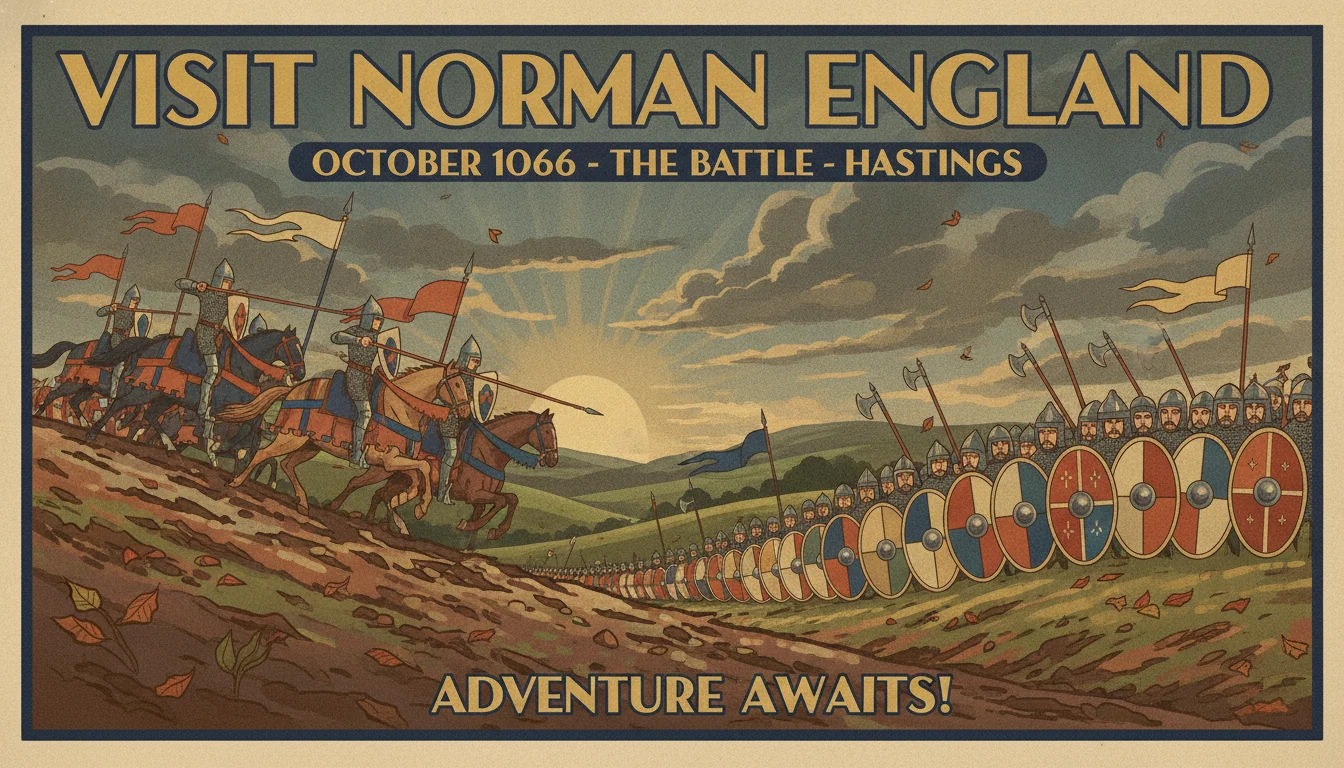
You have arrived in Norman England, 1066, at one of the most disruptive years in the island's recorded history. Three men have claimed the English throne. Two of them are already dead. The third is a Norman duke whose grasp of English consists of knowing which direction Winchester is. The Bayeux Tapestry has not been commissioned yet. The Domesday Book is twenty years away. Everything is, to use the period's own vocabulary, unsettled.
Pack accordingly.
The political situation, briefly
King Edward the Confessor died on January 5, 1066, without a clear heir. Harold Godwinson, the most powerful English earl, was crowned the same day in Westminster Abbey. He had barely warmed the throne before Harald Hardrada of Norway invaded from the north with a Viking army, claiming his own right to the English crown via a tangle of Danish succession politics.
Harold Godwinson marched north and annihilated the Vikings at the Battle of Stamford Bridge on September 25. It was one of the most decisive English victories of the medieval period. Harold lost the better part of his army winning it.
Three days later, William, Duke of Normandy, landed at Pevensey on the south coast with approximately 8,000 men.
Harold marched his exhausted army south. On October 14, on a ridge outside a town later called Battle, the English shield wall met the Norman cavalry and archers. By nightfall, Harold was dead and the English had broken. William marched to London. He was crowned King of England at Westminster Abbey on Christmas Day, 1066.
If your visit falls anywhere in the autumn, stay well clear of Sussex.
What to wear
The distinction between a Norman and an Anglo-Saxon man in 1066 is, unexpectedly, visible from behind. Norman men shave the back of their heads to the neck, leaving hair only on top and at the front. Anglo-Saxon men wear their hair longer, usually to the shoulder, and maintain beards. The Bayeux Tapestry, being stitched by English hands to Norman specifications a few years after your visit, marks this distinction carefully because both sides found it useful for identification in battle.
Women's fashion is more uniform across both cultures. A long-sleeved undergown (the kirtle), a fuller overgown, and a linen head covering. Colors depend entirely on your status. Madder red and weld yellow were accessible dyes; woad blue was common. Bright scarlet from kermes insects was expensive. Purple was an indicator of extraordinary wealth and authority.
If you are male and want to avoid assumptions, grow your beard, keep your hair shoulder-length, and avoid the distinctive Norman crop. If you are female, a linen veil will avoid most awkward questions about your origins.
Shoes are leather, soft-soled, fastened with a toggle or lace at the ankle. Boots exist but are primarily for horseback. In the persistent English mud, you will want the boots.
What to eat and drink
Bread is the foundation of every meal at every economic level. The quality varies dramatically. At the top end, fine wheat manchet loaves. At the bottom, dark rye or barley bread that would challenge a modern dental crown. Pottage, a thick stew of grains, legumes, and whatever vegetables are seasonal, is eaten daily by most of the population. Leeks, onions, peas, and turnips dominate the winter months.
Meat is the food of status. A prosperous household eats salt pork, beef, and mutton. A peasant family eats meat on feast days and otherwise competes with it for the vegetables. Game - deer, boar, hare, wildfowl - is theoretically reserved for those with hunting rights, and those rights are about to become significantly more restricted under Norman forest laws.
Ale is the daily beverage. It is brewed weak enough that children drink it without apparent consequence and strong enough that the English word for health, waes hael, has already begun migrating into drinking toast culture. Wine exists, is imported at great expense, and is drunk by people who can afford imported things.
Do not drink the water from urban streams without boiling it. This advice holds for approximately eight more centuries.
Where to sleep
There are no inns in 1066 in any meaningful modern sense. Travelers rely on the hospitality of monasteries, the households of thegns (the Anglo-Saxon landed gentry), or in extremity the floor of whatever farmstead will accept them.
Monasteries are the most reliable option. English monasteries in 1066 are Benedictine and maintain a tradition of hospitality to pilgrims and travelers. You will sleep in the guest quarters, eat in the refectory, and attend more services than you had planned. Bring a small donation. Demonstrate sufficient piety to avoid awkward theological conversations.
If you end up in a peasant farmstead, you are sleeping in a longhouse that may share its interior with livestock in winter. This is practical: the animals provide heat. It smells exactly as you are imagining.
The major towns - Winchester (still arguably the primary royal capital), York, Lincoln, Canterbury - have sufficient visitor traffic that private hospitality networks function. Winchester in particular, where the royal treasury is kept, is accustomed to travelers with coin.
The social geography
England in 1066 is a kingdom of compact farming settlements, extensive woodland, and poorly maintained Roman roads that remain the best routes between population centers. The population of the whole island is roughly two million people. The largest settlements are modest by later medieval standards.
York is the great northern city, prosperous from Scandinavian trade. Canterbury is the seat of the Archbishop and carries enormous prestige. London - Lundenburh - is already the commercial heart, sitting at the lowest bridging point of the Thames, its streets dense with merchant activity and its docks busy with continental trade.
Outside the towns, England is divided into hides, the Anglo-Saxon administrative and tax unit. Every landholding is assessed in hides, which determines its tax liability under the Danegeld, a national land tax originally levied to buy off Viking raiders and now simply a permanent feature of royal finance. The sophistication of this fiscal infrastructure is one reason William wants it intact.
What changes immediately after October
When William consolidates control over the following months and years, several things shift with notable speed.
Land tenure is the first casualty. The Anglo-Saxon system of thegns holding land by heritable right is replaced over the following decade by Norman feudal tenure: land is held from the king in exchange for military service, and the king can theoretically revoke it. The English aristocracy, those who survive Hastings and the subsequent campaigns, finds its legal footing radically altered.
Language begins its long drift. The new administrative and aristocratic language is Norman French. Latin remains the language of the church and scholarship. Old English continues as the spoken language of most people but loses its prestige writing tradition. It will take roughly three centuries for the collision to produce something recognizable as Middle English.
The forest laws, which William imposes with notorious severity, reserve large tracts of woodland exclusively for royal hunting. Poaching the king's deer becomes a capital offense. For the peasantry living adjacent to those forests, this is not abstract law.
The Domesday Book is William's project, completed in 1086. It is the most comprehensive administrative survey attempted in medieval Europe to that point: every hide, every manor, every ox, every smallholder, recorded and assessed. The Anglo-Saxon administrative system that made it possible was built before the conquest. William simply repurposed it.
What to see
The landscape of 1066 England has its own peculiar texture. Winchester's royal palace and cathedral complex are worth the journey from London. York's Minster is under construction in various phases. Canterbury's cathedral, burned and being rebuilt in subsequent decades, is a major pilgrimage center.
Go to a market if you can. The interaction of buyers, sellers, and the informal justice of market courts gives you a more accurate sense of everyday life than any royal building. Find a monastery scriptorium. The illuminated manuscripts being produced in English monasteries in the eleventh century are among the finest objects of the medieval world, and watching them being made is something no later traveler can experience.
And if you arrive in the summer, before the autumn campaigning season begins, England under Harold Godwinson is a functioning kingdom at the height of its Anglo-Saxon administrative sophistication. Admire it while it lasts. By Christmas, the management has changed. For what that transformed England looked like a century on, the Plantagenet Westminster of 1200 shows the fully Normanized kingdom William's conquest made possible.
Quick Answers
Common questions about this topic
What language was spoken in England in 1066?
Two languages were in rapid collision. Most of the population spoke Old English, a West Germanic language quite unlike modern English. The Norman invaders spoke Old French, a Romance language descended from Latin. The collision of these two would eventually produce Middle English, but in 1066 neither side understood the other without interpreters.
What was the Battle of Hastings actually like?
Harold Godwinson's English forces held a defensive ridge near Hastings on October 14, 1066, and repelled Norman cavalry charges for much of the day. The English shield wall was ultimately broken, Harold was killed - probably in the final cavalry charge rather than the traditional arrow-in-the-eye, which is disputed - and the Norman advance on London began the following week.
What was everyday food like in 1066 England?
For most people, the diet was bread, pottage (a grain-and-vegetable stew), ale, and seasonal vegetables. Meat was largely a luxury for feast days and the aristocracy. Salt fish was widely eaten, especially in coastal areas. Honey was the primary sweetener. The Norman arrival would gradually introduce new spices and cooking influences, but these took generations to filter down.
Was England wealthy in 1066?
Relative to most of Europe, yes. England in 1066 was one of the most administratively sophisticated kingdoms in the western world, with a functioning coinage system, a taxation structure called the Danegeld, and a literate bureaucracy in the church. That administrative wealth was precisely what made it worth invading.

Need Advice from Someone Who Lived There?
Get firsthand accounts from people who actually lived through these moments in history.
Create your free account →No card required. Some figures and features require a paid plan.
Join the HistorIQly Club
Get smarter about the past.
Weekly stories, deep dives, and exclusive content straight to your inbox.