Time Traveler's Guide to Norse Iceland, 1000 AD
Time travel to Norse Iceland, 1000 AD - where the Althing just voted to adopt Christianity, Leif Erikson is sailing west, and your hosts will judge you by how well you haul a net.
Read Wikipedia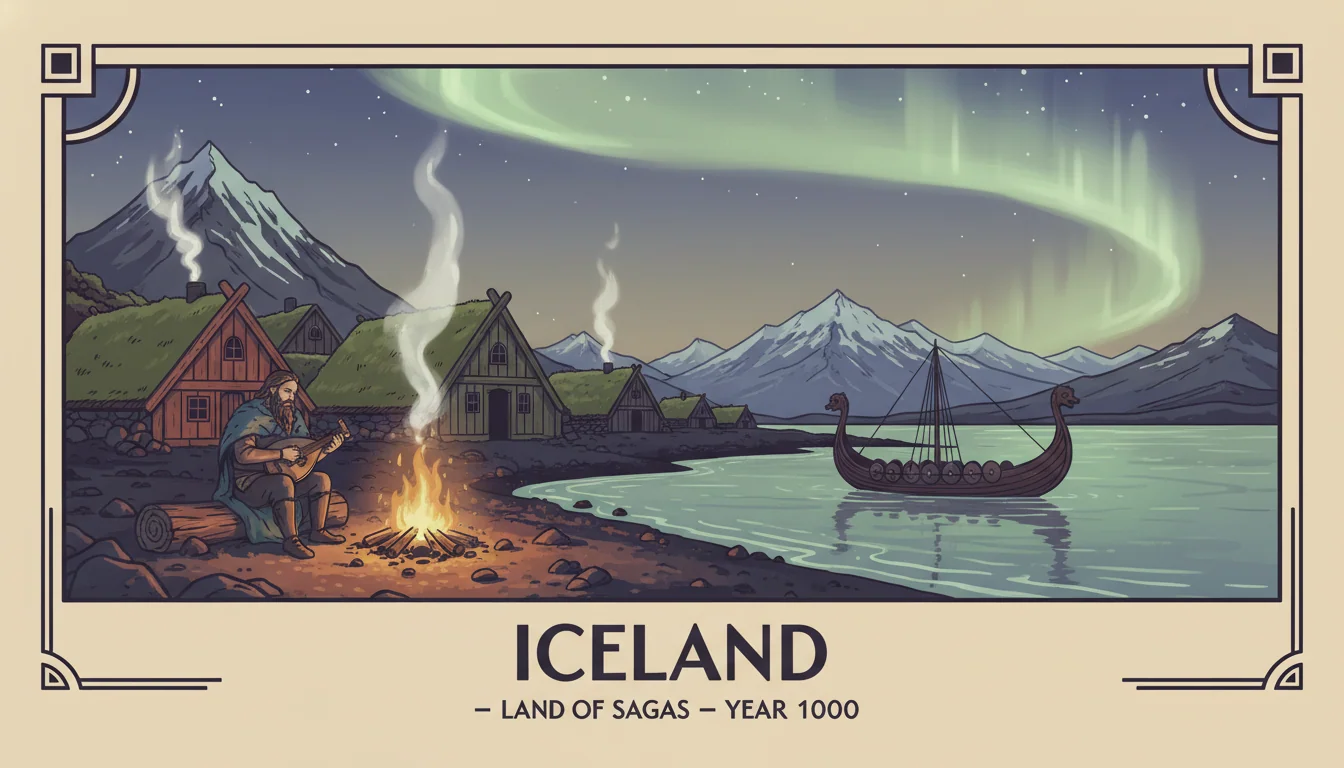
You have arrived in Iceland at the exact wrong time to have a quiet visit. The country has just finished arguing about its religion, and the lawspeaker Thorgeir Thorkelsson, who is not a Christian himself, has just decreed that Iceland will publicly become Christian anyway. Half the country thinks this is wisdom. The other half is doing the pagan equivalent of sulking. Everyone is talking about it at the hot spring.
Welcome to Norse Iceland in the year 1000. Population roughly 50,000. Zero cities. One parliament. Unlimited volcanic drama.
Getting your bearings
Iceland was settled within living memory of your hosts' grandparents. The first Norse settlers arrived around 874 AD, and the island's farmable coastal ring was claimed by free men who had left Norway rather than submit to Harald Fairhair's consolidating monarchy. They brought their families, their thralls, their cattle, and their resentments about royal authority. They have had about 125 years to build a functioning society without a king, which they are irrationally proud of.
There are no cities here. There is no Reykjavik in any recognizable sense - what will eventually become the capital is currently a few farms near a steam vent. Settlement is organized around individual farmsteads, most of them strung along the fjords and coastal lowlands that ring the island. The interior is a wasteland of lava, glacier, and highland desert. You will not be going there unless you have made a serious navigational error.
The landscape will hit you before anything else. The light in summer is exhausting - the sun barely sets, hovering low on the horizon for weeks on end. In winter, the opposite is true. The steam rising from hot springs is visible for miles. The mountains are young and many of them are actively annoyed. An eruption somewhere on the island is a near-annual event, and your hosts treat it with the resigned familiarity of people who have decided that living on a volcano is fundamentally acceptable.
What to wear and why you will regret wool until you don't
Wear wool. Then put on more wool. Then put a cloak of heavy wool over all of that.
Icelandic wool is uniquely suited to this climate because the native sheep produce a fleece with two distinct fiber types - a long outer coat that repels water and a dense inner layer that insulates even when wet. If you have brought cotton anything, leave it in the ship. Cotton is useless here. Linen, if you have it, works for undergarments in summer. In winter, linen is a reminder that you made poor decisions.
Shoes should be leather, ideally with thick soles. The terrain is volcanic rock, wet turf, and glacial gravel. There are no paved surfaces anywhere on the island.
The Norse aesthetic runs toward functional, but there is ornamentation if you can afford it: carved bone and antler pins, simple silver or bronze jewelry, and distinctively worked belt fittings identify your social standing. Come dressed too fine and your hosts will wonder what you are compensating for. Come dressed too poorly and they will not feed you.
Food and drink: the basics of not starving
The Icelandic diet in this period is more monotonous than it is bad.
Dried and salted fish is the staple. Cod and haddock are abundant, and the Norse have developed efficient methods of air-drying them on wooden racks called hjallur. The resulting stockfish is tough, pungent, and keeps for years. You will eat it repeatedly. You will eventually stop noticing the smell.
Lamb is the prestige meat. Iceland has had sheep since settlement and the grass-fed lamb is excellent, though you will mostly encounter it in the form of smoked or boiled cuts at communal meals. Dairy is central to the diet: butter, fresh milk in season, and most importantly skyr, which is made by straining soured milk until it becomes dense and mildly sour. It is filling, nutritious, and widely available. Think of it as the yogurt that everyone eats for breakfast before yogurt was invented.
Grain is scarce and expensive. Bread appears at higher-status households. Berries - crowberries, bilberries, wild strawberries - are gathered in summer. Seabirds and their eggs are eaten in coastal areas. Freshwater fish and the occasional whale complete the picture.
Ale is the default beverage for adults. It is brewed from barley, which has to be imported, so the quality varies significantly by the wealth of the household. Mead appears at important feasts. Water from the streams is clean and genuinely good.
The social structure and why you should memorize it quickly
Icelandic society runs on a three-tier structure that your survival depends on understanding.
At the top are the godar, singular godi - chieftains who hold religious and political authority over their followers. A godi is not a king; he holds his position through voluntary loyalty agreements with free farmers, called thingmen. If his thingmen find him unsatisfactory, they can, in theory, simply transfer their allegiance to another godi. This system is more fluid and more contentious than it sounds.
The bulk of the population are the bondi - free farmers who own land, owe no feudal allegiance in the continental sense, carry weapons, and take enormous pride in their independence. A free farmer in Iceland considers himself the equal of a Norwegian nobleman in terms of personal dignity, and he will tell you this if you give him an opening.
Below the free farmers are the thralls, enslaved people who work the farms and do the most dangerous tasks. Thrall status is inherited, and thralls have few legal protections. The institution is casual and ubiquitous in ways that your 21st-century sensibility will find difficult. You are strongly advised to say nothing about this, however strong the temptation.
What to see
The Althing at Thingvellir is the single most extraordinary thing you will witness. Every summer, chieftains, farmers, traders, and curious bystanders from all over Iceland travel to Thingvellir - Parliament Plains - in the rift valley east of what will become Reykjavik. The geography is spectacular: a wide plain cut by the Mid-Atlantic Ridge, with dramatic lava cliffs called the Law Rock rising above the assembly grounds.
For two weeks, Iceland's entire body politic convenes in one place. The lawspeaker stands at the Law Rock and recites one-third of the legal code from memory. Disputes are heard, verdicts pronounced, outlaws declared. But also: tents everywhere, merchants selling goods, young people meeting potential spouses, poets performing, gossip traveling from one end of the island to the other.
In the year 1000, you are arriving just after the conversion debate. The tension between the Christian and pagan factions is still fresh, and you will hear strong opinions about Thorgeir's decision if you ask any two people in succession.
Also worth visiting: the geothermal hot springs near any major farmstead, which the Norse use for bathing, textile washing, and gathering. The hot spring is the social hub of every neighborhood. If you want to know what is happening in the district, sit near the hot spring and say nothing.
What to avoid
Feuds are the primary hazard of Icelandic social life. The sagas written down in the centuries after your visit document hundreds of them, and they tend to begin with a minor insult or grazing dispute and escalate through legal challenges, ambush, and counter-killing over multiple generations. You do not want to become inadvertently entangled in one.
The rule is: observe, agree with the person currently speaking, and never take a position on any local dispute. You do not know the genealogy. You do not know who is related to whom. You do not know which slight three generations back is still being settled in the current killing.
The sea is the other hazard that kills visitors without warning. Icelandic summer storms arrive quickly and the coastal waters are cold enough to kill you in minutes. The Norse manage this through extraordinary seamanship, but they also lose ships regularly and treat it as the expected cost of ocean travel. Stay away from the water's edge unless you are with experienced locals who are paying attention to the sky.
Getting home
You arrived on a ship from Norway, presumably, or from one of the Western Isles. The sailing season runs roughly from late spring to early autumn. After that, the North Atlantic becomes genuinely dangerous and most traffic stops.
Your hosts, if you have been useful and not rude, will probably let you sleep in the main hall during winter. The longhouse is communal, warm from the central fire, and close enough to the livestock that the body heat helps. It smells accordingly. It is considerably warmer than being outside.
Come spring, find a ship heading south or east. Ask about the ships from Hedeby, the trading port in what is now Denmark. Merchants come through regularly. Pay your passage with whatever skills you have demonstrated or whatever silver you can spare.
You are leaving an island that is, by any reasonable metric, at the edge of the world. It has no king, no cities, no cathedrals, and no army. What it has is a functioning legal system, extraordinary oral culture, and people who built a society in a volcanic wilderness because they preferred autonomy to comfort.
The saga-writers who will document this place in two centuries will make it sound heroic and violent. It is both of those things. It is also, in its way, remarkable.
Watch out for the lava fields on your way to the harbor.
For other extreme time-travel destinations, our guides to Tudor London in 1540 and ancient Uruk in 3000 BC offer very different eras worth exploring.
Quick Answers
Common questions about this topic
What was Iceland like in 1000 AD?
Iceland in 1000 AD was a Norse settlement about 125 years old, with a population of around 40,000 to 60,000 people living on scattered farmsteads across the habitable coastal ring. The country had no cities, no king, and no standing army. It was governed by the Althing, the world's oldest functioning parliament, which met annually at Thingvellir. In the year 1000, the Althing voted to adopt Christianity as the official religion, though pagan practice continued quietly for decades.
What did Vikings eat in Iceland?
The diet in Viking Age Iceland was heavy on dried fish, particularly cod and haddock, along with lamb, dairy products including skyr (a thick cultured dairy product resembling strained yogurt), and wildfowl. Grain was expensive and mostly imported, so bread was a luxury. Berries and wild plants supplemented the diet in summer. Drinking water came from streams; ale was brewed from barley and was the standard adult beverage.
When did Iceland convert to Christianity?
Iceland's official conversion to Christianity occurred at the Althing of approximately 999 or 1000 AD, when the lawspeaker Thorgeir Thorkelsson of Ljosavatn was asked to arbitrate a dispute between Christian and pagan factions. After meditating under a cloak for a day and a night, he announced that Iceland would accept Christianity as its public religion, though private pagan practice would be tolerated. The decision was a political compromise as much as a religious one.
What was the Althing?
The Althing was Iceland's annual assembly, held at Thingvellir (Parliament Plains) every summer for approximately two weeks. All free men were entitled to attend. The lawspeaker recited one-third of the law code from memory each year. Disputes were settled, marriages arranged, trade conducted, and political alliances formed. Founded around 930 AD, it is generally recognized as one of the world's earliest parliaments. It met annually at Thingvellir until 1798.

Need Advice from Someone Who Lived There?
Get firsthand accounts from people who actually lived through these moments in history.
Create your free account →No card required. Some figures and features require a paid plan.
Join the HistorIQly Club
Get smarter about the past.
Weekly stories, deep dives, and exclusive content straight to your inbox.