A Time Traveler's Guide to Pre-Colonial Maynila, 1570
Your guide to pre-colonial Maynila in 1570: a gold-trading Islamic settlement on the Pasig River, connected to China and Brunei by sea, and weeks from Spanish conquest.
The first thing you need to know about Maynila in 1570 is that the Spanish are coming. Martin de Goiti arrived with a reconnaissance force from Cebu earlier this year, fought with Rajah Sulayman's men, and withdrew. Miguel Lopez de Legazpi is consolidating Spanish authority in the archipelago to the south. By next year, a larger force will return, burn the palisaded settlement to its foundations, and begin building a walled colonial city on top of it.
Your window is narrow. And the city worth seeing before it disappears is extraordinary.
What you are looking at
Maynila in 1570 sits on the south bank of the Pasig River, at the point where the river empties into a wide sheltered bay. Across the river to the north, separated by a few hundred meters of water, is the older and larger kingdom of Tondo, ruled by Rajah Lakandula, who is Sulayman's uncle. The two settlements exist in a relationship of kinship, rivalry, and commercial partnership that has structured this part of the archipelago for generations.
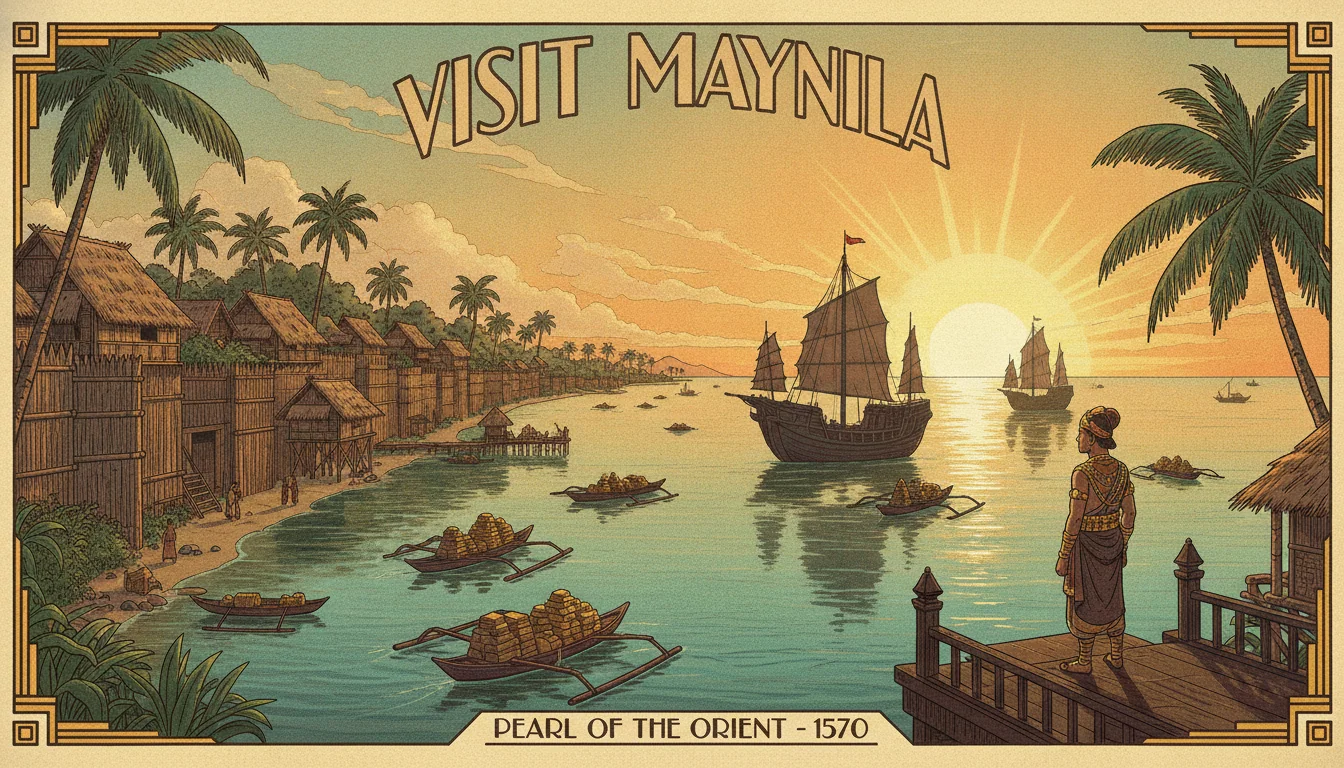
The settlement is enclosed by a palisade of bamboo and heavy timber, running along the riverbank and behind to the land approaches. This is not only a defensive perimeter - it is also the boundary of a regulated trading zone, a point where goods are inspected and commercial relationships are managed. Inside the walls, nipa-palm houses stand on stilts over the water and on the low ground beside the river. The architecture is designed for a tropical climate offering months of heat and driving rain: high-pitched roofs that shed water quickly, open sides for ventilation, bamboo floors that let air circulate beneath.
The center of political authority is Rajah Sulayman's residence - a more substantial structure than the surrounding dwellings, with carved wooden details and a platform that overlooks the river traffic. Sulayman's court has come under the political and cultural influence of the Sultanate of Brunei. The elite practice Islam, dress in Malay-influenced garments, and understand themselves as part of a wider maritime Muslim world that stretches from Malacca through Borneo to the southern Philippine islands. Ordinary people maintain a mix of animist beliefs and recently arrived Islamic practice, which is not considered contradictory.
Getting around
The Pasig River is your primary thoroughfare. Do not attempt to navigate Maynila primarily on foot if you want to move efficiently or at any distance. The settlement organizes itself around water, and almost everything worth reaching is accessible by small boat. The wide bay to the west is where the large trading vessels anchor.
In the bay you will find Chinese junks - large, flat-bottomed trading vessels from Fujian and Guangdong that have been making this run for at least a century. The merchants aboard carry porcelain, silk, iron, and metal goods eastward, and return with beeswax, gold, forest products, and cotton cloth. This exchange is the engine of Maynila's commercial wealth and its political significance in the regional trading system.
Smaller Malay proas from Borneo carry traders who often also represent the commercial and political interests of the Brunei sultanate. Javanese and other Southeast Asian vessels appear seasonally. The bay on a clear morning is one of the more impressive trading scenes visible in the Pacific world of 1570. The commercial routes visible here run north to Ming Dynasty China and south through the Javanese archipelago, connecting Maynila to a maritime world that reached its earlier peak at Majapahit's Trowulan.
On the river itself, outrigger bancas - narrow wooden boats with bamboo stabilizers - carry cargo and passengers between the settlement, Tondo, and points upriver. These are fast and cheap. Learn to step into one without overbalancing.
Dress and appearance
The local dress standard is lighter than anything familiar from a European or East Asian context. Men wear a short collarless upper garment called a baro and a strip of cloth wrapped around the lower body. Women wear the baro over a long wrapped skirt. Both are typically woven cotton, sometimes dyed with plant pigments in geometric patterns. Footwear is optional and often absent.
Gold is the element that will most unsettle your assumptions. The Spanish chroniclers who arrive in this period write with undisguised amazement about the quantity of gold worn by ordinary people. Earrings, necklaces, arm rings, anklets, and elaborate belt clasps are common across social levels. The region's gold trade is well established, and local craftsmen work the metal into filigree designs of considerable delicacy. Do not arrive without gold jewelry of some kind. Silver reads as poverty or foreignness - neither useful.
Your physical appearance matters less than your dress and your manners. Maynila's trading nature means a range of appearances is familiar in the marketplace. What will mark you as an outsider is your clothing, your shoes if you are wearing any, and your failure to read the social cues that structure interaction with strangers.
Food and water
Rice is the staple, served at almost every meal. It is grown on terraced fields inland and brought to Maynila along the river system. The fish supply is excellent - the bay and the river yield bangus, several varieties of shellfish, and smaller river fish that are caught fresh daily. Coconut appears in almost everything: the water is a reliable safe drink, the flesh is food and a cooking medium, and the leaves serve a dozen practical construction purposes.
Vinegar made from coconut sap is the dominant souring agent in the local cooking. Fermented shrimp paste functions as a condiment and salt source. The flavors are more acidic and pungent than Chinese or European cooking. They are also quite good, once you have adjusted to them.
Do not drink river water. Coconut water is safe and available everywhere. Local alcoholic beverages include tuba, a palm wine fermented from coconut or nipa sap that is widely available and moderately potent. It is not as consistent as wine from a barrel.
What you must not do
Do not show insufficient respect to a datu. The society of Maynila is organized into barangay units, each led by a chief. The datu's authority over his people and over commercial transactions within his barangay is not negotiable by the conventions of this time, and he does not need to justify his decisions to anyone below him in the hierarchy. A perceived insult to a datu in his own territory is not a social embarrassment. It is a legal and potentially physical problem.
Do not handle religious objects without invitation. The mixture of animist practice and Islam in Maynila in 1570 means the two traditions are in active negotiation, particularly at the elite level. Sacred items from either tradition are not objects of curiosity for outsiders.
The kris dagger is a status symbol as much as a weapon. Men of standing carry one. It is not an invitation to ask questions or to request a closer look.
What to see before it is gone
The view from the Pasig River mouth at dawn, when the Chinese junks are anchored in the bay and the morning light comes over the mountains inland, does not exist after 1571. Pre-colonial Maynila - its wooden palisade, nipa houses on stilts, trading platforms and outrigger traffic - will all be dismantled or burned and replaced by Intramuros, the Spanish stone-walled city built on this exact site.
The gold-working craftsmen in the settlement's commercial quarter produce jewelry that will be looted, melted, or carried off within a year of the conquest. Spanish accounts from the period confirm they removed significant quantities of worked gold from Maynila and Tondo in 1571.
The baybayin script used by the local literate class is in active daily use for correspondence and records. Because it is written on bamboo, leaves, and wood rather than stone or fired clay, almost no pre-conquest Philippine texts survive to the modern world. What you are observing is a fully functioning literacy operating on perishable materials that were never intended to outlast their authors.
The practical note
If you arrive in the early months of 1570, before Martin de Goiti's reconnaissance attack in May, the settlement is intact and the political situation has not yet reached open crisis. Rajah Sulayman, by the Spanish accounts written shortly after the conquest, was young, politically acute, and not inclined to surrender without resistance. He resisted. The settlement burned in 1571.
Come early in 1570. Give yourself time to see the whole thing before the smoke rises.
Quick Answers
Common questions about this topic
What was Maynila before the Spanish arrived?
Before the Spanish conquest, Maynila was a palisaded Islamic trading settlement on the south bank of the Pasig River at its mouth in Manila Bay. It was ruled by Rajah Sulayman and was a commercial center connected by sea trade to China, Brunei, Java, and other parts of Southeast Asia. The settlement specialized in gold, beeswax, and tropical forest products.
Who was Rajah Sulayman?
Rajah Sulayman (also Soliman) was the paramount ruler of Maynila in the late 16th century. He was a Muslim ruler who had come under the political and cultural influence of the Sultanate of Brunei. He resisted Spanish colonization and refused to submit peacefully. Maynila was burned during the Spanish conquest in 1571, and Sulayman died fighting the colonial forces.
What language did people speak in Maynila in 1570?
The local population spoke Old Tagalog as their primary language. Malay served as the language of regional trade, particularly useful for dealings with merchants from Borneo, Java, and other parts of Southeast Asia. Members of the elite also used Baybayin, an indigenous script written on perishable materials like bamboo and leaves.
Why does the visit window close after 1570?
Spanish forces under Martin de Goiti attacked Maynila in May 1570 and briefly withdrew. Miguel Lopez de Legazpi returned with a larger force in 1571, burned the settlement, and established Intramuros on its site. The pre-colonial settlement of Maynila effectively ceased to exist in 1571, replaced by the Spanish colonial city.

Need Advice from Someone Who Lived There?
Get firsthand accounts from people who actually lived through these moments in history.
Ask Them YourselfJoin the HistorIQly Club
Get smarter about the past.
Weekly stories, deep dives, and exclusive content straight to your inbox.