A Time Traveler's Guide to Pictish Scotland, 700 CE
Visiting Pictish Scotland 700 CE: the Picts have just stopped the Northumbrian advance and are carving their most ambitious symbol stones. A practical survival guide.
Read Wikipedia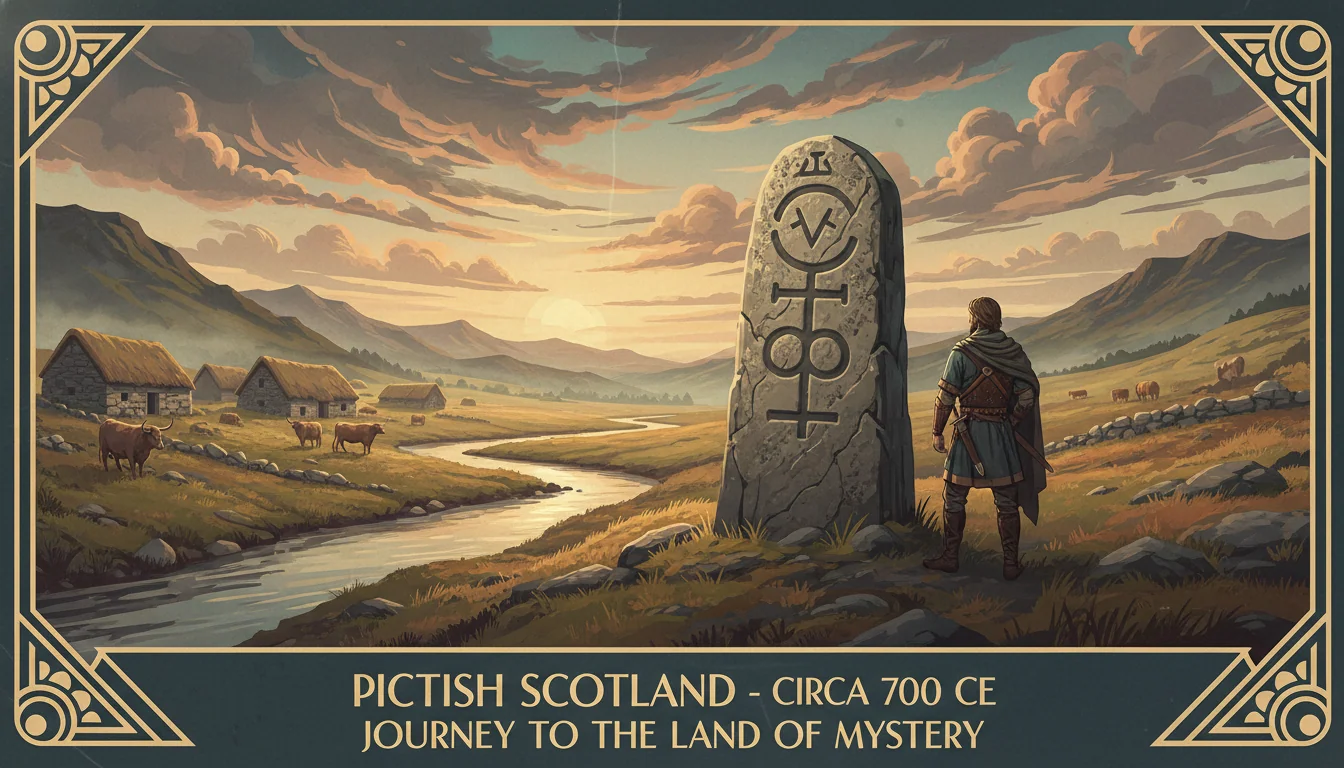
Fifteen years ago, the Northumbrians came north across the Firth of Forth and most people assumed the Picts were finished. The Angles of Northumbria had expanded relentlessly through the 7th century, pushing from Yorkshire up through Lothian, converting kingdoms with a combination of military pressure and Christian missionaries, and Pictland seemed the next logical conquest.
Then, in 685 CE, King Bridei mac Bili led a Pictish army into the hills near the loch the locals call Linn Garan, in the territory of Forfarshire, and ambushed the Northumbrian king Ecgfrith. The Angles walked into a landscape they didn't understand, into a bog-flanked killing ground their cavalry couldn't negotiate. Ecgfrith died. His army was wrecked. The Northumbrian advance stopped permanently.
You are visiting in 700 CE, fifteen years after Nechtansmere. The Picts know they won. You can feel it.
Orienting yourself
Pictland in 700 CE is not a single city or court. It is a network of kingdoms and sub-kingdoms stretching from the Black Isle in the north to the Ochil Hills in the south, from the Grampian coast westward to wherever Dál Riata's Irish-Gaelic enclave begins in Argyll. The dominant territory is Fortriu, centered roughly around the Moray Firth and Strathearn, which is where the most powerful kings have been based for two generations.
The capital, insofar as the word applies, is probably somewhere in the vicinity of what will one day be called Inverness, though Scone, near the Tay, already functions as an assembly and inauguration site. If you want to find the king, head for the royal hall at Fortriu. Bring a gift, preferably livestock or metalwork. Do not arrive unannounced.
Your cover story is simple: you are a pilgrim or a merchant from Northumbria (pretend to be Anglian, not Pictish; your accent will give you away regardless). Cross-border movement exists. There is enough trade - leather, dried fish, cattle, worked metal - that strangers are not automatically suspect. Speak carefully about the battle of 685. It was a great Pictish victory and a source of pride, but Ecgfrith's death also left political complications that are still being negotiated.
Dress to belong
Forget the tattooed blue warrior of popular imagination. The Picts of 700 CE are Christian farmers, fishermen, and craftsmen, dressed in practical wool.
Men wear a long knee-length tunic (leine) in undyed or earth-toned wool, belted at the waist, with breeches underneath. A rectangular woolen cloak, fastened at the shoulder with a penannular brooch if you can afford one, handles the cold. Shoes are leather, often simple turnshoe construction. A knife is standard equipment, not a weapon - it is a tool everyone carries.
Women wear a longer ankle-length version of the same tunic, usually with a second layer pinned at the shoulders. Headcoverings are common for women above a certain social rank, simple wrapped or pinned linen cloth.
Jewelry is where Pictish craft is extraordinary. The penannular brooch - a near-circle of silver or bronze with a free-running pin - is the dominant dress fastening and status marker. Some examples are heavily decorated with animal interlace, geometric patterns, and the same abstract motifs you see on the symbol stones. If you want to fit in and have the means, acquire a decent brooch. It signals craft appreciation, which Picts understand.
What you will eat
The Pictish diet in 700 CE is nutritious if monotonous. The agricultural staples are oats and barley, grown in the lowland strips around each settlement. Oat porridge (eaten with salt or dairy) is a daily reality. Barley goes into bread, into flatcakes cooked on a hearth stone, and into ale. Ale is the standard beverage for everyone from the hall to the field; the water quality in most settlements makes it the safer option.
Animal protein comes from cattle (slaughtered in autumn when pasture runs out), pigs, sheep, and deer. Salmon is abundant and important - the rivers of eastern Scotland in this period are extraordinarily rich, and smoked or dried salmon is a trade commodity. Sea fish, shellfish, and seabirds supplement the diet in coastal communities.
Dairy is significant. Soft cheese, butter, and cream are consumed when animals are producing. The Pictish name for a butter-producing farm appears in several later documents.
Do not expect imported goods beyond the occasional glass bead, Frankish wine traded at coastal ports, or an Irish manuscript. Pictland in 700 CE is not poor, but it is not the Mediterranean.
Navigating the symbol stones
You will not travel a day without encountering them. The Pictish symbol stones stand along ridgeways, on hillsides, in churchyards, at river crossings - carved slabs and natural boulders bearing the same mysterious repertoire: the crescent and V-rod, the double disc, the swimming Pictish beast, the mirror and comb pair, the salmon, the eagle, the boar.
Locals are not mysterious about them. They are markers - of territory, of lineage, of commemoration. A stone at a ford means something. A stone near a farmstead means something. The precise grammar of what each symbol combination means is not something a stranger will decode in a short visit.
What you can observe is the quality. The incised lines are clean, deep, and confident. Whoever carved these had practiced for years. The animal forms in particular, the salmon especially, show a naturalness of line that is striking in any period. Stop and look. You are seeing one of early medieval Europe's most distinctive art forms in active use.
By 700 CE, the Class II slab tradition is developing, combining the old symbol vocabulary with a Christian cross on the other face. The Aberlemno roadside stone, not far from the battlefield of 685, carries both: a battle scene on one face and a cross on the other. The Picts are integrating their inherited symbolic language with their Christianity rather than discarding one for the other.
The religion question
Do not expect paganism. Columba converted the northern Picts in the late 6th century, and by 700 CE there are monks, monasteries, and Christian communities throughout Pictland. The monastery at Portmahomack on the Tarbat peninsula in Easter Ross is an active center of manuscript production and metalworking. Abernethy in Strathearn is an important ecclesiastical site.
Pictish Christianity has its own character - art-rich, monastic, influenced by the Irish traditions that came through Iona - but it is recognizably mainstream in its theology. The Pictish king Nechtan mac Der-Ilei, who will come to power in the first decade of the 8th century, will formally align the Pictish church with Rome on the Easter calculation controversy, but that debate is already underway in clerical circles by 700.
If you need sanctuary, find a monastery. They are the safest places in Pictland for a stranger. Bring a manuscript if you have one. A book is a luxury import worth more than most livestock.
What to avoid
The Vikings are not coming yet. The first raids on Iona and the Northumbrian coast are still in the 790s. That threat does not exist in 700 CE.
The real dangers are more prosaic. Dál Riata, the Gaelic kingdom that occupies Argyll and extends into Ulster, is a neighbor with whom the Picts have a complicated relationship. The western highlands are Dál Riatan territory. Do not wander west of the Drumalbyn mountains without understanding that you are entering a different political jurisdiction with different social rules.
Livestock raiding is endemic. A small farm is a reasonable target for a neighboring settlement's young men testing their luck. Do not sleep with cattle and nothing else between you and the dark.
Disease is the constant. Dysentery, respiratory infections, and periodic epidemic illness are facts of life. The Pictish plague outbreak that hit several decades earlier is in living memory. Stay away from any settlement showing signs of fever. Wash in rivers, not standing water.
The cold is also not decorative. Seven hundred CE in northern Scotland is not a gentler climate than today. Wool and a fire are not luxuries.
What makes it worth going
The symbol stones at Aberlemno by late afternoon light. The salmon running the River Tay in autumn. A Pictish hall at night with the fire going and the brooches catching the light. The sheer strangeness of a sophisticated, literate, Christian society that chose to communicate some of its most important messages in a visual language that nobody outside it could fully read - and that we still cannot fully read, thirteen centuries later.
The Picts are near the end of their independent existence. In another hundred and forty years the name will be absorbed into the kingdom of Alba and the language will begin to fade. In 700 CE, none of that has happened. They are at the height of their confidence, carving their symbols into stone as if the symbols will last forever.
They were right about that, if nothing else.
To see how the wider world around Pictland was changing in the same era, our guides to Carolingian Aachen, 800 AD and Viking Jorvik, 950 AD tell the stories of two civilizations that would reshape northern Europe in the centuries that followed.
Quick Answers
Common questions about this topic
Who were the Picts?
The Picts were a confederation of tribes inhabiting what is now northern and eastern Scotland, roughly from the Firth of Forth northward to Caithness. By 700 CE they were a unified kingdom at the height of their power, having decisively defeated the Northumbrian Angles at the Battle of Dun Nechtain in 685 CE. They spoke a Brittonic language and left behind an extraordinary body of carved symbol stones whose imagery is still not fully decoded.
What do Pictish symbol stones depict?
Pictish symbol stones carry a distinctive set of motifs - the crescent and V-rod, the double disc and Z-rod, the Pictish beast (a stylized swimming creature), the mirror and comb, the serpent, the salmon, the boar, and the eagle, among others. They appear on natural boulders (Class I) and shaped stone slabs (Class II, which add a Christian cross). Their precise function - territorial marker, memorial, genealogical record, or religious statement - remains debated.
Were the Picts really tattooed?
Possibly, but the evidence is thin. The Roman name 'Picti' (the painted or tattooed ones) appears in sources from the late 3rd century CE, but Roman writers were often loose with ethnographic details. Archaeological finds have not confirmed body-painting or tattooing, and by 700 CE the Picts were Christian. The tattoo theory is not disproven, but modern historians treat it with caution.
What happened to the Picts?
The Pictish kingdom was absorbed into the kingdom of Alba in the 9th century, traditionally associated with the reign of Kenneth MacAlpin, whose succession around 843 CE merged the Pictish and Gaelic Dál Riatan dynasties. The Picts did not disappear as a people - they were gradually assimilated into the emerging Scottish identity - but the Pictish language and royal tradition faded over the following century.

Need Advice from Someone Who Lived There?
Get firsthand accounts from people who actually lived through these moments in history.
Create your free account →No card required. Talk to anyone in history with 8 free credits a day. Some features require a paid plan.
Join the HistorIQly Club
Get smarter about the past.
Weekly stories, deep dives, and exclusive content straight to your inbox.