A Time Traveler's Guide to Sasanian Ctesiphon, 550 AD
Sasanian Ctesiphon history in 550 AD: a Persian capital that rivaled Rome, home to the greatest brick arch ever built. Here is how to arrive and survive.
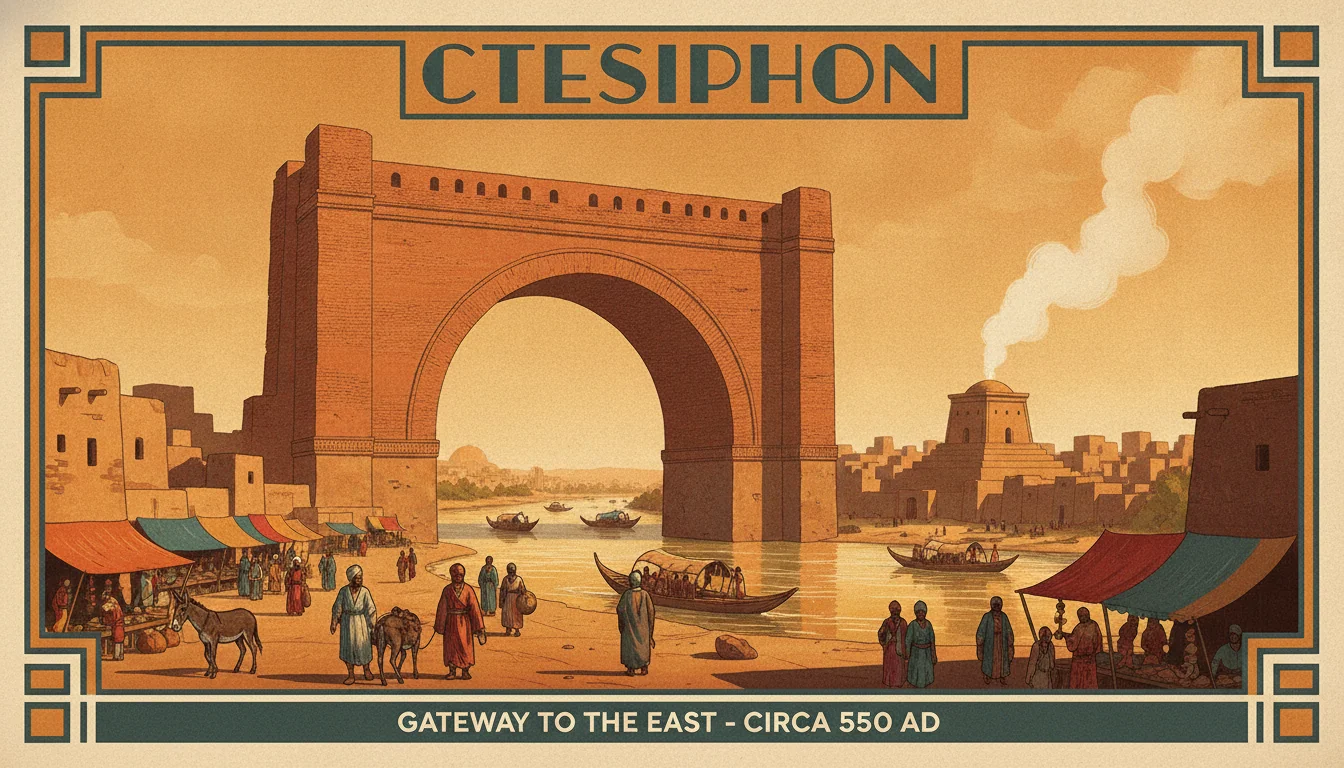
The city you are entering does not call itself the largest in the world, but in 550 AD it effectively is - at least west of China. Constantinople is impressive. Alexandria is ancient and still magnificent. But Ctesiphon, winter capital of the Sasanian shahanshah, has been accumulating wealth, people, and architectural ambition for three centuries. Right now, under Khosrow I Anushirvan - king of kings, reformer, philosopher-patron, and the ruler Byzantine diplomats quietly consider the most formidable man alive - the city is at its fullest expression.
Prepare accordingly.
What you are walking into
Ctesiphon sits on the eastern bank of the Tigris in the lower Mesopotamian floodplain, in what is now Iraq roughly 35 kilometers south of Baghdad. It is not one city but a cluster of urban settlements that have merged until the distinctions between them are largely theoretical. On the western bank lies Seleucia, the old Greek foundation left by Alexander's generals. On the eastern bank sits the Sasanian palace complex and the royal city. Between them and spreading in every direction: markets, residential quarters, warehouses, workshops, fire temples, and a grid of Tigris-fed canals that keep both agriculture and commerce running.
The population, based on what historians have assembled from tax records and settlement archaeology, probably runs between 200,000 and 500,000. You will feel every one of them in the market districts.
It is 550 AD, approximately. Khosrow I has been king for about nineteen years. His reign has already transformed the empire: the old land-tax system that was bleeding small farmers has been replaced with a fixed survey-based assessment. Roads have been maintained, irrigation systems repaired, the central bureaucracy professionalized. He concluded a formal peace with the Byzantine Emperor Justinian in 532 - the so-called Eternal Peace, though it will not last - and has used the breathing space to finish rebuilding the capital. The philosophers displaced when Justinian closed the Platonic Academy in Athens in 529 have been arriving in Khosrow's court, welcomed with stipends and positions. Greek intellectual life is fashionable at the highest levels of Sasanian society.
Chess arrived from India sometime in this reign. The astronomer Buzurgmihr is translating Sanskrit scientific texts. New Zoroastrian liturgical compositions are being finalized in the scriptoria attached to the fire temples.
You have arrived at a very particular moment. Sasanian Ctesiphon in 550 is the rival of Justinian's Byzantine Constantinople - both capitals of ancient civilizations that considered themselves the center of the world, separated by a few hundred miles of contested frontier and perpetually at war.
The first thing you will see
The Taq Kasra stops you. If you come by river, it dominates the eastern horizon as your boat rounds the bend. If you arrive by road from the south, you see it from several kilometers out.
It is the great iwan arch of the Sasanian royal palace: a vaulted throne hall whose fired-brick arch climbs roughly 37 meters from the ground and spans about 26 meters across, constructed without supporting centering and without mortar in the conventional sense - the bricks lean inward in progressive courses, set with a mud compound that dried faster than the bricks could collapse. The result is a vault of impossible size that appears to hover. No standing Roman building is as tall in a single interior span. No brick structure in the world will match it for centuries.
Do not attempt to enter the palace complex on arrival. You need a formal introduction and a recognized commercial or diplomatic purpose. Establish that first.
Your cover story
The safest identity for a foreign visitor to Ctesiphon in 550 is a Greek-speaking merchant from the Byzantine east - a trader from Antioch, Alexandria, or one of the Syrian cities who has come with goods and is seeking connections along the Silk Road.
This works for several reasons. Byzantine-Sasanian trade continued through most periods of political hostility and is active in the current peace. Foreign merchants from the western empire are well established in Ctesiphon and have long-standing commercial relationships with the Armenian intermediaries who operate legally on both sides of the border. Greek is also a prestige language at Khosrow's court: the refugee scholars from Athens have made it intellectually fashionable, and claiming an association with philosophical circles will open doors with the educated nobility.
What you should not claim: to be an independent western Christian cleric. The Sasanian Empire has a substantial Nestorian Christian minority, tolerated and even protected under formal arrangements, but a Roman-rite priest without obvious merchant business will attract questions from both the Magi and the palace security apparatus. Stick to the merchant frame.
Dress and presentation
The Sasanian nobility wears a silhouette that is nothing like anything in the Roman world. The baseline for a man of middle or upper status is a close-fitting tunic reaching to the knee, wide trousers gathered at the ankle, a fitted jacket or surcoat, and a distinctively shaped cap - either a Phrygian-style hat or a wrapped turban depending on regional and ethnic affiliation. Colors are rich: deep crimson, saffron, vivid blue. The Sasanian textile industry, fed by the Silk Road, produces dyes that the Roman world can barely access and cannot replicate.
As a foreign merchant you can dress in Byzantine style without giving offense, provided you make a gesture toward Sasanian conventions when approaching the court or entering a fire temple precinct. Bare-headed inside a fire temple is not acceptable. Borrow a head covering from your host before entering any sacred space.
Leave jewelry you do not need secured in your lodgings. The market districts are professionally operated, and a foreign visitor heavy with gold is an advertisement.
Navigating the city
The Tigris is your main artery. Flat-bottomed river craft move goods and passengers continuously. Hire one with a rate agreed before you board. For overland movement within the city, hire a local guide on your first day. The canal grid is complex, street names are in Middle Persian (Pahlavi), and a wrong turn in the warehouse district will deposit you in a neighborhood where foreigners are unexpected.
The major markets are organized by commodity: cloth merchants in one district, spice traders adjacent, metalworkers near the canal intake. Prices are negotiated. Bring small weights and a balance for checking coin purity. The Sasanian silver drachm is the standard trade currency, but you will also encounter Byzantine gold solidi, Indian punch-marked coins, and occasionally Chinese silk squares used as currency by long-distance Silk Road traders.
Food, water, and survival
Ctesiphon's cuisine is sophisticated by the standards of any city in 550. The Sasanian court has developed rice dishes, herb-heavy stews of lamb with dried fruit, flatbreads from clay ovens, and pomegranate-based sauces that reappear centuries later in Persian cooking as still practiced today.
For a foreign visitor: eat at establishments also frequented by the local Armenian and Syrian Christian merchant communities. These populations are well established, their food suppliers have been vetted by long experience, and the water supplied through their quarters tends to be cleaner than the general river supply. Avoid raw fish from street stalls in summer. Avoid drinking canal water.
The grain-fermented beer of lower Mesopotamia is safe and available everywhere. Grape wine exists but is expensive. Do not drink directly from the Tigris.
The fire temples
Ctesiphon and its surrounding territory are dense with Zoroastrian fire temples, where the Magi maintain sacred flames that have burned in some cases for generations. These are active religious sites and the spiritual infrastructure of the empire. The fire inside each temple is treated as a living, conscious being requiring continuous tending and ritual purity.
You can observe a temple exterior respectfully. Do not attempt to enter an inner sanctum without a Zoroastrian host who formally sponsors your presence. The concept of ritual pollution (druj) is taken seriously: foreigners, the ill, and the ritually impure are expected to maintain distance from the sacred fire. This is enforced not with hostility but with firm redirection. Accept the redirection.
What to be careful about
Ctesiphon in 550 is a well-administered city. The palace maintains a guard corps in the royal district and a professional bureaucracy throughout the rest. You are not in danger from arbitrary state violence unless you provide a reason.
Reasons to avoid providing: refusing to step aside when a royal cavalcade passes; any public disrespect toward the sacred fire or the Magi; attempting to sketch or memorize the palace fortifications; inserting yourself into the political affairs of the large Jewish community in Mesopotamia, which has its own academies and leadership structure and does not welcome foreign involvement. The Jewish population is treated with formal neutrality by the Sasanian state. Merchants who complicate that arrangement are unwelcome.
The experience you should not miss
If you can spend one afternoon in Ctesiphon's main bazaar - the covered market section adjacent to the river gate - take it. The smell is a catalog of the medieval world: cardamom, incense, wet wool, tanning leather, smoke from braziers, river mud underneath everything. The people moving through it represent almost every ethnic and linguistic group between the Aegean and the Indus: Armenians, Syrians, Greeks, Arabs, Turks from the steppe, Indians, and the occasional Chinese silk merchant working the western end of the Road.
Somewhere in this city, right now, scholars are translating Plato into Middle Persian. A chess set is being introduced to the court for the first time. Zoroastrian priests are composing the liturgical texts that will form the basis of the surviving Avesta. The astronomical calculations being made in the palace library will eventually pass through Arabic translation into medieval European science.
Ctesiphon in 550 is not the end of something old. It is a civilization at high tide, five decades before the Byzantine wars resume and over a century before the Arab conquest that will end the Sasanian dynasty permanently. The Taq Kasra arch will still be partially standing in the 21st century. Everything else will be gone.
Pack light. Hire a guide on arrival. Arrange your papers and cover story before you reach the river gate. The bureaucrats at the checkpoint are thorough and immovable.
For a different experience of a great non-European capital at its peak, our guide to Gupta India's Pataliputra in 400 AD covers the subcontinent's Golden Age at roughly the same moment in world history. Both flourished while Rome was falling.
Quick Answers
Common questions about this topic
What was Ctesiphon in 550 AD?
Ctesiphon was the capital of the Sasanian Persian Empire, located on the eastern bank of the Tigris River in what is now Iraq, roughly 35 kilometers south of modern Baghdad. In 550 AD, under King Khosrow I Anushirvan, it was one of the largest and wealthiest cities on earth, with a population historians estimate at several hundred thousand.
Who was Khosrow I?
Khosrow I Anushirvan ('of the immortal soul') ruled from 531 to 579 AD and is widely considered the greatest Sasanian king. He reformed the empire's tax system, repaired its infrastructure, patronized philosophy and medicine, and welcomed Greek scholars who fled Justinian's closure of the Platonic Academy in Athens. Under him, Ctesiphon reached its administrative and cultural peak.
What was the Taq Kasra?
The Taq Kasra, or Arch of Khosrow, was the central throne hall of the Sasanian royal palace at Ctesiphon. Its iwan arch, built from fired brick without conventional mortar, reached roughly 37 meters in height with a span of about 26 meters - the largest single-span brick arch in the ancient world. Half the structure still stands in modern Iraq.
What religion did Sasanian Persians practice?
Zoroastrianism was the state religion of the Sasanian Empire. Zoroastrians worshipped Ahura Mazda (the Wise Lord), maintained sacred fire temples whose flames were never extinguished, and were led by a priestly class called the Magi. The religion profoundly influenced later conceptions of heaven, hell, divine judgment, and the cosmic conflict between good and evil in Judaism, Christianity, and Islam.

Need Advice from Someone Who Lived There?
Get firsthand accounts from people who actually lived through these moments in history.
Ask Them YourselfJoin the HistorIQly Club
Get smarter about the past.
Weekly stories, deep dives, and exclusive content straight to your inbox.