A Time Traveler's Guide to the Scythian Steppe, 400 BC
The Scythians ruled the Pontic steppe at the height of their power in 400 BC. This guide to Scythian steppe history covers culture, gold, warfare, and how to survive.
The Scythians left almost nothing in writing. Their history reaches us through people who feared or traded with them - Herodotus above all, who devotes a substantial section of Book IV to their customs, their wars, their cannabis vapor baths, and their habit of turning enemy skulls into gilded drinking cups. He gathered what he could from informants and merchants at Olbia, a Greek colony on the Black Sea's northern shore. Some of what he reports is careful ethnography. Some of it is legend. Both are worth knowing.
In 400 BC the Scythians are at their peak. The Persian emperor Darius tried to conquer them in 513 BC and failed completely, turned back after weeks of being led across the steppe without a battle offered. The Greeks know better. If you want to visit one of the last great horse cultures before Sarmatian pressure from the east ends it, this is your window.
First, understand where you are
The Scythian steppe at 400 BC is not a landscape of empty grass. It is a working territory, densely used, with established routes between seasonal pastures, known trading posts, burial grounds marking clan territory, and river crossings that serve as de facto meeting points between groups.
The dominant group you will encounter north of the Black Sea is the Royal Scythians, the ruling clan Herodotus identifies as the most powerful. Their primary territory runs from the Dnieper River east to the Don, with the Crimean peninsula as their southern anchor and their primary interface with the Greek world. Below the Royal Scythians in the wider hierarchy are the Farmer Scythians along the Dnieper and Bug river valleys, and the Nomadic Scythians of the open steppe interior.
These groups speak the same Iranian language, share the same visual culture, and broadly recognize Scythian royal authority, but they are not the same people. Getting the distinction wrong in conversation will identify you as an ignorant foreigner, which you are. This is fine if handled with appropriate humility.
What you are wearing is wrong
Scythian dress is functional for a life spent almost entirely on horseback, and it differs sharply from anything worn in the Greek or Persian world.
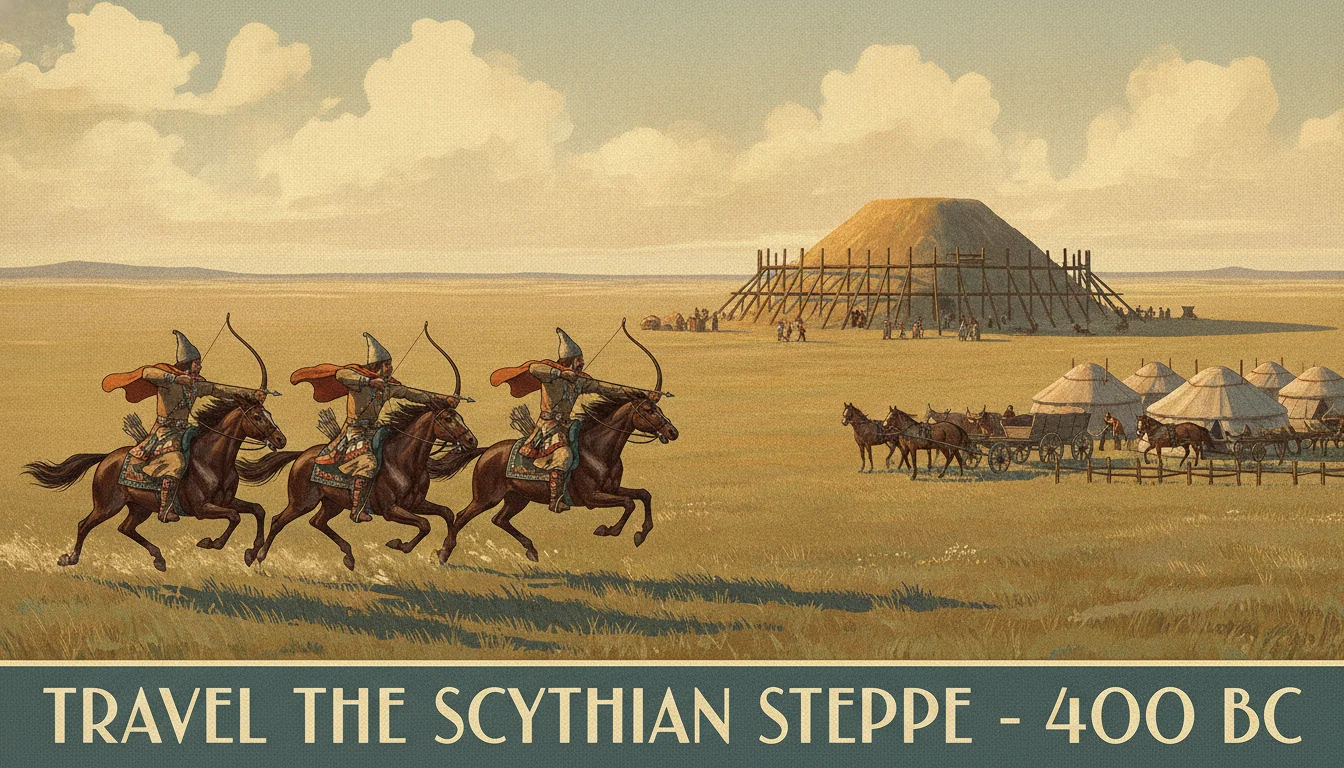
For men: trousers. This will strike any Greek you encounter as distinctly barbarian, but trousers are the correct and necessary adaptation for daily riding. They are leather or felt, often decorated with applique or embroidery. Over them goes a belted tunic of felt or wool, sometimes a short jacket. In winter, a heavy felt coat. Always a pointed felt cap of the type depicted in nearly every piece of Scythian figurative art - tall, soft-sided, sometimes folded forward at the tip.
Footwear is soft leather boots. Not sandals. Never sandals.
For women the clothing is similar in cut but often more elaborate in decoration. Female garment finds in excavated Scythian tombs show considerable investment in gold applique, beadwork, and sewn decorations. Do not assume women are noncombatants or domestic figures. Some of the women you encounter will have buried weapons at the head of their sleeping mats. Archaeological excavation has confirmed this. Herodotus also noted it, and on this point he was right.
You should not be wearing a chiton, a himation, or anything else that signals Greek identity. The Scythians trade with Greeks and use their goods, but they are not impressed by them. Arriving as a trader from Olbia carrying wine amphorae is a defensible cover. Arriving looking like a Greek philosopher is suspicious.
Getting around
You will be on horseback. This is not optional.
The steppe has no roads. Movement follows seasonal patterns, river valleys, and the accumulated knowledge of experienced herders who know where reliable water sits across hundreds of miles of grass. If you arrive without the ability to ride, you will not get far from wherever you land. If you bring your own horse, treat it well and do not allow anyone to take it. A person without a horse on the Pontic steppe in 400 BC is a person who cannot move.
The wheeled wagons you will see are not for adults of status. They carry felt tents, supplies, and children too young to ride, pulled by teams of oxen. A grown man riding in a wagon is a person who cannot ride, and that is not a comfortable position on the steppe.
Where to sleep and what to eat
Scythian housing is the felt tent - a circular, portable structure built on a wooden frame and covered in layered felt. It is warm in winter, reasonably ventilated in summer, and can be raised or struck in a few hours. The interior is organized by established convention: the right side from the entrance is male space, the left female, and the area directly opposite the door is the place of honor reserved for guests and sacred objects. If you are invited into a tent, you will be seated opposite the door. Accept.
Food centers on horse and cattle. Boiled meat is standard. Herodotus describes a method of cooking meat in the animal's own stomach over a fire built partly from the animal's bones where wood is scarce - practical and efficient in a landscape with almost none of the former. Fermented mare's milk, kumiss, is consumed daily and offered to guests as a matter of hospitality. Refusing it is a social error. It is mildly alcoholic, pleasantly sour after the first few days, and will unsettle your digestive system for a week. Drink it anyway.
The Greeks at Olbia export olive oil, wine, and painted pottery. Scythian aristocrats keep Greek wine, and it is an excellent trade good to carry.
Three things worth seeing
A kurgan burial in progress
Scythian royal burials are among the most elaborate mortuary practices in the ancient world. The kurgan is a mound of earth built over a timber burial chamber that may descend several meters underground. Royal interments include the king, sacrificed horses and servants, weapons, food, and extraordinary gold objects: pectorals, torques, comb handles, scabbard fittings, all worked in the animal style.
You will not be permitted to attend the burial itself - it is restricted to the clan, and the process involves interring retainers who die alongside their king. But if you arrive in the weeks before or after, the mound being raised on the open steppe is visible from a considerable distance. The scale of the earthwork required to build a major royal kurgan is itself worth observing.
The animal-style metalwork
The Scythians produce gold in a visual language unlike anything in the Greek or Persian repertoire. The animal style depicts predator and prey in interlocked, dynamic compositions: a stag with exaggerated branching antlers, a panther gripping its own tail, an eagle stooping onto a deer. The forms are twisted, energetic, and strikingly immediate - objects made in the 5th century BC that feel, when you look at them in a museum case, as though they were finished last week.
These are not decorative luxury items in the Greek sense. They are markers of status, ritual equipment, and objects intended for the afterlife. The craftsmen are specialists working near the Greek colonies or traveling with the royal retinue.
The diplomatic circuit
The Scythian royal court, wherever it moves on the steppe, is the center of an active diplomatic network. In 400 BC the Scythians are sending and receiving embassies from Greek cities on the Black Sea coast, from Persian satraps to the south, and from Thracian chieftains to the west. The court is fully aware that Herodotus has written about the Darius campaign and derives visible satisfaction from the account.
If you can secure an introduction through an interpreter from Olbia - professional ones exist - the political conversation will be multilingual and unusually candid. The Royal Scythians have not lost a war in living memory.
Dangers worth taking seriously
The steppe is not lawless, but it is not governed in any way you will recognize from the Mediterranean world. Disputes between clans over pasture, herds, or perceived insults are resolved by the parties involved. There is no neutral arbitration and no appeal.
Animal hazards are real. Wolves travel in large packs on the open steppe and are not afraid of solitary travelers. Steppe grass conceals vipers. River crossings during spring snowmelt can be lethal even for experienced riders.
The Scythian practice of scalping defeated enemies is not legend. Herodotus describes it in specific detail. Enemy skulls are sometimes covered in leather and fitted with gold rims by men of rank, who use them as drinking vessels. This is not a threat to a visiting trader who presents himself correctly. Carry good trade goods, present yourself as a merchant from Olbia, and do not attempt to pass as Scythian. The attempt is more insulting than the honest position of foreigner.
The cannabis ritual
Herodotus describes a Scythian purification and intoxication practice in which hemp seeds are cast on hot stones inside a small felt tent or covered frame, and the vapor is inhaled until participants cry out in pleasure. He treats this as remarkable and somewhat strange. Modern readers will find it less so.
This is a real documented practice, confirmed by archaeological finds of hemp seeds in burial mounds and bronze vessels consistent with Herodotus's description. It is associated with specific ritual occasions, not daily life. If you encounter it, participating is likely considered appropriate for an honored guest. The effects are what you expect.
What to bring and what to trade
The Scythians want: Greek wine (in amphorae, properly sealed), Greek painted pottery, grain, bronze objects, and reliable information about their neighbors' movements and intentions. They will give: gold, furs, amber, grain from the agricultural zones, and safe passage through their territory.
A trader from Olbia with serviceable Greek and a cart of wine is the safest cover identity on the Pontic steppe in 400 BC. The Scythian world ends in the 2nd century BC under Sarmatian pressure from the east; in 400 BC it still feels permanent. Pack practical clothes, learn to ride before you arrive, and do not touch anyone's horse without permission.
Quick Answers
Common questions about this topic
Who were the Scythians?
The Scythians were Iranian-speaking nomadic pastoralists who dominated the Pontic steppe, the grasslands north of the Black Sea, from roughly the 9th to 3rd centuries BC. They were among the most militarily effective horse-riders and archers of the ancient world. Herodotus devoted Book IV of his Histories to them, mixing careful ethnography with obvious legend.
What did the Scythians eat and drink?
The staple diet was horse meat and fermented mare's milk, called kumiss, supplemented with grain, cheese, and goods acquired through trade with Greek colonies on the Black Sea coast. Herodotus describes a ritual stew made from an animal slaughtered and cooked over an open fire. Kumiss was consumed daily and used in religious ceremony.
What was Scythian gold?
The Scythians produced elaborate gold jewelry, weapons fittings, and ceremonial objects in the animal style - a visual vocabulary of predator-prey relationships rendered in twisted, interlocking animal forms. Royal kurgans excavated from the 18th century onward have yielded extraordinary objects now held in the Hermitage Museum and other collections worldwide.
Did Scythian women really fight?
Archaeological evidence confirms that some Scythian women were buried with weapons, horses, and armor. Genetic analysis of excavated skeletons has identified female warriors alongside male ones. The Greek stories of Amazonian women warriors on the steppe appear to be based, at least partly, on observation of Scythian and related Sauromatian culture.

Need Advice from Someone Who Lived There?
Get firsthand accounts from people who actually lived through these moments in history.
Ask Them YourselfJoin the HistorIQly Club
Get smarter about the past.
Weekly stories, deep dives, and exclusive content straight to your inbox.