Time Traveler's Guide to Songhai Gao, 1500
A time traveler's guide to the Songhai Empire capital Gao in 1500: how to arrive, what to trade, and how to navigate Askia Muhammad's court.
Read Wikipedia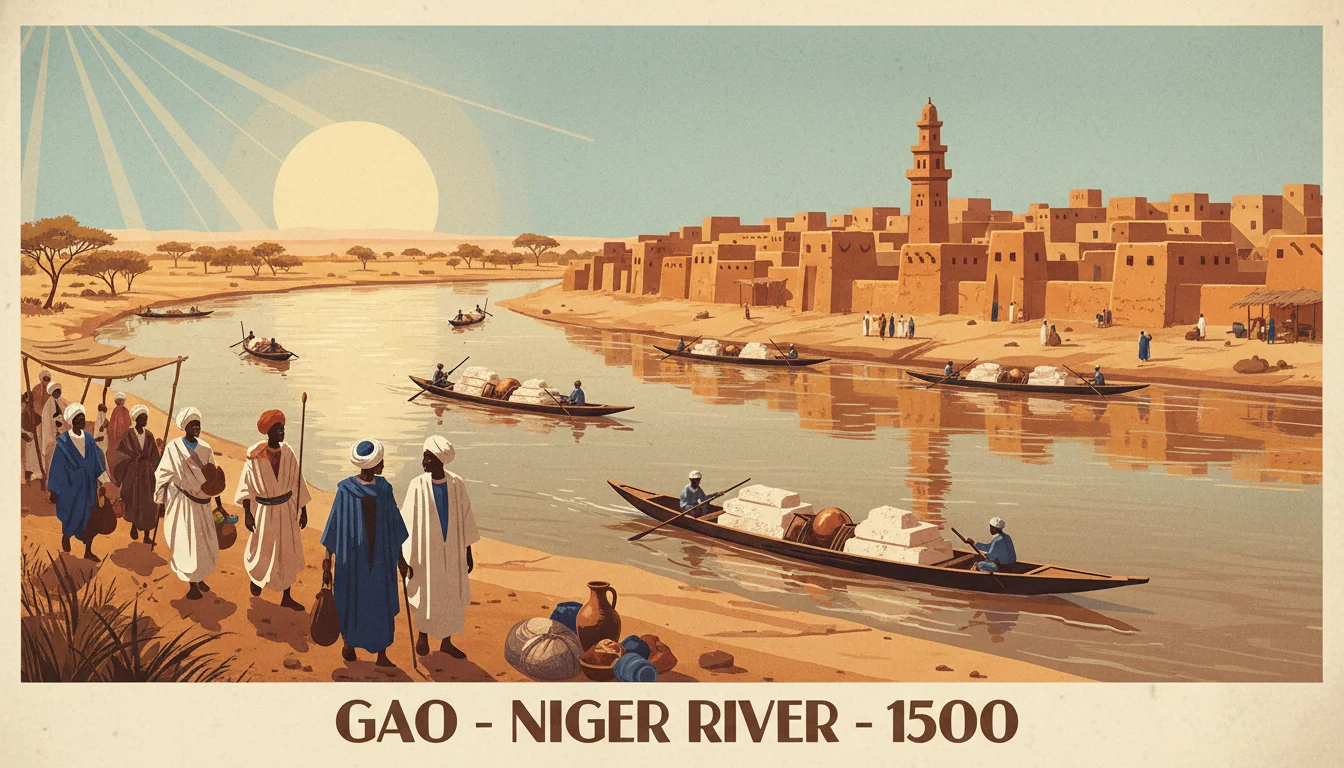
Before you even consider a visit, understand what you are stepping into. Gao in the year 1500 is the capital of the Songhai Empire, the largest empire Africa has ever produced. The city sits on the eastern bend of the Niger River, a flat, sun-bleached settlement of flat-roofed mudbrick buildings that looks modest from a distance and turns out, on closer inspection, to be teeming with wealth, power, and a court that controls trade routes stretching from the Atlantic coast to the edge of the Hausa cities 2,000 kilometers to the east.
The man running all of this is Askia Muhammad, who seized the throne in 1493 and has been reforming, expanding, and Islamizing the empire ever since. He is pious, organized, and dangerous. The empire he is building will, at its greatest extent, be larger than Western Europe. You have arrived at the best possible moment.
Getting there
Forget the idea of a quick overland journey. Gao is accessible by two routes, both of them hard.
From the north, you cross the Sahara from Morocco or Tunisia along the caravan routes that terminate at Gao after weeks of waterless travel. You will need camels, guides, and a merchant sponsor, because the desert is not crossed alone and the Tuareg who control the northern approaches to the empire do not look kindly on unaffiliated travelers. The salt caravans from Taghaza are the best-organized option, since their regularity means the logistics are understood and the danger is at least predictable.
From the south and west, you follow the Niger River. Songhai maintains a substantial river fleet, and traveling by canoe or pirogue along the Niger is genuinely efficient. The river road connects Gao to Timbuktu, to Djenne, and eventually to the western savanna. If you can attach yourself to a merchant convoy, this is the more comfortable option.
Arrive with something to trade. Gold, salt, kola nuts, copper, fine cloth, or horses are the currencies of respect in this market. A stranger with nothing to offer is a problem. A stranger with high-quality goods is welcome.
What Gao looks like
Leo Africanus, the scholar-traveler who visited the Songhai territories around 1510, described Gao as a sprawling settlement with a court that moved in impressive procession through the streets on royal occasions. He noted the market stalls, the merchants from North Africa and Egypt, the abundance of foodstuffs, and a king's household that displayed its wealth in public to an almost theatrical degree.
The city is built almost entirely of sunbaked mudbrick, which in this climate means it is maintenance-intensive - the annual rains require constant patching - but also surprisingly cool inside. Houses cluster along narrow streets around central courtyards. The royal compound sits elevated relative to the rest of the city, protected and identifiable at a distance. The great mosque, recently expanded, rises above the commercial quarter.
The Niger provides everything the interior cannot. Fish is abundant and forms the dietary base for the majority of the population who are not wealthy merchants or court functionaries. Millet and sorghum come in from the agricultural villages of the interior, some via tribute, some through the market. Dried meat travels in on the caravans. The market itself, which operates daily, is one of the most active in West Africa.
Religion and court life
Askia Muhammad is a serious Muslim and has been working since his coup to deepen Islamic institutions across the empire. He made a Hajj to Mecca in 1496-1497, departing with a retinue of 500 cavalry, 1,000 infantry, and reportedly 300,000 gold pieces for distribution as alms - an ostentatious declaration of wealth and piety that made Gao's name in the wider Islamic world. He came back with the title of Caliph of the Western Sudan, conferred by the Sharif of Mecca.
In Gao, Islamic law is the operating legal framework for the court, for commerce, and for resolution of disputes among the elite. The scholars he has brought to Timbuktu (which remains the intellectual capital) debate jurisprudence and theology at a level that would be recognizable in Cairo or Baghdad. Bring a copy of the Quran and know at least your prayers. It signals respect and opens doors.
Away from the court, older animist practices survive quietly in the villages and among the fishing communities of the river. Do not draw attention to this in mixed company. It is a sensitive subject. The court's Islam is sincere; its tolerance of older practices is pragmatic, not enthusiastic.
What to wear
West African heat combined with social expectations means modest, layered clothing in light cotton or linen. Men wear flowing robes - in the Niger basin style, a wide-sleeved cotton garment reaching the knee or below, often in white, indigo, or undyed natural colors. Your head should be covered; a wrapped turban is both practical against the sun and socially appropriate.
Women dress in wrapped cloth with a head covering. Anyone presenting as a woman traveling without male accompaniment will draw attention, most of it not hostile but all of it exhausting. Bring a convincing story about who you are with and where they are.
Do not wear gold openly in the market. It marks you immediately as either a target for theft or a person of consequence who is expected to behave accordingly. Merchants traveling from North Africa and Egypt dress down for similar reasons.
Dangers you did not anticipate
The court hierarchy is invisible and absolute. Gao operates under a system of court titles and ranks that determines who may speak to whom, who may enter which spaces, and who may look directly at which officials. Getting this wrong will not immediately get you killed, but it will get you excluded and quite possibly detained.
Horses carry status. Songhai cavalry is the empire's military spine. Horses are expensive, imported from North Africa, and owned only by the elite. Do not ride a horse unless you are certain you have the status to match. Walking, or canoe, is safer for the socially ambiguous.
The river at night. The Niger after dark is crocodile territory. Do not swim in it under any circumstances, and approach the banks at night with care. This is not a Songhai-specific warning; it applies anywhere on this river in any era.
Tax and tribute enforcement. Songhai's administrative system is one of the more sophisticated in Africa at this moment in history. Askia Muhammad has organized the empire into provinces, appointed governors, and standardized weights and measures to allow reliable tax extraction. A traveling merchant who misrepresents their goods will eventually encounter someone who knows exactly what those goods are worth.
The markets
Gao's market is worth the entire trip. It runs daily and draws merchants from every direction of the compass. From the north come blocks of rock salt from the Taghaza mines, copper from the Maghreb, and fine cloth from the Mediterranean ports. From the south and west come gold dust, kola nuts, slaves, and agricultural produce. From the east, Hausa leather goods, dyed cloth, and cattle.
Salt from Taghaza is one of the great currencies of this world. A block of Saharan rock salt can be traded for its weight in gold in the forest zones to the south, where salt is scarce and gold is relatively abundant. The economics are not a mystery to anyone at the market; everyone is pricing in relative scarcity. Learn the going rates before you try to trade anything.
When to leave
The best time to depart Gao is with the northbound salt caravan at the end of the dry season, before the rains make the desert crossings unpredictable and the Niger flood season arrives. If you're going south or west, the river in the dry season is passable and fast-flowing enough to make good time.
Do not stay long enough to become embedded in court politics. Gao in 1500 is at peak stability under Askia Muhammad, but the succession arrangements that will eventually destabilize the empire are already visible to a careful observer. The court is full of capable men, several of whom will try to seize power within the next generation. The visitor who stays long enough to be identified with any faction is the visitor who cannot leave cleanly.
Take your time at the market. See the river at sunrise. Eat the fish. Come back with a clear head and a bag of salt.
For more time-traveler guides to medieval Africa, see A Time Traveler's Guide to Mali and Timbuktu, 1325 and A Time Traveler's Guide to Great Zimbabwe, 1300.
Quick Answers
Common questions about this topic
What was Gao in 1500?
Gao was the capital city of the Songhai Empire, the largest empire in West African history at its peak. It sat on the eastern bend of the Niger River in what is now Mali. In 1500, it was a major commercial hub connecting the trans-Saharan gold and salt trade with the agricultural heartland of the Niger Delta.
Who ruled Songhai in 1500?
Askia Muhammad, also known as Askia the Great, had ruled since 1493, when he deposed the last Sunni ruler. He was a devout Muslim reformer who consolidated Islamic institutions, standardized weights and measures across the empire, and brought the Songhai state to its greatest territorial extent.
How big was the Songhai Empire?
At its peak under Askia Muhammad, the Songhai Empire stretched roughly 2,400 kilometers from the Atlantic coast near present-day Senegal east to the Hausa city-states of present-day Nigeria. It encompassed the great trading cities of Timbuktu, Djenne, and Gao, and contained a population scholars estimate at several million.
What ended the Songhai Empire?
The Songhai Empire was destroyed by a Moroccan invasion in 1591. Sultan Ahmad al-Mansur sent a force of around 4,000 soldiers armed with arquebuses across the Sahara. The Songhai cavalry, which had no firearms equivalent, was shattered at the Battle of Tondibi. Gao was sacked and never fully recovered.

Need Advice from Someone Who Lived There?
Get firsthand accounts from people who actually lived through these moments in history.
Create your free account →No card required. Talk to anyone in history with 8 free credits a day. Some features require a paid plan.
Join the HistorIQly Club
Get smarter about the past.
Weekly stories, deep dives, and exclusive content straight to your inbox.