Time Traveler's Guide to Spanish Conquest Mexico, 1521
Tenochtitlan in 1521 is the largest city in the Western Hemisphere and is about to cease to exist. A guide to surviving - and witnessing - the fall of the Aztec capital.
Read Wikipedia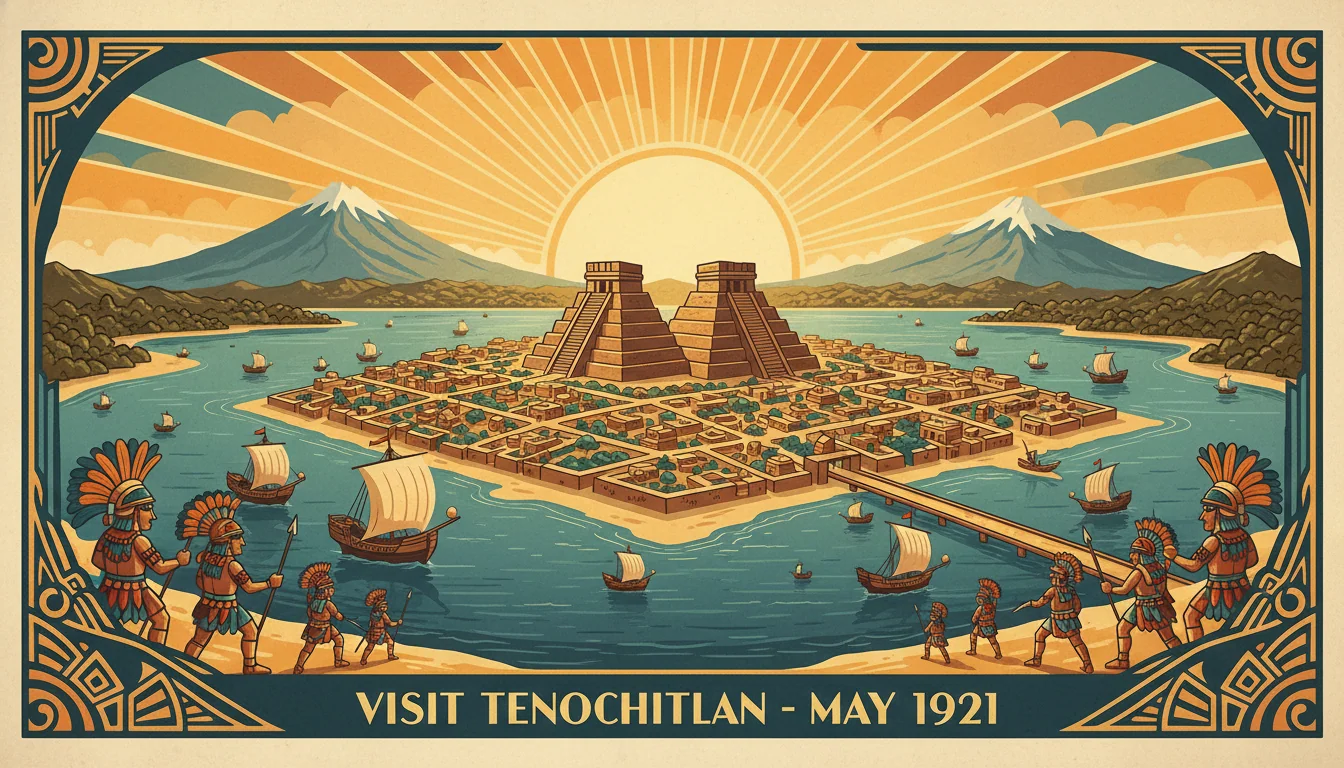
The siege of Tenochtitlan is one of the most consequential events in the history of the Americas. The island city in Lake Texcoco - the Aztec capital, the largest settlement in the Western Hemisphere, home to perhaps a quarter million people - fell to a Spanish force of a few hundred men and tens of thousands of Tlaxcalan and other allied indigenous warriors after a three-month siege.
If you are going to arrive in the middle of it, some preparation is essential.
When to arrive
The siege ran from roughly May to August 1521. The choice of window matters.
The early phase, May 1521, gives you a functioning city under severe pressure. The three causeways connecting Tenochtitlan to the shore are contested. The markets have stopped because the city is surrounded. Spanish brigantines - flat-bottomed boats built inland and hauled over the mountains to Lake Texcoco - now patrol the lake. But inside the city itself, the neighborhoods still stand, the Templo Mayor still towers above the sacred precinct, and the scale of what is being lost is still visible.
The final weeks, July into August 1521, are considerably more dangerous and considerably more grim. By July the Spanish and their allies are advancing block by block, demolishing buildings as they go to prevent the defenders from retaking high ground overnight. Smallpox arrived in the city in late 1520 and killed a significant portion of the population, including the ruler Cuitlahuac, before the final siege even began. By midsummer 1521, the city is short of food and water, its population severely reduced, and the fighting is brutal and close.
The most useful window for observation - if you are there to witness rather than merely survive - is mid-May 1521. The city is still intact. You can still see what is about to be destroyed.
What to know before you arrive
Tenochtitlan is a grid city on an island. The island is connected to the lakeshore by three major causeways: north to Tepeyac, west to Tlacopan, and south to Iztapalapa. These causeways have gaps bridged by removable wooden beams - a defensive feature that has served the city for generations and will continue to create problems for Spanish infantry in the early weeks of the siege.
The city has a center: the sacred precinct, the Templo Mayor, the Great Pyramid with its twin shrines dedicated to Tlaloc and Huitzilopochtli. Around the center are residential neighborhoods, specialized craft districts, and markets. The palace complex of Moctezuma II stands nearby. Moctezuma was killed in disputed circumstances in June 1520, during the period when Cortes and his men were guests-turned-prisoners in the city. His successor Cuitlahuac died of smallpox within months. Cuauhtemoc, the current ruler, is directing the defense.
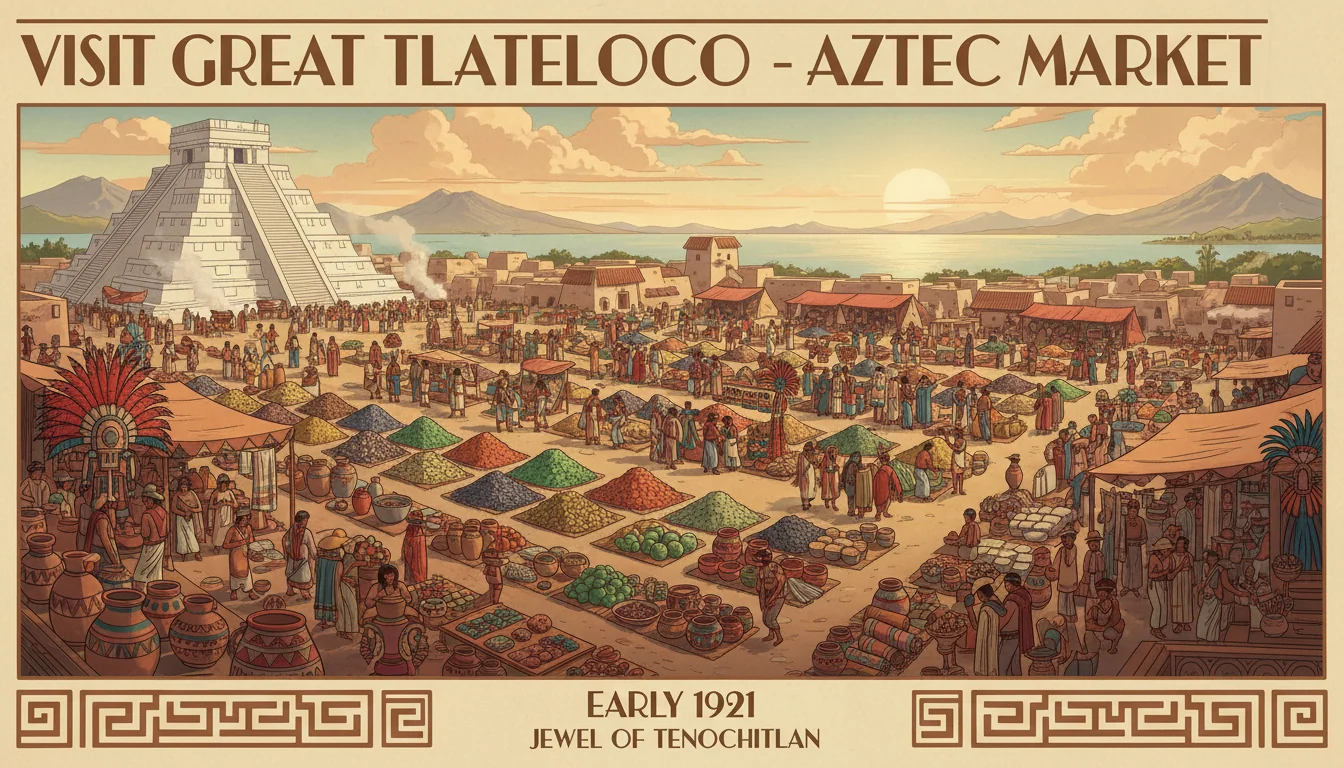
The great market of Tlatelolco, located on the northern section of the island, is the largest in the Americas. Under normal conditions it hosted tens of thousands of traders selling cacao, rubber, slaves, cotton, feathers, turquoise, gold, and food from across Mesoamerica. The Spanish who first saw it in 1519 described it with more wonder than they used for European cities. It has been shut since the siege began and will not reopen.
What to wear
European clothing is a serious liability. If you arrive looking Spanish, you are in the most hostile environment imaginable for anyone associated with the conquering force. Inside the city you will be treated as a collaborator or spy. On the Spanish side of the causeways you will be a complication with no clear affiliation.
The practical approach is clothing consistent with the ordinary Aztec or Tlaxcalan population. For men this means a loincloth and a tilma - a cotton cloak knotted at the shoulder. Sandals with cactus-fiber soles are standard. The Valley of Mexico at 2,200 meters elevation is cool in the mornings and evenings even in summer; bring something warm for dawn.
Elaborate warrior regalia - headdresses, quilted cotton armor, insignia indicating rank - are reserved for specific military grades and will attract immediate attention. Stay plain.
Bring no metal. Metal in this context reads as Spanish.
What to eat and drink
The ongoing siege has cut supply lines into the city. Food inside Tenochtitlan is scarce by May 1521 and will become scarcer. On the Spanish-allied side of the perimeter, or in Tlaxcalan territory to the east, the typical Mesoamerican diet remains accessible: tortillas made from nixtamalized maize, tamales, black beans, squash, chili peppers, tomatoes. The Valley of Mexico produces amaranth, consumed as flatbread and in ritual preparations.
The standard drink under normal conditions is pulque, the fermented sap of the maguey plant. Cacao is consumed as a bitter liquid, typically with chili rather than sweetener.
Do not drink from Lake Texcoco. The lake is a system of fresh and brackish sections, and under siege conditions water management has broken down. The Chapultepec aqueduct that supplies the city has already been cut by Spanish forces in the early phase of the siege. Water inside the city is a critical and dwindling resource.
The dangers
They are numerous and require honest assessment.
Combat. The fighting on the causeways and in the streets involves close-range engagements: obsidian-edged macuahuitl clubs, fire-hardened thrusting spears, atlatl-thrown darts, and on the Spanish and allied side, steel swords, crossbows, and a small number of early firearms. Spanish brigantines on the lake carry cannon. Artillery at this period is inaccurate and slow to reload, but the psychological and material effect on unarmored defenders is significant.
Smallpox. If you are not immune, the epidemic circulating in the city is a severe and immediate hazard. The disease arrived in late 1520 in a man from Cuba who came with the force sent to stop Cortes. It spread through a population with no prior exposure with devastating speed. The epidemic is the largest single factor in the Spanish ability to sustain an effective siege against what should have been an overwhelmingly superior defending force.
Social navigation. The situation is not a simple Spanish-versus-Aztec conflict. The majority of the force surrounding Tenochtitlan is made up of Tlaxcalans and other indigenous allies who had existing grievances against the Aztec Triple Alliance and joined the Spanish as an opportunity to end its dominance. The politics are complex, and strangers without clear affiliation attract suspicion from every direction.
The final weeks. If you are still present in July, the city is being systematically destroyed. The Spanish command made the decision to demolish each captured section rather than hold ground against counterattacks. What you see in May will not be there in August.
What to see
The Templo Mayor in the sacred precinct is the central monument of a civilization. The great double pyramid - rebuilt and expanded by successive rulers, probably reaching sixty meters or more in height - has twin shrines at the summit, one for Tlaloc, god of rain and agriculture, one for Huitzilopochtli, god of war. Copal incense burns continuously. Priests in black robes maintain the shrines. Flowers and offerings cover the base platforms.
The pyramid will be demolished after the conquest. The Spanish Cathedral of Mexico City was later built on the same site using stones from the Templo Mayor. Archaeologists excavating below the cathedral's foundations in the late 20th century began recovering the layers of what you are looking at in 1521.
If you are on the Spanish side of the operation, Hernan Cortes has established his command post at Coyoacan on the southern shore. He is in his mid-thirties. He is a man of genuine military intelligence operating in terrain he arrived in knowing almost nothing about, who has survived a mutiny launched against him from Cuba, a catastrophic retreat from Tenochtitlan in June 1520 known as the Noche Triste, and a years-long improvised campaign that has no real precedent. He is also writing letters to King Charles I of Spain that will become among the most significant primary documents of the period.
What happens next
Tenochtitlan falls on August 13, 1521. Cuauhtemoc, the last tlatoani, tries to escape by canoe across the lake and is captured. He is tortured in subsequent years in an attempt to discover the location of Aztec gold - the famous image of his feet being burned while he reportedly asked that his captor stop complaining is documented in multiple sources - and eventually executed in 1525.
The city is largely destroyed in the siege's final phase. Mexico City is built on the same island, using the foundations and much of the stone of what preceded it. The lake is gradually drained over the following centuries.
The population of central Mexico in 1521 is estimated in the millions. Most will not survive the century. The demographic collapse driven by epidemic disease, forced labor, and social disruption is among the most severe in recorded human history. The world you are visiting in May 1521 is extraordinary and, within months, irreversible.
Arrive with that in mind. The city functions. It is alive. It is the largest and most sophisticated settlement in the Americas. It will not be there in August, and it will not come back.
For another great pre-Columbian civilization at its zenith, our guide to Inca Cusco in 1450 covers the Andean empire seventy years before Spanish contact.
Quick Answers
Common questions about this topic
How big was Tenochtitlan in 1521?
Tenochtitlan was the largest city in the Americas at the time, with population estimates ranging from roughly 200,000 to as many as 400,000 people. It sat on an artificial island in Lake Texcoco, connected to the shore by three major causeways, and had a sophisticated system of markets, temples, palaces, and neighborhoods organized around a central sacred precinct.
Who were the Tlaxcalans in the Spanish conquest?
The Tlaxcalans were a powerful indigenous nation in central Mexico who had long-standing conflicts with the Aztec Triple Alliance. They allied with Hernan Cortes in 1519 and contributed the majority of the military force that eventually besieged and captured Tenochtitlan. The conquest was not a simple European-versus-Aztec conflict but a coalition war involving tens of thousands of indigenous allies.
How did smallpox affect the conquest?
A smallpox epidemic arrived in Tenochtitlan in late 1520 carried by soldiers from Cuba. It killed the Aztec leader Cuitlahuac within months and spread through a population with no prior immunity. By the time the final siege began in May 1521, the city's population and military capacity had been severely reduced. The epidemic was probably the largest single factor in the speed of the Spanish victory.
When exactly did Tenochtitlan fall?
Tenochtitlan fell on August 13, 1521. The final Aztec ruler Cuauhtemoc was captured trying to escape by canoe. The Spanish and their allies then began dismantling the city and constructing Mexico City on the same site, which remains the location of Mexico's capital today.

Need Advice from Someone Who Lived There?
Get firsthand accounts from people who actually lived through these moments in history.
Create your free account →No card required. Some figures and features require a paid plan.
Join the HistorIQly Club
Get smarter about the past.
Weekly stories, deep dives, and exclusive content straight to your inbox.