A Time Traveler's Guide to Tahiti at First Contact, 1769
Your guide to Tahiti 1769 during Captain Cook's first contact: how to survive, blend in, and avoid offending the most stratified island society in the Pacific.
Read Wikipedia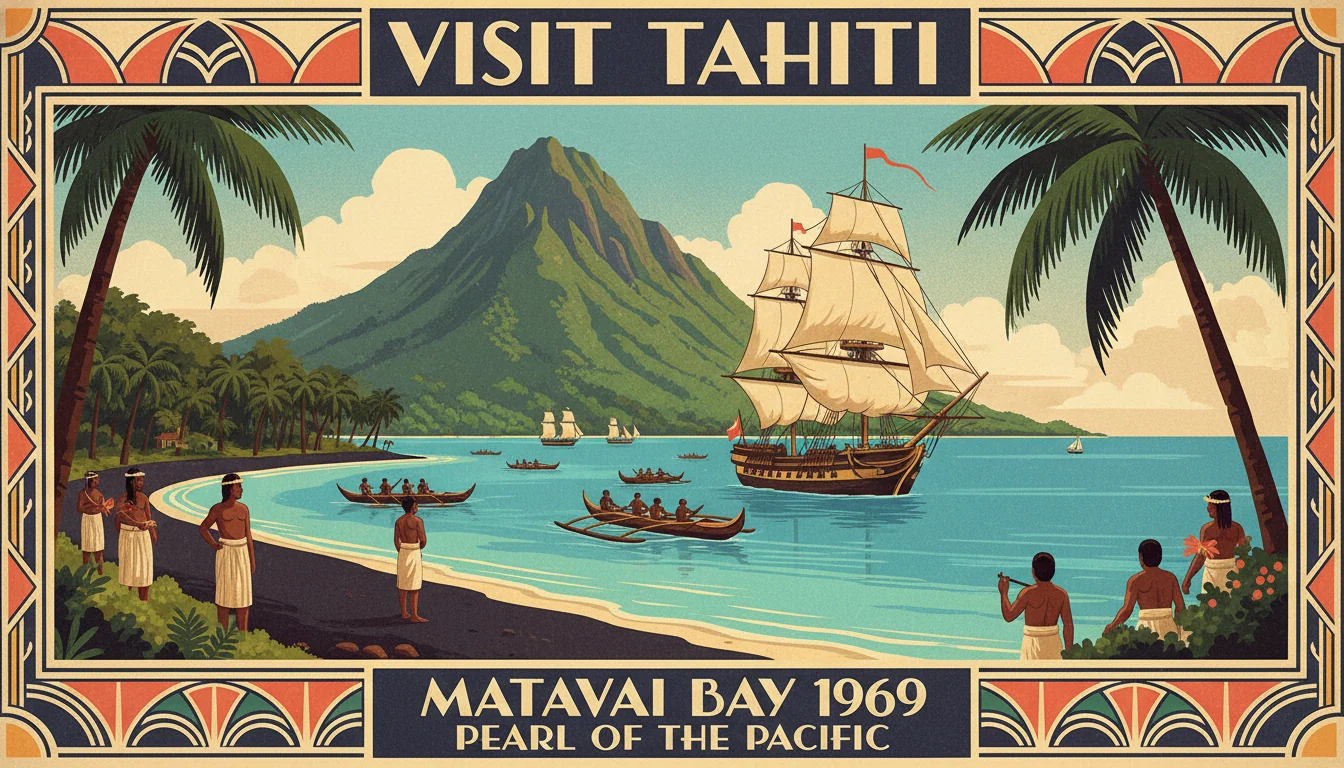
The Endeavour drops anchor in Matavai Bay on April 13, 1769, and the view from the ship is the one that made European sailors write embarrassingly overwrought letters home for the next twenty years. A lagoon of impossible blue. Mountains wrapped in dark green. Canoes pushing out immediately from the shore, carrying people who are, by any reasonable measure, not surprised to see you. They've seen ships before. They have opinions about what ships from the west bring.
You should know what you're walking into before you go ashore.
What kind of place this is
Tahiti is not an unspoiled paradise. It is a politically complex, hierarchically rigid island society of perhaps 35,000 people, distributed across the two lobes of a volcanic island in the central Pacific. The people are Polynesian, speakers of a language related to Hawaiian and Maori. They have been here for roughly a thousand years. They have a functioning agriculture, a priesthood, a warrior class, a hereditary aristocracy, a body of oral literature, and a religious system that touches every aspect of daily life.
The island is divided into districts, each with its own chief. At the time of your visit, a figure known as Tu - later remembered under the dynastic name Pomare I - is emerging as the most powerful chief on the island's larger lobe, though his supremacy is not yet fully consolidated. Cook will develop a careful friendship with him that benefits both parties considerably.
The social hierarchy runs roughly: ari'i (high chiefs and their families) at the top, ra'atira (landholding lineages) in the middle, and manahune (the common majority) at the base. Beneath that, teuteu serve the chiefly households. Do not mistake friendliness for equality. The ranking system is observed constantly and by everyone.
Dress, or the relative lack of it
Acceptable dress in Tahiti in 1769 is considerably less clothing than you are used to. Men of all ranks generally wear a maro, a length of bark cloth wrapped around the waist and between the legs. Rank is displayed through the quality of the cloth and through additional pieces worn at festivals and religious occasions. Women wear a length of cloth wrapped at the waist. Tatooing - the word enters English directly from the Tahitian tatau, noted in Cook's journal on this very voyage - marks both sex and rank with permanent precision.
If you show up in European clothing you will stand out immediately and will be offered immediate alternative solutions. Participating in the local dress code is not only comfortable in the heat but tends to produce better interactions with everyone who is not trying to assess whether you're wealthy.
Bring nothing metal that you are not willing to trade or have stolen. Your buttons, your buckles, your small tools are more valuable here than you have been warned.
The tapu system, and why you must take it seriously
Tapu - the root of the English word taboo - is the most important concept for your survival. It is a system of sacred prohibitions enforced by religious authority and social consensus, and violations range from embarrassing to genuinely dangerous.
The most critical rules:
Do not enter a marae uninvited. Marae are the stone platforms - some quite large - that serve as sacred sites for ritual, prayer, and the presence of the gods (atua). They are attached to chiefly lineages. Wandering onto a marae belonging to a high-ranking family is not a minor faux pas. It is a transgression against the sacred.
Do not touch a high chief's head. In Polynesian culture generally, the head of a high-ranking person is intensely tapu. The higher the rank, the more protected the head. Do not reach over, tap, or gesture toward the head of anyone who appears to be important.
Do not take food that has been set aside for ritual purposes, and watch where you sit to eat. Eating and the sacred do not mix well. If you are uncertain, wait and watch what the people around you do.
The flip side of tapu is mana - the sacred power or prestige that high status confers. The chiefs who carry high mana are genuinely feared as well as respected. Their word in their district is effectively law.
The Arioi and the Heiva
One of the more remarkable institutions you will encounter is the Arioi - a religious and artistic society whose members travel between islands performing drama, dance, and religious ceremony. The Arioi are associated with the god 'Oro and hold a privileged social position that cuts across ordinary rank in some respects while being deeply embedded in it in others.
The Heiva is the festival season - a period of competitive performance, feasting, and inter-district social engagement. If you arrive during a Heiva period you will find the island more animated, more politically charged, and considerably noisier than at other times. The performances include formal oratory, athletic contests (including surfing), and dramatic presentations.
Surfing - specifically standing surfing on long boards, riding waves for sport and competition - is a normal part of Tahitian recreational culture. Cook's journal records it, apparently with some astonishment.
Food and drink, and what to be careful about
The staples are breadfruit (cooked in earth ovens or roasted), coconut in every form, taro, and fish. Pigs and chickens are raised and eaten, especially at feasts. The food is genuinely excellent by the standards of what your ship's cook is producing.
Kava - a drink made from the pounded root of Piper methysticum - is used ceremonially. It produces a mild relaxation rather than intoxication in the alcohol sense. It is offered at certain social occasions. You can accept a small amount without any risk beyond the taste, which is not pleasant.
Do not eat from chiefly food stores without invitation. The consequences are social and potentially spiritual rather than physical, but they are immediate. Watch what other visitors from the ship do, and calibrate accordingly.
Coconut water from green coconuts is perfectly safe to drink and readily available. Drinking from streams closer to the shoreline is inadvisable by the time several hundred people and their provisions have been using the area for weeks.
The exchange economy
There is no coin here. Everything runs on reciprocal exchange and gift-giving, which is not the same as barter but resembles it to outsiders.
Iron is the critical currency. The Tahitians had no iron before European contact, and they understand immediately that the ships carry it in huge quantities. A nail will get you food, affection, guidance, or introduction to someone useful. A larger piece of iron - a file, a chisel - will get you considerable goodwill. A bolt will make you briefly famous.
The problem you will face is that other members of the ship's crew are having exactly the same insight, and some of them are pulling nails from the ship's hull to facilitate their own transactions. Cook's journal is full of exasperated orders about this.
Cloth, particularly red cloth, is also highly valued. Glass beads are of moderate interest. European manufactured goods in general attract curiosity, but iron is king.
Do not promise what you cannot deliver. If you indicate you are offering something specific and then produce something different, the transaction goes badly and the news travels fast.
What not to do
Do not assume the hospitality is unconditional. The Tahitians are experienced hosts who have extended very considerable generosity to European visitors. They have also been stolen from, threatened, and had their social structures disrupted by the same visitors. The friendliness has practical limits that shift based on behavior.
Do not interfere with ritual activity. If something is happening at a marae, around a canoe being prepared for a voyage, or involving the Arioi, stay back and watch from a respectful distance unless you are explicitly invited forward.
Do not make promises about when the ships will return or what the outside world is like. You do not know what the next fifty years will bring to these islands, and neither does anyone else. Resist the temptation to fill the information gap with speculation.
Do not assume the recording of what you see is a private matter. The Tahitians observe the observers. They are curious about writing, about instruments, and about why people from ships spend so much time pointing at the sky.
The experience to prioritize
If you can arrange exactly one unrestricted afternoon, walk up the valleys behind Matavai Bay before the trade becomes entirely transactional. The waterfalls above the settlement, the dark basalt interior, the view back down over the bay with the Endeavour riding at anchor - none of this exists anywhere else in 1769, and very little of it will look this way for much longer.
For the Pacific world before European contact rewrote it, Rapa Nui, 1500 CE shows Polynesian civilization at its peak without the ships. The Inca capital at Cusco, 1450 gives the continental counterpart from the same pre-contact era.
Tahiti at first contact is not unchanged wilderness. It is a fully inhabited, fully organized human world. What makes it worth the journey is not its remoteness from history but its depth inside a history most visitors from the west have never tried to understand. Go prepared to learn rather than just to arrive, and the island will give you considerably more than the view.
Quick Answers
Common questions about this topic
Why did Captain Cook go to Tahiti in 1769?
Cook's primary scientific mission was to observe the Transit of Venus across the sun on June 3, 1769, from a fixed location in the Pacific. The Royal Society and the British Admiralty had concluded that Tahiti, sighted by Captain Samuel Wallis in 1767 and named King George III Island, offered ideal conditions for the observation. Cook also carried sealed secret orders to search for the hypothetical southern continent Terra Australis Incognita.
Was Tahiti already known to Europeans before Cook?
Yes, though briefly. The British captain Samuel Wallis made the first documented European contact in 1767. The French explorer Louis-Antoine de Bougainville arrived in 1768, a year before Cook, and named the island Nouvelle-Cythere after the Greek island of Aphrodite. By the time Cook anchored in Matavai Bay in April 1769, the Tahitians had already experienced two European visits and had some idea of what ships from that direction brought.
What is the tapu system a visitor needs to know about?
Tapu (the origin of the English word taboo) was a pervasive system of sacred prohibitions governing who could approach what places, objects, and people. Violations were not merely rude - they were believed to invite disaster. As a visitor, the most important thing to know is that ari'i (high chiefs) and sacred sites attached to marae platforms required specific behaviors. Entering a marae uninvited or touching a chief's possessions without permission could provoke serious responses.
What did the Endeavour crew trade with Tahitians?
Iron was the most valued commodity. Nails proved so desirable that crew members pulled them from the ship's planking in numbers that alarmed Cook. Cloth, mirrors, and glass beads also traded well. The Tahitians, for their part, offered provisions - breadfruit, coconuts, fish, pigs, and chickens - as well as craft objects and, controversially, sexual services that created a complex dynamic Cook spent much of his stay trying to regulate.

Need Advice from Someone Who Lived There?
Get firsthand accounts from people who actually lived through these moments in history.
Create your free account →No card required. Some figures and features require a paid plan.
Join the HistorIQly Club
Get smarter about the past.
Weekly stories, deep dives, and exclusive content straight to your inbox.