A Time Traveler's Guide to Three Kingdoms China, AD 220
Luoyang in AD 220 is ground zero for Three Kingdoms China history: the Han falls, Cao Wei rises, and the era remembered forever begins. A survival guide.
Read Wikipedia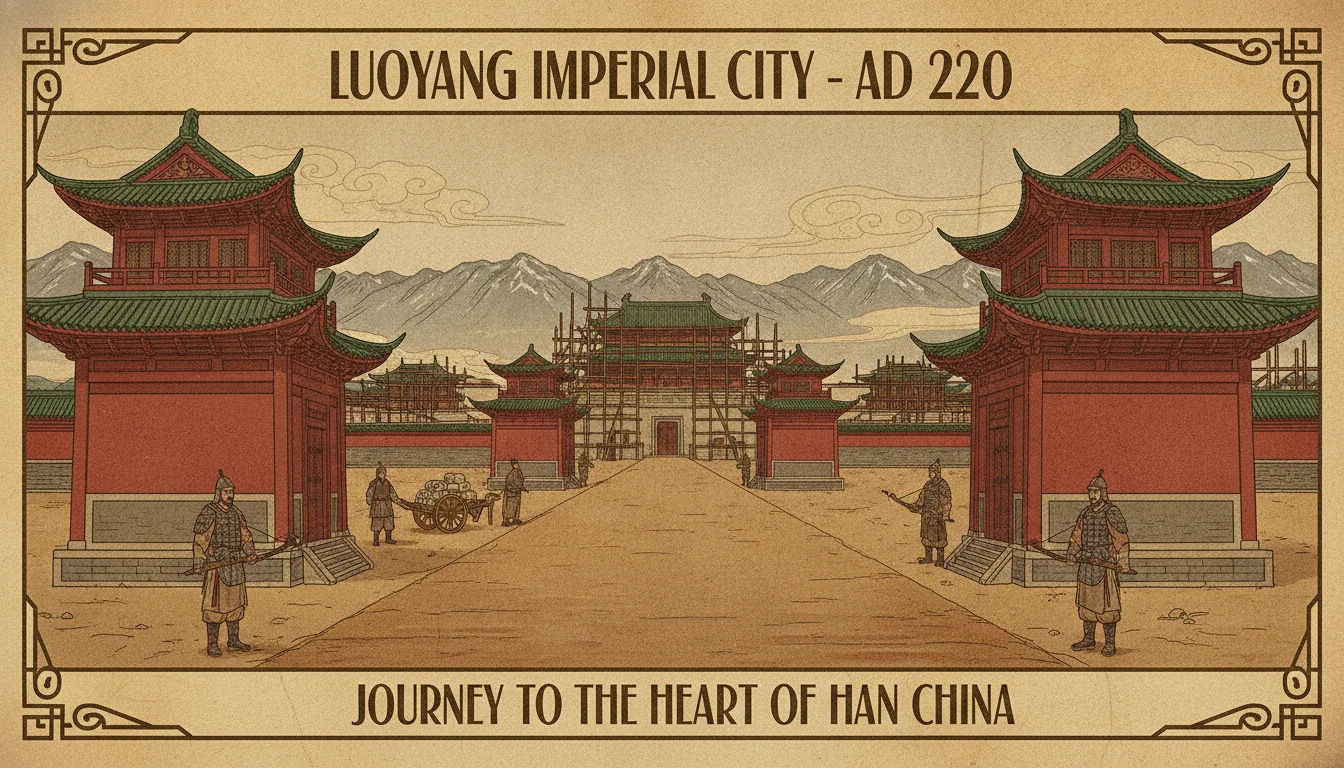
Luoyang in the year 220 is a city in the middle of a political transition so large that nobody in it has quite processed what it means yet. The Han dynasty, which has ruled China for over four centuries, is about to end. Cao Cao - the most powerful warlord in the known world, the man who controlled the Han emperor for the last twenty years while keeping the dynasty's name in place as a useful fiction - died in January. His son, Cao Pi, is about to extract a formal abdication from the last Han emperor and declare himself the Son of Heaven of a new dynasty.
If you arrive in the first months of 220, you are stepping into a moment that will be analyzed, dramatized, and mythologized for the next eighteen hundred years. Romance of the Three Kingdoms, written in the 14th century by Luo Guanzhong, is one of China's four great classical novels, and it is set in the world you are entering. The characters walking the streets of Luoyang will become cultural archetypes. The political decisions being made in the palace above you will echo in Chinese literature, strategy manuals, and video games for millennia.
No pressure.
Where you are landing
Luoyang sits at the confluence of several river systems and mountain passes in what is now Henan Province, at the eastern end of the Wei River valley where the central plains of China meet the mountains. The Eastern Han dynasty had used it as its main capital. The warlord Dong Zhuo burned and evacuated it in 189, and it was largely a ruin for decades. Cao Cao began rebuilding it as his administrative center, and by 220 it is a functioning if still-recovering city.
The population is perhaps 150,000 to 200,000, modest by the Tang and Song standards that will come centuries later, but substantial for a city that was rubble within living memory. The palace complex is under active construction. Government bureaus, granaries, barracks, markets, and workshops fill the rebuilt sections of the old Han grid. Streets run straight between mud-brick walls. The smell of fresh timber and lime mortar mixes with charcoal smoke and the ever-present animal waste of a working city.
Your cover story
The safest identity is a merchant traveling from the western trade routes or from the southern river cities. Foreign-looking travelers are not entirely unknown in Luoyang. The Silk Road brings Central Asian merchants to the northern Chinese cities, and the Han-period world had enough contact with distant peoples through intermediaries that extreme strangeness is not instantly fatal. Extreme strangeness combined with ignorance of basic customs is.
Do not claim any military affiliation, loyalty to any of the three kingdoms, or knowledge of current political events. At this precise moment in 220, the transition from Han to Wei is happening and the political atmosphere is charged. Many families whose status derived from Han legitimacy are quietly devastated. Many officials who served Cao Cao are anxious about what they owe the new dynasty and what the new dynasty owes them. Strangers who ask pointed questions about the succession get pointed attention in return.
You are a merchant who trades in northern silk and bronze goods. You have been traveling for three months. You are politely confused about local politics because you have been on the road.
This is entirely believable, because most people in 220 are genuinely confused about something.
Dress, food, and comportment
Dress for Han and early Wei period divides into two clear categories: working-class hemp and official silk. Hemp garments of undyed brown and grey are what the vast majority of the population wears. They are loose, layered against the cold (Luoyang winters are severe), and practical for travel. Silk is reserved for the aristocracy and officials, and its display is governed by sumptuary conventions you should not attempt to navigate without inside guidance. Arriving in silk you cannot explain will mark you as a thief.
The standard men's head covering is a cloth headband or a simple wrapped topknot. Official headgear is elaborate, rank-specific, and immediately legible to everyone who sees it. Do not mimic it.
Food runs to boiled millet, wheat noodles (the Chinese had been eating noodles for centuries by this point - this is not a modern invention), pickled vegetables, and, if you can afford it, pork and game. The northern plains under Wei control are productive and grain is available, if not abundant, in Luoyang's markets. Fermented grain wine called jiu is the common drink. Tea culture has not yet reached the northern cities in the form that will later define Chinese social life.
Eat whatever is offered. Refusing food from a host is a serious insult in this culture. Accept it, bow slightly, and eat it.
Three things you will immediately notice
The noise and dust of construction. Cao Pi is rebuilding Luoyang as the full apparatus of an imperial capital: palace halls, government offices, sacrificial altars, temples, storehouses. Stone masons and carpenters work from dawn. Wooden scaffolding climbs the palace walls. The streets near the construction zone are choked with ox carts carrying stone, lumber, and fired brick. The air above the work sites smells of sawdust, lime, and animal dung.
The soldiers. Even in the capital, the Three Kingdoms period maintains a visible war footing. Guards stand at every major gate and checkpoint. Weapons are in evidence. Movement after dark is restricted and enforced. Wei has been at technical peace with the other two kingdoms only since the formal abdication, and everyone knows this peace is provisional. The armies are positioned on the frontiers, and the frontier is never very far from anyone's thinking in Luoyang in 220.
The bureaucrats in their carriages. The Wei state is modeled on Han administrative forms and has a functioning Secretariat, a Chancery, and various ministries staffed by the sons of the gentry class. You will see these men traveling in covered two-wheeled carriages through the wider streets, preceded by servants clearing the way. They are educated, careful, and deeply invested in the transition going smoothly. If you find yourself near them, discuss agricultural yields, flood management, or the quality of the road from the eastern passes. Do not discuss political succession.
What to avoid
The most dangerous topic in Luoyang in 220 is the legitimacy of the Han abdication. Whether Cao Pi's accession was a usurpation or a natural transfer of the Mandate of Heaven is not a settled question in the minds of many people in the city, including some who will publicly endorse the new emperor and privately mourn the old dynasty.
Do not express opinions about Liu Bei. The ruler of Shu Han in the southwest claims to be a descendant of the Han imperial family and has declared the Wei dynasty illegitimate. His name is politically dangerous to say in the wrong company. Similarly, do not mention Sun Quan of Eastern Wu unless you are certain you know exactly whose household you are in.
Do not attempt to travel north of the city toward the military districts without papers. Do not attempt to enter any section of the palace complex without an explicit official invitation. And do not, under any circumstances, attempt to profit from selling information about troop movements, supply logistics, or court politics. The Wei state's internal security apparatus is effective and its methods of dealing with suspected spies are not gentle.
The unmissable
If you can arrange to witness any of the formal ceremonies marking the accession of the new Wei dynasty, take that opportunity at whatever cost. You are watching the transfer of the Mandate of Heaven in real time - the elaborate ritual succession that Chinese political theory regards as the moment when one dynasty legitimately supersedes another. These ceremonies involve mass sacrifices at the ancestral altars, formal proclamations read to assembled officials, and the handing over of the imperial seals. The last time someone did this in northern China, the Han dynasty itself began, in 206 BC.
The Eastern Market in the restored section of Luoyang is worth an afternoon. Merchants from across the northern plain, and a handful from the Silk Road routes through the Gansu corridor, sell lacquerware, bronze vessels, silk cloth in graded qualities, agricultural tools, ceramics, and dried foods. Prices are haggled. Numbers are drawn in the air or on palms when language fails. The market has survived every political transition the city has seen, because trade is more durable than dynasties.
The city walls, viewed from outside, are impressive in their restored scale. The original Han walls were massive and much of that stonework was reused in the reconstruction. Walking the exterior gives you a sense of how completely Cao Cao's engineers rebuilt what Dong Zhuo destroyed. Do not, however, approach the palace walls. There is no version of that interaction that goes well for an unfamiliar traveler in the middle of a dynastic transition.
The most honest advice for anyone visiting Luoyang in 220 is this: you are in a city full of people who have survived extraordinary violence and uncertainty to reach this moment, and who have not yet learned whether the transition will hold or whether the next decade will look like the decade just past. They are watchful, tired, and capable of quick decisions about who to trust. Blend in, observe, and remember that the drama you are watching from the outside is being experienced from the inside by people with everything to lose.
Quick Answers
Common questions about this topic
What was happening in Luoyang in AD 220?
In early 220, Cao Cao - the dominant warlord of the late Han period - died, and his son Cao Pi accepted the abdication of Emperor Xian, the last Han emperor, and proclaimed himself the first emperor of the new Wei dynasty. Luoyang became the Wei imperial capital. This triggered the formal start of the Three Kingdoms period, with Shu Han in the southwest and Eastern Wu in the southeast each asserting rival claims.
Was the Three Kingdoms period as dramatic as the novel describes?
The 14th-century novel Romance of the Three Kingdoms by Luo Guanzhong dramatically amplifies real events. Characters like Zhuge Liang, Guan Yu, and Lu Bu were real historical figures, though the novel gave them near-supernatural abilities. The political maneuvering, betrayals, and shifting alliances were as intricate as depicted - the martial-arts heroism and divine stratagems were literary enhancement.
What language did people speak in Luoyang in AD 220?
The spoken language was an early form of Middle Chinese, which sounds significantly different from any modern Chinese dialect including Mandarin. Written classical Chinese, the administrative and literary language, would be partially legible to a modern Mandarin reader but the spoken language would be almost incomprehensible. Regional accents varied considerably even within the Wei heartland.
Was Luoyang safe for visitors in AD 220?
Safer than it had been in the preceding decades, which had seen the Yellow Turban Rebellion, warlord civil wars, and the burning of the city itself by the warlord Dong Zhuo in 189. By 220, Cao Wei controlled the northern plains and Luoyang was functioning as a rebuilt imperial capital. The wider kingdom remained on permanent war footing, however, and the city had active military checkpoints and an atmosphere of political tension.

Need Advice from Someone Who Lived There?
Get firsthand accounts from people who actually lived through these moments in history.
Create your free account →No card required. Some figures and features require a paid plan.
Join the HistorIQly Club
Get smarter about the past.
Weekly stories, deep dives, and exclusive content straight to your inbox.