What If the Spanish Armada Had Landed in 1588?
The Spanish Armada 1588 plan hinged on a Dutch blockade it could not break. What if English fireships had failed on the one calm night that mattered?
Read Wikipedia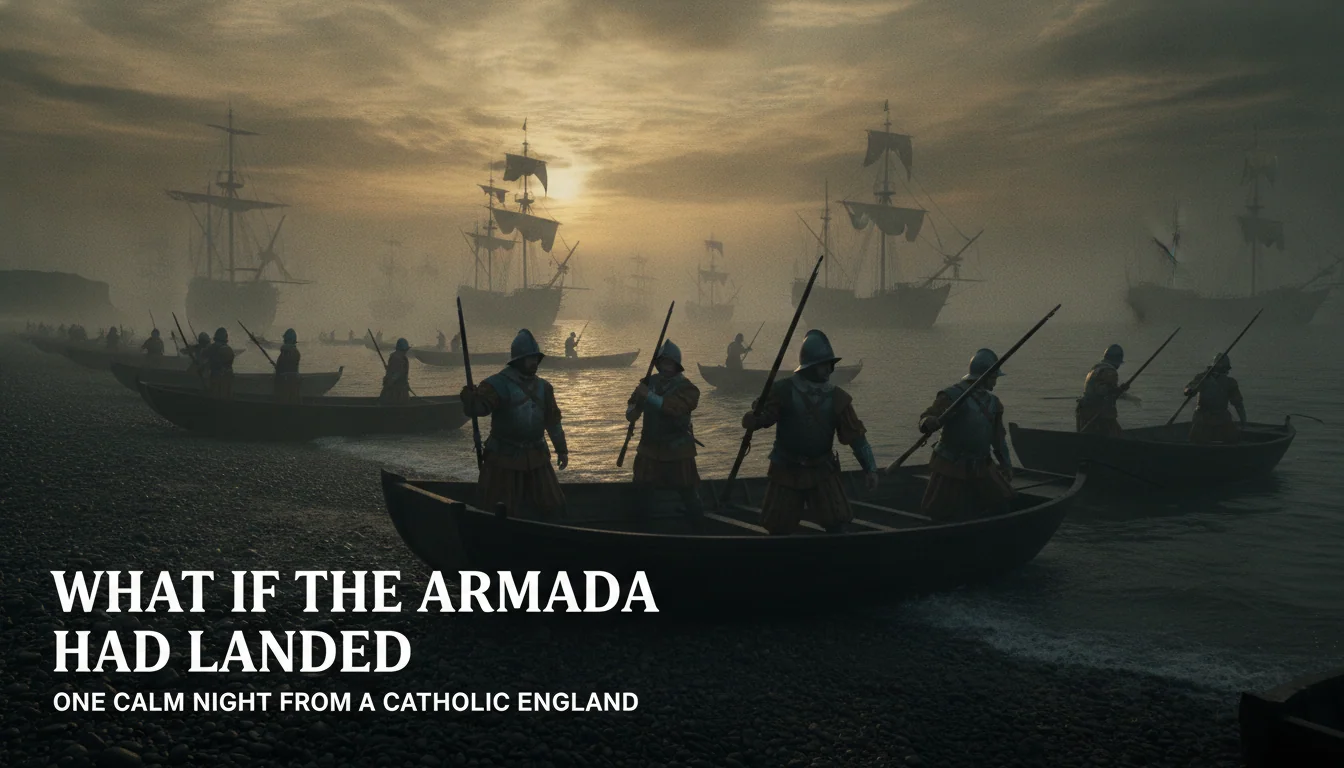
On the night of 7 August 1588, English fireships drifted into the Spanish anchorage off Calais and did more damage to Spain's chances of conquering England than two weeks of skirmishing had managed. Spanish captains cut their anchor cables in a panic, scattered into the dark, and never reformed the tight defensive crescent that had carried the Armada up the Channel from Plymouth. The next morning the guns at Gravelines finished what the fire had started. What was meant to be the deliberate transfer of a battle-hardened Spanish army onto English soil became, instead, a ragged retreat around the top of Scotland and down the Irish coast, one of the most famous disasters in naval history.
What actually happened
The plan had never been to win a great sea battle. The Spanish Armada 1588 fleet, something like 130 ships under the Duke of Medina Sidonia (a late replacement after the far more experienced Marquis of Santa Cruz died before the fleet sailed), was built to do one specific job: hold the Channel long enough to escort the Duke of Parma's veteran tercios, tens of thousands of Spain's best infantry then stationed in the Spanish Netherlands, across roughly twenty miles of water to Kent. The soldiers, not the ships, were supposed to win England. King Philip II had spent years and a fortune assembling the fleet as a floating shield for a crossing that was, on paper, the easy part.
That plan had a structural problem the English fleet did not need to solve for them. Parma's invasion force was to cross in flat-bottomed river barges: cheap, unarmed, and useless in anything but calm water. Those barges sat bottled up on the Flemish coast, blockaded by Dutch flyboats under Justin of Nassau, shallow-draft vessels built for exactly this kind of coastal work. The Armada's deep-draft galleons, built for the open Atlantic, could not follow the Dutch ships into the shoals and channels where the blockade operated. The rendezvous therefore depended on Parma clearing his own exit while the Armada held open water nearby, and neither side of that arrangement had a good way to help the other.
Add the ordinary miseries of a sixteenth-century fleet at sea for weeks. Water and salted food went bad in poorly seasoned casks. Dysentery and scurvy had already thinned the crews before a shot was fired in anger. The supply chain had been built for a short campaign, not the running fight up the Channel the English actually gave them, harrying the Armada from Plymouth to Portland to the Isle of Wight without ever risking a close engagement. By the time the fleet anchored off Calais to wait for word from Parma, it was already a wasting asset, and it had not yet fought its one real battle.
The point of divergence
None of that is speculation. It is what the Spanish inquiry testimony, English intelligence reports, and surviving logbooks describe. The counterfactual starts at one specific hinge: the night of the fireships.
Medina Sidonia had in fact anticipated a fireship attack and posted picket boats meant to grapple burning hulks and tow them clear before they reached the fleet. Accounts of that night suggest the tactic failed less because it was unsound than because the vessels sent that night were larger and closer than expected, and panic did the rest of the work. It is reasonable to think that on a different night, with steadier nerves in the picket boats or slightly more warning, that plan could plausibly have worked as designed: the fireships towed clear, the fleet holding its anchorage rather than scattering.
If the Armada had kept its formation through that night and the following day, and if the intermittent calm spells that August Channel weather was known to produce had lasted a little longer, then a portion of Parma's army, plausibly somewhere in the range of fifteen to twenty thousand men, could have made the crossing under the Armada's guns before the wind turned and the English regrouped. This is the scenario worth taking seriously: not a Spanish fleet that wins a sea battle it was never built to win, but a Spanish army that gets across a stretch of water it came agonizingly close to crossing anyway.
The consequence chain
Landing was not conquering. England's defense rested on the Earl of Leicester's army mustering at Tilbury and a much larger, much rawer county militia: a force that looked formidable on the muster rolls and had almost no one in it who had fought a real battle. Parma's tercios were the opposite, seasoned against the Dutch and among the most experienced infantry in Europe. It is plausible that a landed Spanish force, if it could stay supplied, would have beaten Leicester's army in the field.
The catch is the same one that nearly sank the crossing in the first place. Staying supplied meant controlling the Channel, and Gravelines had already shown that the English fleet, battered but intact, was not going away. A Spanish beachhead in Kent would plausibly have faced the identical problem as the barges that carried it there: cut off from reinforcement the moment English ships reasserted themselves at sea.
Even a battle Spain eventually lost could have been a crown Elizabeth I lost immediately. A landed invasion, regardless of its final battlefield outcome, would plausibly have triggered the kind of succession panic England's government feared most. Mary, Queen of Scots, the obvious domestic Catholic alternative, had already been executed the year before, which left Philip II's own claim to the English throne, distant and never fully worked out even in his own court, as the practical Catholic option on the table. Had London fallen or Elizabeth been captured, it is reasonable to think the Elizabethan religious settlement would not have survived contact with a Spanish garrison and an imposed Catholic restoration. English support for the Dutch Revolt, formalized only three years earlier by treaty, would likely have collapsed with it, removing one of the props under the rebellion against Spain and plausibly extending Spanish control over the Netherlands. England's transatlantic ambitions had already taken a real hit from the crisis: the Armada scare kept Governor John White's resupply ships tied up in English ports through 1588, and he would not get back to the Roanoke colonists he had left behind until 1590, by which time they had vanished. A longer war fought over who ruled England would plausibly have pushed that kind of colonial venture even further down the list of what Spain or England could spare ships and money for.
The limits of the counterfactual
Here the speculation runs out of solid footing. Even a successful occupation would have collided almost immediately with problems no invasion fleet could fix. Spain's finances were already strained by simultaneous wars in the Netherlands and the Mediterranean, and garrisoning a hostile island while fighting everywhere else was not an obviously sustainable arrangement for long. A Protestant Scotland next door, ruled by James VI with his own strong claim to the English throne, meant any Catholic settlement of England would have run into a determined rival on its own border rather than a clean slate. The wider Reformation across northern Europe, in Scotland, the German states, and Scandinavia, was not resting on the outcome of one Channel crossing; it would plausibly have continued regardless of what happened to Elizabeth's crown. We cannot know how long a Spanish-backed Catholic England could have held. We can only say with any confidence that it would have opened an argument rather than settled one.
None of this happened, and no historian can say with real confidence what would have followed if it had. What the record does support is that the Armada's failure was not a single stroke of luck undoing an unstoppable machine. It was a plan with a genuine structural weakness, a Dutch blockade the Spanish fleet was built the wrong way to break, exposed at exactly the moment English fireships found it. Move that one night's outcome and the chain of what follows gets progressively less certain, not more. That is the honest shape of a question like this one: the closer you hold to the real constraints, the smaller the space of what could plausibly have changed.
Quick Answers
Common questions about this topic
What actually happened to the Spanish Armada in 1588?
Spain's roughly 130-ship invasion fleet sailed up the English Channel to escort the Duke of Parma's army across from Flanders, but English fireships broke its anchorage formation off Calais on the night of 7 August, the fleet was mauled the next day at the Battle of Gravelines, and storms then drove the surviving ships around Scotland and Ireland. Parma's troops never crossed, and Spain lost roughly half its ships and thousands of men getting home.
Could the Spanish Armada have actually landed troops in England?
Plausibly, at least part of Parma's army, if the Armada had held its anchorage off Calais through the fireship attack and a spell of calm weather had lasted a little longer. That is informed speculation built on real constraints, not a documented near miss, and historians disagree on how close the crossing actually came to happening.
Would England have become Catholic again if Spain had won?
It is reasonable to think a successful invasion and the capture or death of Elizabeth I would have led to an imposed Catholic restoration, especially since Mary, Queen of Scots, the obvious domestic Catholic alternative, had already been executed in 1587. Whether such a settlement could have survived long term against a Protestant Scotland next door is a separate and much less certain question.
What actually stopped the Spanish Armada from landing?
Mainly a Dutch naval blockade of the Flemish coast that the Armada's deep-draft galleons could not break, combined with English fireships that scattered the fleet's formation at the exact moment it needed to hold position to protect the crossing. Bad food, bad water, and disease had already weakened the fleet before either of those blows landed.

Debate the Timeline
Chat with historical figures about how differently it could have gone.
Create your free account →No card required. Some figures and features require a paid plan.
Join the HistorIQly Club
Get smarter about the past.
Weekly stories, deep dives, and exclusive content straight to your inbox.