Young Woman and the Sea vs. History: How Accurate Is the Trudy Ederle Biopic?
Young Woman and the Sea accuracy: the Trudy Ederle biopic earns 8/10, faithful to the 1926 Channel crossing and 1925 Wolffe incident, less so on what followed.
Read Wikipedia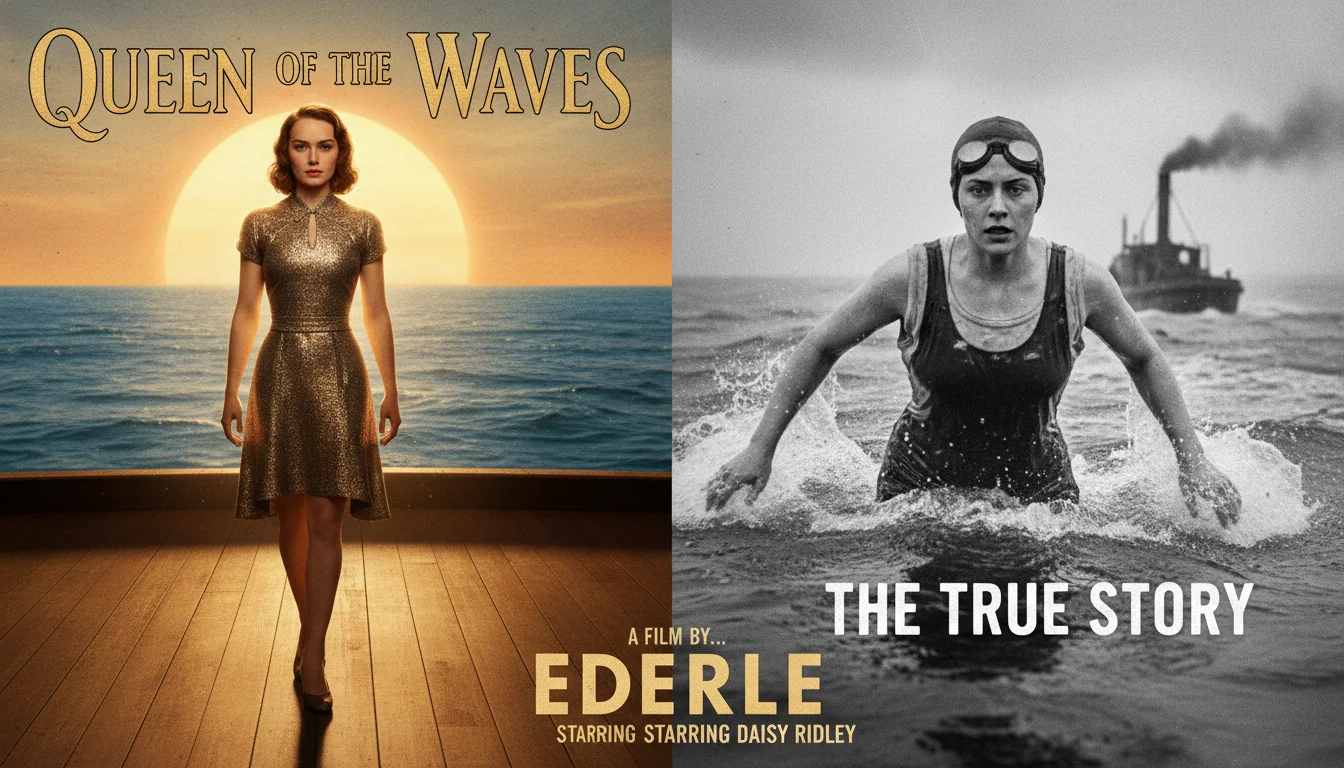
On August 6, 1926, Gertrude Ederle waded ashore at Kingsdown on the English coast after 14 hours and 31 minutes in the Channel, and the world changed around her in real time. She had not just crossed the water. She had done it nearly two hours faster than the existing men's record, in conditions that had forced five other swimmers to abandon their attempts that year, while wearing a customized two-piece swimsuit that the Amateur Athletic Union had initially objected to.
Young Woman and the Sea, the 2024 Disney film directed by Joachim Ronning and starring Daisy Ridley, tells that story with genuine care. It is one of the more historically accurate sports biopics of recent years - partly because the actual events are dramatic enough that invention would only flatten them.
So what did it get right, what did it compress, and where did Hollywood's instinct to tidy history produce distortions?
What Hollywood Got RIGHT
Ederle's competitive career before the Channel
The film correctly establishes Ederle as a dominant competitive swimmer before the 1926 crossing. She set world records in freestyle events as a teenager, was a member of the American women's swimming team that won gold in the 4x100m relay at the 1924 Paris Olympics, and was already a celebrated figure in American sports media years before the Channel attempt. The film's treatment of her early career accurately captures both her talent and the institutional environment she had to navigate, even if the timeline is necessarily compressed.
The Amateur Athletic Union's obstruction
The AAU's attitude toward women swimmers in the early 1920s is rendered accurately as formally supportive and practically obstructive. The film depicts organizational skepticism about whether women could endure the physical and psychological demands of distance swimming, a position stated explicitly by male officials in contemporary newspaper interviews. That skepticism was being contradicted almost in real time by the results of female swimmers breaking records on both sides of the Atlantic, which is part of what gives the film's central conflict its historical weight.
The 1925 first attempt
Ederle's first Channel attempt in August 1925 ended in controversy. Her trainer Jabez Wolffe reached into the water and touched her while she was still swimming, which under open-water rules constituted assistance and invalidated the swim. Wolffe claimed she had gestured for help. Ederle insisted she had done nothing of the sort and later challenged his account publicly. The film centers this incident as the emotional catalyst for her return attempt, which is accurate to the historical sequence.
Wolffe was a complicated figure in real life. He had attempted the Channel himself multiple times without success and was the leading English authority on Channel swimming at the time. His stated reasons for pulling Ederle from the water were contested by other witnesses present on the escort boat. He later wrote a book about the attempt that Ederle found a serious misrepresentation of events - she took legal action over it. The film's portrait of him as an obstacle is fair if somewhat flattened.
Her father's support
Henry Ederle, Trudy's father - a German-born butcher from the Gramercy Park neighborhood of New York - was, by all contemporary accounts, her most consistent advocate. The film's depiction of his steady encouragement while others in the family were skeptical tracks with interview material Ederle gave after the crossing. The specific pride conveyed through the film's harbor scenes reflects the emotional tenor of contemporary press coverage of their relationship.
The coating and the goggles
The film depicts Ederle's body being coated in multiple layers of lanolin and petroleum jelly before entering the Channel, both to insulate against the cold water and to reduce skin irritation from prolonged salt water exposure. This is accurate. The specific formulation she used was developed with care and was more systematically applied than what earlier Channel swimmers had used. The goggles Ederle wore - which she designed herself using electrician's wax to create a facial seal against the water - are correctly depicted as a genuine innovation.
The New York reception
The August 27, 1926 ticker-tape parade through lower Manhattan was real. An estimated two million people attended. President Calvin Coolidge sent a telegram praising her. Mayor James Walker received her at City Hall. The film's parade sequence captures the scale and the public mood accurately - Ederle was briefly one of the most famous people in the United States, more celebrated than any other American sportswoman of her era.
What Hollywood Got WRONG
The timeline compression
Young Woman and the Sea necessarily compresses roughly eight years of competitive swimming into what feels like two or three dramatic seasons. Ederle's record-setting competitive career began as early as 1919, when she was a teenager training at the Women's Swimming Association on West 23rd Street in New York. The film does not have time to render the full decade of documented excellence that preceded the Channel swim, which means viewers leave with a slightly underweighted sense of how accomplished she already was when she entered the water at Cap Gris-Nez.
The deafness in the water
The film addresses Ederle's deafness thoughtfully but softens its practical impact during the swim itself. By 1926 her hearing was already significantly impaired, and the physical demands of the Channel crossing placed specific stress on her ears. The goggles' wax seal helped protect them, but the swim represented a genuine sensory challenge in addition to a physical one. This dimension is present in the film but treated more lightly than the historical record supports.
What the film does not show after the parade
The film ends with the parade and with Ederle at the height of her fame, which is where biopics conventionally end. The decade that followed was difficult in ways worth knowing about. She suffered a nervous breakdown in the late 1920s. A fall during a vaudeville tour left her with a serious spinal injury that kept her bedridden for approximately four years. Her hearing worsened significantly. She pursued legal action over Wolffe's book. Eventually she returned to swimming by working as an instructor for deaf children, which is where she spent much of her later professional life. She lived to be 98.
None of this diminishes the Channel swim. But it is worth noting that the real Gertrude Ederle's story did not resolve cleanly in triumph, and the film's decision to end on the parade necessarily understates the cost of what she had done to her body and her life.
Wolffe's internal logic
The film requires Jabez Wolffe to be a legible antagonist - a man who underestimates Ederle and ultimately acts in ways that prioritize his own authority over her agency. The historical Wolffe is harder to read. He was not a cartoon obstructionist. He was an experienced Channel swimming authority who had experienced repeated personal failure at the same crossing, who may have genuinely believed Ederle was in distress, and who left conflicting statements about his motivations. The film's dramatic compression makes him more coherent as a character and less accurate as a person.
Historical Accuracy Score: 8/10
Young Woman and the Sea is one of the more careful sports biopics a major studio has produced. The core facts - the Olympic record, the AAU friction, the 1925 controversy, the 1926 crossing, the record time, and the New York reception - are all rendered with genuine attention. Timeline compression and sharpened character motivations are genre requirements rather than distortions.
What the film gets most right: the 1925 incident with Wolffe, which is the emotional pivot of the story and which happened essentially as depicted.
What it gets most wrong: the suggestion, inevitable in a film that ends with the parade, that Ederle's life resolved cleanly into the celebrity she had earned. History was less kind to her than the credits imply.
The real Trudy Ederle, who spent decades teaching deaf children to swim in New York and who received the Presidential Medal of Freedom in 2022, at the age of 98, deserved both the celebration the film provides and the more complicated story that followed it.
For other films about athletes navigating early twentieth-century institutional barriers, see Nyad vs. History on Diana Nyad's Cuba-to-Florida record swim, and The Founder vs. History for a harder look at how institutions absorb and sometimes consume the people who challenge them.
Quick Answers
Common questions about this topic
Did Gertrude Ederle really swim the English Channel?
Yes. On August 6, 1926, Gertrude Ederle became the first woman to swim the English Channel, crossing from Cap Gris-Nez in France to Kingsdown on the English coast in 14 hours and 31 minutes. Her time shattered the standing men's record by nearly two hours.
Was Trudy Ederle really deaf?
Yes. Ederle lost much of her hearing as a child following a serious illness, variously described as measles or scarlet fever. Her deafness worsened progressively through her competitive career. She later worked as a swimming instructor for deaf children in New York and was functionally deaf in her later years.
Did someone really try to pull Trudy Ederle from the water?
Her trainer Jabez Wolffe touched her during her first Channel attempt in August 1925, which under the rules of the sport constituted assistance and ended the swim. Wolffe claimed she had signaled distress. Ederle strenuously denied requesting help. The incident cost her the first crossing and is a central moment in the film.
What happened to Gertrude Ederle after her Channel swim?
Ederle received a ticker-tape parade in New York attended by an estimated two million people, but her postwar life was difficult. She suffered a nervous breakdown in the late 1920s, sustained a back injury during a vaudeville tour that left her bedridden for years, and lost most of her remaining hearing. She lived to the age of 98 and is buried in New York.

Debate the Accuracy with the Real Figures
Ask the real people what Hollywood got wrong about their lives.
Create your free account →No card required. Talk to anyone in history with 8 free credits a day. Some features require a paid plan.
Join the HistorIQly Club
Get smarter about the past.
Weekly stories, deep dives, and exclusive content straight to your inbox.